

Three English words — tryst, destiny and stars — are curiously bound to two defining moments in modern India. One belongs to the midnight of freedom; the other to a high-altitude military confrontation more than seven decades later.
The first is “Tryst with Destiny”, the immortal address delivered by India’s first Prime Minister, Jawaharlal Nehru, to the Constituent Assembly on the night of 14-15 August 1947. Spoken in the Central Hall of Parliament as the Union Jack was lowered and the tricolour hoisted, the speech marked the formal end of nearly two centuries of British rule. It was not merely ceremonial theatre but a moral charter.
Nehru spoke of redeeming a pledge made long ago — of ending poverty, ignorance and inequality, and of ensuring justice and dignity for every citizen. His famous line — “At the stroke of the midnight hour, when the world sleeps, India will awake to life and freedom” — captured both drama and duty. Independence, he insisted, was not an end but a beginning, a promise to wipe “every tear from every eye”. Freedom carried responsibility; sovereignty demanded accountability.
That midnight speech endures because it articulated the ethical and constitutional foundations of the Republic at the moment of its birth. It framed independence as an obligation to citizens and to history.
It is against that echo that another phrase, Four Stars of Destiny, acquires resonance.
A General’s Reckoning
The title belongs to the memoir of former Army Chief Manoj Mukund Naravane, who led the Indian Army during the gravest border crisis with China in decades. If Nehru spoke at the dawn of nationhood, Naravane writes from a moment when that nation’s territorial integrity was tested in the icy heights of Eastern Ladakh.
The memoir has triggered political and legal controversy after briefly appearing for sale online despite the government maintaining that it remained “unpublished”. Printed by Penguin Random House India, it was listed on Amazon at ₹699, with delivery charges of about ₹100. Copies were available for purchase until February 9 this year, and members of the public placed orders.
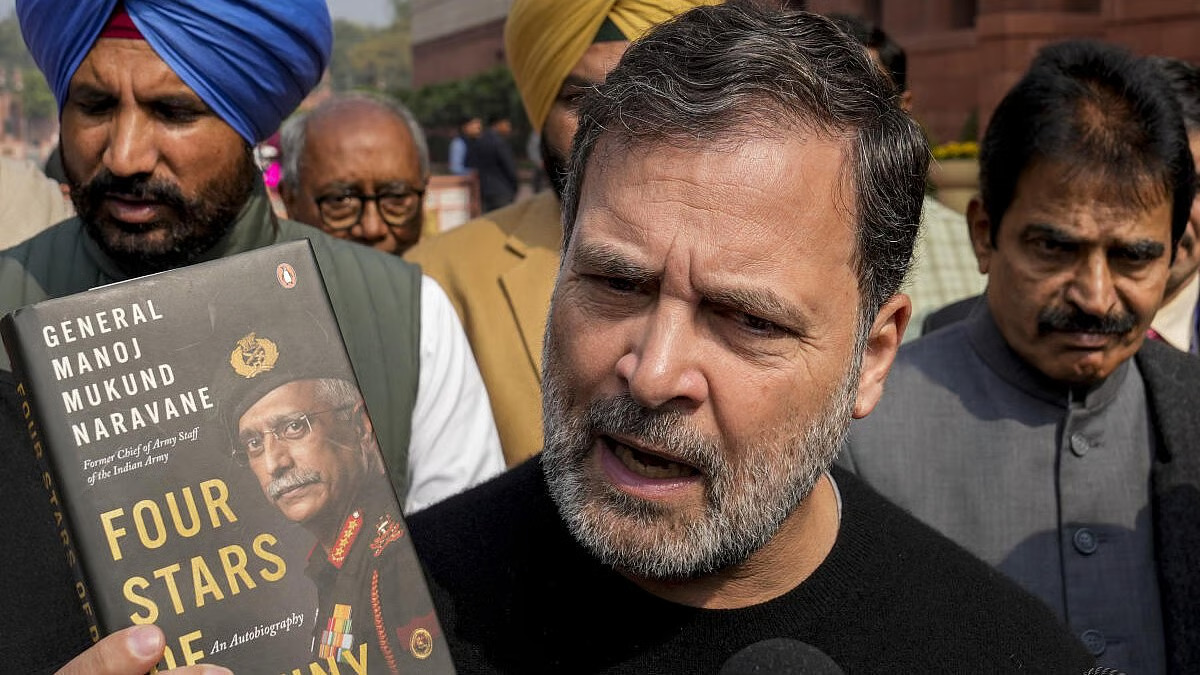
The matter erupted in Parliament on February 2 when Leader of the Opposition Rahul Gandhi informed the Lok Sabha that he had bought the book online. Holding up a copy in the House, he asserted that it had already been published and was publicly accessible. The Government maintained that it was “unpublished”. On February 9, Delhi Police registered an FIR and initiated an investigation. The following day, General Naravane reposted a publisher’s statement asserting that the book had not been formally released. Although no official ban was announced, the title disappeared from Amazon listings after February 10.
The dispute over status and clearance is procedural. The deeper controversy lies in what the memoir contains.
The Ladakh Crisis: What the Memoir Says
The book revisits the 2020 India-China standoff in Eastern Ladakh, including the deadly Galwan Valley clash, military mobilisation around Pangong Tso, and tense manoeuvres near Rezang La. Excerpts released earlier by PTI in December 2023 had already stirred debate across national publications. They suggested that during critical phases of confrontation, the situation may not have been as firmly under control as official statements indicated.
According to the extracts, when Chinese tanks advanced towards Indian positions in Galwan and later near Rezang La in August 2020, clear political directives were not immediately forthcoming. At one stage, Chinese armour reportedly halted within 500 metres of Indian posts.
Naravane writes that he informed Defence Minister Rajnath Singh of the developments and received a brief instruction: “Do what you think appropriate.” He adds that he was told the Prime Minister had been briefed and regarded the situation as a “purely military matter”.
The memoir further claims that several Indian soldiers were temporarily detained by the PLA and allegedly subjected to mistreatment before being returned. It challenges Beijing’s assertion that only four Chinese soldiers were killed in the Galwan clash, stating that additional bodies were later recovered from the river. In a pointed observation, Naravane notes that June 16, 2020 — the day after the clash in which 20 Indian soldiers were killed — was Chinese President Xi Jinping’s birthday, remarking that such casualties had not occurred in a border confrontation since 1979.
Agnipath and the ‘Lightning from the Sky’
Another politically sensitive chapter concerns the Government’s Agnipath recruitment scheme. Naravane writes that he had originally proposed a limited “Tour of Duty” model applicable only to the Army. According to his account, the Prime Minister’s Office significantly altered the proposal, expanding it into the broader Agnipath scheme covering the Army, Navy and Air Force. He describes the final announcement as “like lightning from the sky”. The Army’s original recommendation, he states, had envisaged retaining 75 per cent of recruits, a feature absent in the final design.
The disclosure prompted opposition parties to question whether Agnipath was conceived by the armed forces or principally shaped by the PMO. The episode underscores the blurred boundary between military advice and political decision-making.
Clearance, Control and Consistency
The publication timeline complicates matters further. Penguin Random House India had announced the memoir in December 2023 and opened pre-orders with a January 2024 release in view. However, Defence Ministry clearance was pending. Naravane publicly remarked in October 2025 that he had completed the manuscript and that “the ball is in the court of the government and the publisher”. The text was reportedly under official review when printed copies surfaced online without formal release.
The episode has revived a perennial democratic tension: how to balance national security with transparency. Critics argue that a review process should not morph into an instrument to suppress politically inconvenient material. Supporters counter that operational details of an ongoing or recent border crisis demand scrutiny before publication.
Previous memoirs by former Army Chiefs, including General V.P. Malik, were published without comparable controversy, raising questions about standards and consistency.
The Soldier at the Centre
Naravane’s career frames the seriousness of the period he chronicles. Commissioned in June 1980 into the 7th Battalion of the Sikh Light Infantry, he served for more than four decades, commanding formations in Jammu and Kashmir and the Northeast, and holding senior appointments including Vice Chief of Army Staff. As Chief from December 1, 2019 to April 30, 2022, he authorised the occupation of strategic heights on the southern bank of Pangong Tso in August 2020, a move that strengthened India’s negotiating leverage. He has described June 18, 2020, in the aftermath of Galwan, as the saddest day of his military life.
Destiny, Revisited
The juxtaposition of Nehru’s midnight pledge and Naravane’s high-altitude reckoning is not merely rhetorical. In 1947, India promised itself constitutionalism, democratic accountability and moral clarity. In 2020, it confronted a severe test of sovereignty amid strategic ambiguity and geopolitical rivalry. One moment was illuminated by ceremony; the other was defined by uncertainty.
Yet both revolve around a common premise: destiny is neither mystical nor preordained. It is shaped by decisions taken under pressure by political leaders, by soldiers on wind-scoured ridgelines, and by institutions negotiating the line between secrecy and openness.
For now, Four Stars of Destiny remains unavailable in the marketplace but firmly embedded in national discourse. The unresolved questions are fundamental. Can a former Army Chief publicly recount operational details of a still-sensitive border crisis? Where does transparency end and security begin? And can a government’s review mechanism delay publication without appearing to silence uncomfortable truths?
Nearly eight decades after “Tryst with Destiny”, India continues to interpret that promise, not in the glow of a midnight ceremony, but in the unforgiving light of the frontier.
(The author is a veteran Delhi-based journalist and political analyst)