


Despite Washington’s 20-point roadmap to end the Gaza conflict, a true sense of closure remains elusive. The deal offers a flicker of hope, but also exposes the deep, unresolved fault lines that still define one of the world’s most intractable conflicts.
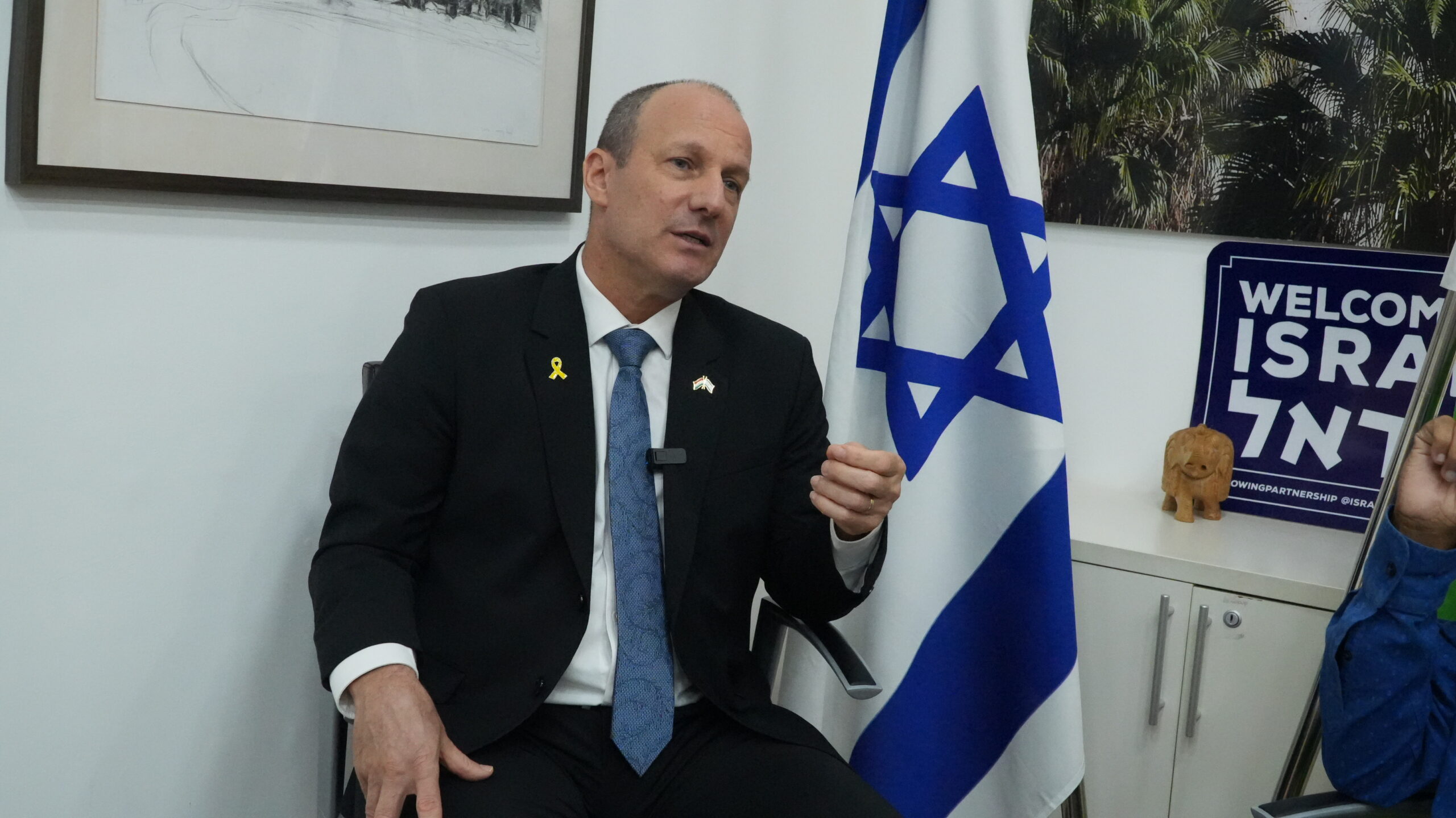
Israel’s Ambassador to India, Reuven Azar, in an exclusive interview with New Delhi Post’s Bikash C Paul, said that despite the agreement, Hamas is showing clear signs of violation. However, he added, “Israel remains committed to the stabilisation process.”The ambassador offered a blunt defence of his country’s war policy. “Hamas has to go,” he said, vowing the group would be hunted “wherever they are”. The envoy accused Europe of being “detached from reality” and “empowering Hamas” by pushing for Palestinian statehood, while dismissing UN famine claims as “propaganda”.
On India-Israel ties, the ambassador confirmed that post-Operation Sindoor, cooperation in counter-terrorism, defence and cybersecurity is deepening. Excerpts:
It has now been a few weeks since the agreement, the 20-point peace plan, was signed. Could you please give me an update on how the peace process has progressed since then?
The 20-point Trump plan to advance peace in our region has garnered international consensus around Israel’s declared objectives: the immediate return of all our hostages, the disarmament of Hamas, and the demilitarisation of Gaza. This would pave the way for a process of reconstruction coordinated by the international community, in partnership with local Palestinian forces committed to non-violence.
Hamas, however, is breaching the agreement. Its violations threaten to derail the stabilisation efforts. Israel remains committed to the plan and will continue to work — both regionally and globally — to achieve lasting peace.
One of the major developments in the last few weeks is that Israel’s top European partners are vociferously supporting Palestinian statehood, which is, of course, contradictory to Israel’s official position.
It’s very unfortunate. The timing is very bad. What Israel wants to see is Hamas disbanded and the return of our hostages. The European declaration gave a huge boost to Hamas, which toughened its line in the ongoing negotiations. Europe is making a mistake.
Remember, the greatest blow against Palestinian statehood happened on 7 October 2023, when Hamas used its control of Gaza to attack Israel brutally, blowing apart the prospects for statehood. Israel has repeatedly offered a two-state solution in 2000, 2008 and 2010, but the Palestinians repeatedly rejected it. Hamas’s goal remains the destruction of Israel. Those countries promoting Palestinian statehood at this time are detached from reality. I would say to European powers: stop preaching Israel’s destruction.
Statehood requires effective control, defined borders and a monopoly on power — all of which are absent in Palestine. Our focus now is on creating Palestinian self-rule in a conducive way. Once Hamas is defeated, a leadership could emerge that is peace-oriented, recognises Israel’s right to exist as a Jewish state and is acceptable to Israel.
There is consensus both in the Arab world, in Europe and in other places that Hamas has to relinquish power in Gaza. But nobody is willing to step up to the plate. And even they are attacking Israel for actually trying to enforce an outcome that everybody wants. This means you have a wish, but you want somebody else to do the job, and then you criticise them for doing it. It’s completely unacceptable.
A recent UN report on the humanitarian crisis in Gaza was very damaging from the Israeli perspective. There has been worldwide condemnation of the war crimes and atrocities in Gaza.
There is immense suffering in Gaza, primarily caused by Hamas’s 7 October attack and its tactics, including using human shields, firing from hospitals and disguising fighters as journalists or ambulance drivers. Unfortunately, the UN system is highly biased. A numerical majority of countries appoint individuals such as Navi Pillay, who demanded sanctions against Israel five years ago. They write reports that distort facts, apply implausible standards and unfairly blame Israel for atrocities. This propaganda is regrettable.
Israel is countering this with facts. We supply Gaza with food, providing 4,000 calories per person per day. That is more than double the requirement, yet Hamas diverts much of it. Markets in Gaza remain 100 per cent stocked. We strive to distinguish terrorists from civilians, targeting only the former, even though many civilians support Hamas. The reality is harsh: this is a crisis, as every war is. Israel’s approach seeks to minimise civilian harm while addressing the security threat posed by Hamas, ensuring humanitarian aid continues despite the ongoing conflict.
There have been widespread complaints that Israel is barring even humanitarian agencies from entering Gaza, while starvation and death are not a secret.
No, it’s not so. We are inviting all agencies to participate. Occasionally, issues arise when individuals are unwilling to comply with security protocols or act independently, but we have successfully managed such situations. There is raw propaganda intended to limit Israel’s right to defend itself. People, especially Hamas and their accomplices, want to create a situation in which the war ends and Hamas stays in power. We’re not going to agree to that.
How many people are still inside Gaza?
Two million are still there.
How far is it true that Israel has demanded that residents vacate Gaza?
No, we are not saying that. What we are saying is that in every conflict, people have the right to flee. When the war in Ukraine started, five million people left Ukraine. In the Syrian war, six million people left. The Palestinians in Gaza are the only ones who are not being allowed to leave. What President Trump and the Israeli government are saying is that people have the right to flee to a safe haven. For some reason, the Palestinians are being denied that right.
The perception is that Israel wants Gaza to be under its control, and it is not going to be handed over to the Palestinian Authority.
No, Israel does not seek to control Gaza; we withdrew in 2005. After the 7 October attack killing our civilians, we cannot trust Hamas, so we must oversee security. Our goal is to transfer authority to a civilian body that manages daily life and, eventually, security. We do not intend to stay indefinitely.
Another thorny issue is the hostage crisis…
We have retrieved 206 hostages out of 254; about 20 are still alive. We cannot wait. Almost two years have passed.
How can you justify Israel’s attack on Qatar? Although the basic objective was to eliminate the Hamas leadership in Qatar, it now looks like a misadventure.
We served a clear purpose: Hamas leaders must know they have nowhere to escape. Negotiating for hostages does not mean we will not pursue them. Qatar presented itself as an honest broker, but we saw it backing Hamas and creating propaganda tools through Al Jazeera and other channels. By trying to play a double game, Qatar prolonged the war instead of pressuring Hamas. Qatar must understand the limits of Israel’s patience. We did not attack Qatar; we attacked terrorists, and we will continue to target them wherever they are. Their crimes are unforgivable and cannot be normalised.
Has Israel achieved its diplomatic and strategic goals with a 12-day war against Iran?
Absolutely. Iran attacked us with hundreds of missiles and aimed to annihilate Israel through its nuclear programme. Our action has restricted and put limits on this abrasive attitude of the Iranians, who were striving to become the hegemonic power in the region, not only to eliminate Israel but to take over Mecca and Medina. Iran is now cautious, returning to cooperation with the IAEA, aware that any attempt to re-establish its nuclear programme would face another attack. Iran is back in the box. This is a major strategic achievement.
Islamic forces and Islamic terrorism are up in arms against Israel, not only in the Middle East, but everywhere in the world, posing a direct existential crisis for Tel Aviv.
Islamic terrorism is a global threat, not just to Israel. Since the 1970s, radical Islam has sought to derail peace, from Sadat’s assassination to suicide attacks against Palestinians. The 2011 Arab Spring further enabled these forces. While ISIS was defeated, it persists, and Iran’s radical regime continues to destabilise the region. Israel has significantly curtailed their capabilities in Lebanon, Syria, and Tehran. Yet threats remain: the Houthis disrupt international trade, and Sunni extremist groups like Hamas, Palestinian Islamic Jihad, and other militias operate across the Levant and sub-Saharan Africa, continuing to challenge regional and global security. The world has a huge challenge.
Indian Foreign Minister Jaishankar said in the UN, “We have a problem with double standards.” There cannot be double standards. This fight against terrorism must be treated in a unified way. The fact that the international community is not unified against terrorism and radicalism undermines the struggle and makes it much harder for countries like Israel and India to deal with it. So essentially, you find that this has to be fought jointly everywhere, including in South Asia.
Post-Operation Sindoor, is there any sea change in the relationship with India as far as counterterrorism is concerned?
Undoubtedly, there’s an increased interest in deepening the cooperation and making it wider. So we are engaged in updating our defence and security agreement to include as many issues as possible on counterterrorism—from joint production, joint development capabilities, and solutions to address the mounting terrorist threats and the weapons that are getting into their hands. This is a very important dimension that we are going to pursue, and I think, in the near future, you’re going to hear more news about that.
On cybersecurity, Israel is a global powerhouse. We are doing a lot of things together in cyber defence. But the collaboration goes beyond defence; many things are happening in the civilian sectors too, to create robust capabilities. Israeli companies are already working with Indian partners to create cyber labs and build a skilled cadre for cyber defence. One of the challenges is that our technology is usually expensive, and we have to adapt it for the Indian market, which likes scalability and lower prices. This is something that we are struggling with.
Israel is the only country fully implementing India’s “Make in India” policy in defence procurement. Our major industries are already engaged in joint ventures on drones, missiles, surveillance systems, and autonomous vehicles. We’re now expanding that cooperation further.
Beyond defence, there are other verticals in the relations that are also very important. There are additional areas we are introducing into the relationship. We are upgrading it. Some of these include infrastructure, stock exchanges, and financial markets, as well as the early operationalisation of payments through UPI in Israel. This synergy—Israeli innovation and Indian production—is the next frontier.
Overall, India has a great role in today’s geopolitics, given its constructive dimension. India has interests in both the Arab Gulf and Israel.
In this context, how do you view Pakistan signing a military agreement with Saudi Arabia, much to the discomfort of New Delhi?
Saudi Arabia and Pakistan share a long-standing defence partnership, dating back to Riyadh’s funding of Pakistan’s nuclear programme. The current cooperation isn’t new or reactionary; it has been in the works for over a year. Saudi Arabia continues to work closely with the US under CENTCOM, coordinating regional air defence and intercepting attacks. So, linking the latest Saudi-Pakistan defence agreement to recent events, like strikes in Qatar, is misplaced. This is part of a long, ongoing relationship driven by Saudi security priorities. Israel does not see too much into this.
