



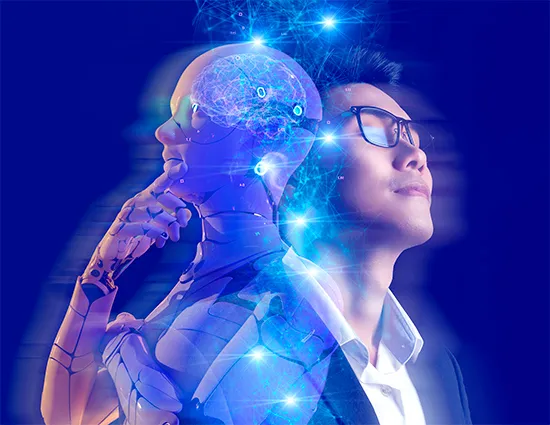
In the time it takes you to read this article, an AI somewhere has processed more data than you could in a lifetime, predicting outcomes, generating text and simulating thought without pause or reflection.
Just a decade ago, the idea that machines could think belonged to science fiction. But today, in data centres across the world, algorithms are edging closer to what once felt impossible: replacing parts of human cognition.
The question now is: are we entering the age of machine thinking, or the decline of human thought?
For centuries, thinking was humanity’s highest gift. It was slow, messy, and deeply human, weaving logic with memory, fact with feeling, hesitation with imagination. This inefficiency was precisely its strength. It gave us poetry, philosophy, discovery and democracy. Human thinking was never about speed. It was about meaning.
But speed has become the new gold standard and speed belongs to machines.
Artificial intelligence thrives on it. It consumes oceans of data, identifies patterns, and delivers fluent answers instantly. Chatbots draft essays, neural networks flag diseases and recommendation engines predict desires we haven’t yet formed.
It looks like thought, but it is not.
Machines calculate probabilities; they do not wrestle with questions of purpose. They can simulate cognition, but they cannot feel it.
Recent research now shows how this reliance on AI may quietly dull our minds. A first-of-its-kind MIT brain-scan study recently revealed that prolonged ChatGPT use leads to a 47% drop in neural engagement.
Eighty-three percent of users couldn’t recall a single sentence they’d written just minutes earlier. Even after discontinuing AI use, their performance remained lower than those who never used it, suggesting more than dependency, a kind of cognitive weakening.
AI makes you 60% faster, but reduces mental effort by 32%. The top-performing group? Those who began without AI and introduced it later retained the best memory and brain activity.
It’s a paradox: the faster we get, the less we think.
Ancient Indian mythology offers a fitting metaphor. In Samudra Manthan, the churning of the cosmic ocean, gods and demons sought Amrit, the nectar of immortality. But before the nectar emerged, poison rose first. Only through struggle, only through endurance, did the nectar finally appear.
Human thinking has always been such a churning. Reading, writing, and reflection are our churn-sticks: slow, demanding and often uncomfortable. The confusion and friction are the poison; the clarity that follows is the nectar.
But in our rush to let machines churn for us, we risk skipping the struggle and losing the nectar altogether.
The danger is not that machines rise. It is that humans abdicate. We let autocomplete finish our sentences, algorithms shape our choices and AI drafts our ideas until we no longer wrestle with them ourselves. Thinking does not vanish in a burst of noise; it fades in small, quiet surrenders.
If human thinking fades, we risk a future of flawless processing without wisdom. Knowledge without conscience. Answers without questions. Power without purpose.
Yet, this need not be an obituary. Machine thinking can liberate us from cognitive drudgery, giving us time to ask what no algorithm can: What is love? What is justice? What makes life worth living?
The myth of Samudra Manthan reminds us: nectar comes only after poison, meaning only after struggle. If we give up the struggle, we lose the wisdom that defines us.
The rise of machines is inevitable. The end of human thinking is not.
The choice remains ours to think slowly, deeply, imperfectly in a world that rewards instant answers.
(Abhishek Anand is a tech professional and writes on emerging technology and social media)