






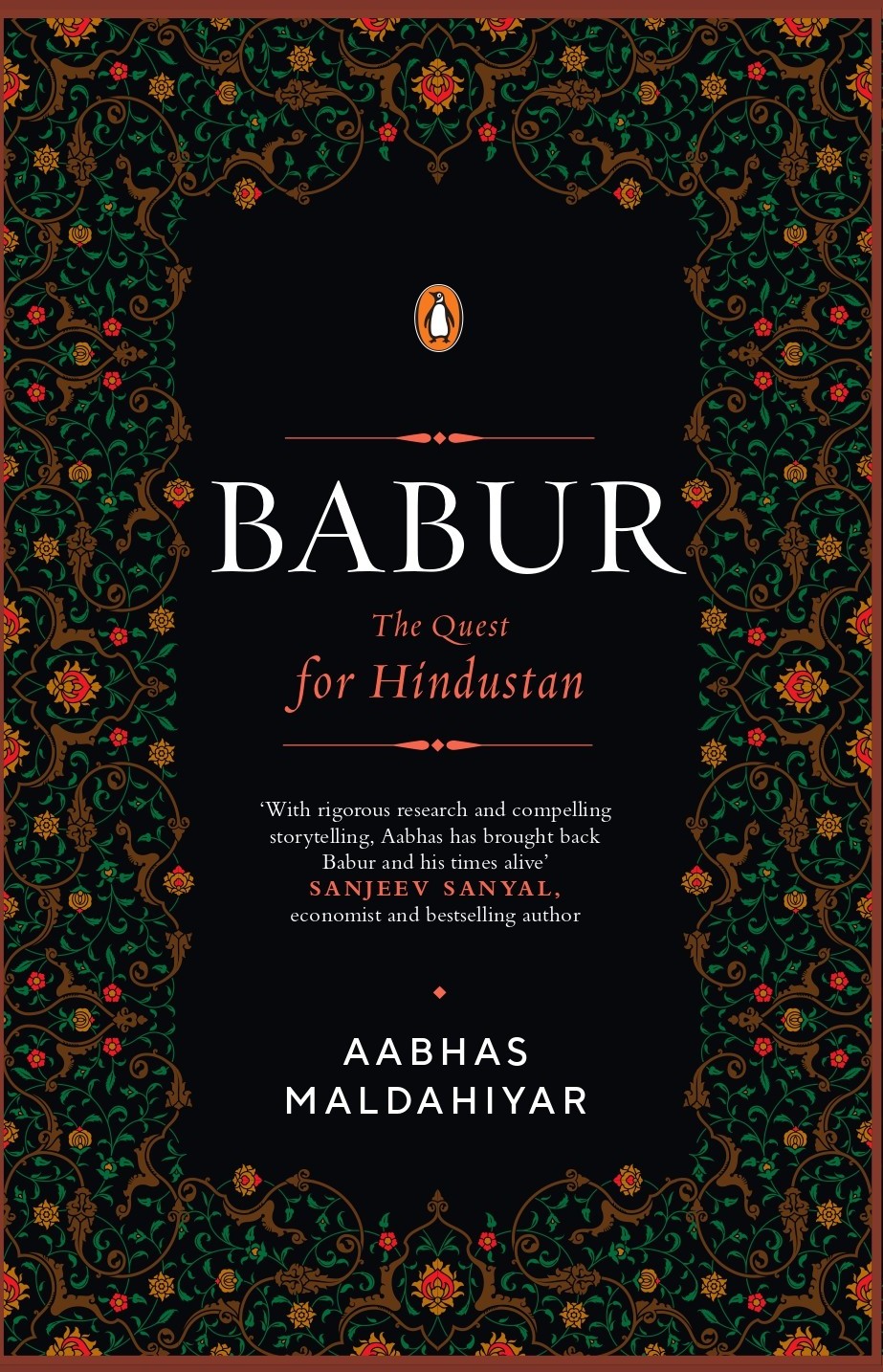
Aabhas Maldahiyar’s book meticulously crafted the saga of Babur—the visionary whose strategic genius and indomitable spirit reshaped history. Relive the battles of Khanwa and Chandiri, where his tactical brilliance and his warriors’ valour defined an era. Beyond the clash of swords, the book unveils Babur’s relentless campaigns to unite a fragmented land and lay the foundations of an enduring empire. His court, rich with poets, scholars and artists, reveals a ruler as devoted to culture as he was to conquest. Through vivid storytelling and Babur’s own reflective writings, readers glimpse the inner world of a leader who combined ambition with repentance, power with poetry. Babur: The Quest for Hindustan is not just history—it is a living portrait of triumphs, struggles and legacies. A must-read for history enthusiasts and curious minds, it opens a vibrant window into the dawn of the Timurid age.
EXCERPTS
Hindustān shimmered as a distant prize, a treasury to seize:
Ever since we came into Kābul it had been in my mind to move on Hindūstān, but this had not been done for a variety of reasons.
That yearning was no idle musing—it was a conqueror’s intent.
The respite following Shaybānī Khān’s demise in 916 AH (AD 1510) at the Battle of Merv, where Shāh Ismā‘īl defeated the Uzbeks, offered a moment’s pause. Bābur seized this opportunity to attempt a return to Samarqand in 918 AH.
Yet, this triumph was fleeting—the Uzbeks, regrouping under new leadership, expelled him once more. This failure redirected his ambitions southward, toward Hindustān, where the Delhi Sultanate under Ibrāhīm Ludī was rife with internal dissent. Bābur’s earlier probes into Hindustān—raids in 922 AH (AD 1516) near Bhira and in 923 AH (AD 1517) toward Punjab—had yielded plunder but no foothold. These forays, however, honed his strategy, preparing him for the decisive campaign that Volume 2 chronicles.
Bajaur in 925 AH marked Bābur’s opening move. The use of matchlocks, a novelty in the region, showcased his tactical ingenuity, allowing his smaller force to overpower the Bajauris’ defences. The aftermath was brutal as Bābur writes:
As the Bajaurīs were rebels and at enmity with the people of Islām, and as, by reason of the heathenish and hostile customs prevailing in their midst, the very name of Islām was rooted out from their tribe, they were put to general massacre and their wives and children were made captive. At a guess more than 3000 men went to their death; as the fight did not reach to the eastern side of the fort, a few got away there.
Bābur’s own words reveal his intent, which was to punish them as they appeared like enemy of Islam to him.
Deeming the Bajauris as rebels whose existence stood like a thorn against the garden of Islam, and whose heathenish rites were an open wound upon its sanctity, the imperial forces unleashed their fury: the men were hewn down like withered trees in a storm, while their wives and children were gathered as captive spoils of conquest.
This was not mere conquest—it was a statement, a harbinger of the violence that would mark his campaigns in Hindustān.
ABOUT THE AUTHOR
Aabhas Maldahiyar is an author, architect, and historian who fuses his love for history with the craft of storytelling. Passionate about the interplay of history and architecture, he views every structure as both a record of past civilizations and a vessel of future narratives. A skilled reader of Persian manuscripts, he reframes history through rigorously sourced accounts, often challenging accepted retellings. His Timurid Gūrkāniyān series (commonly mislabelled “Mughals”) seeks to redefine Medieval Indian history, beginning with Babur: The Chessboard King and continuing with Babur: The Quest for Hindustan.
Beyond the Timurid chronicles, his acclaimed Hitler: The Proclaimed Messiah of the Palestinian Cause explores overlooked ideological entanglements. As a founding member of the Foundation for Indian Historical and Cultural Research, Aabhas continues reshaping historical discourse with uncompromising fidelity.


