



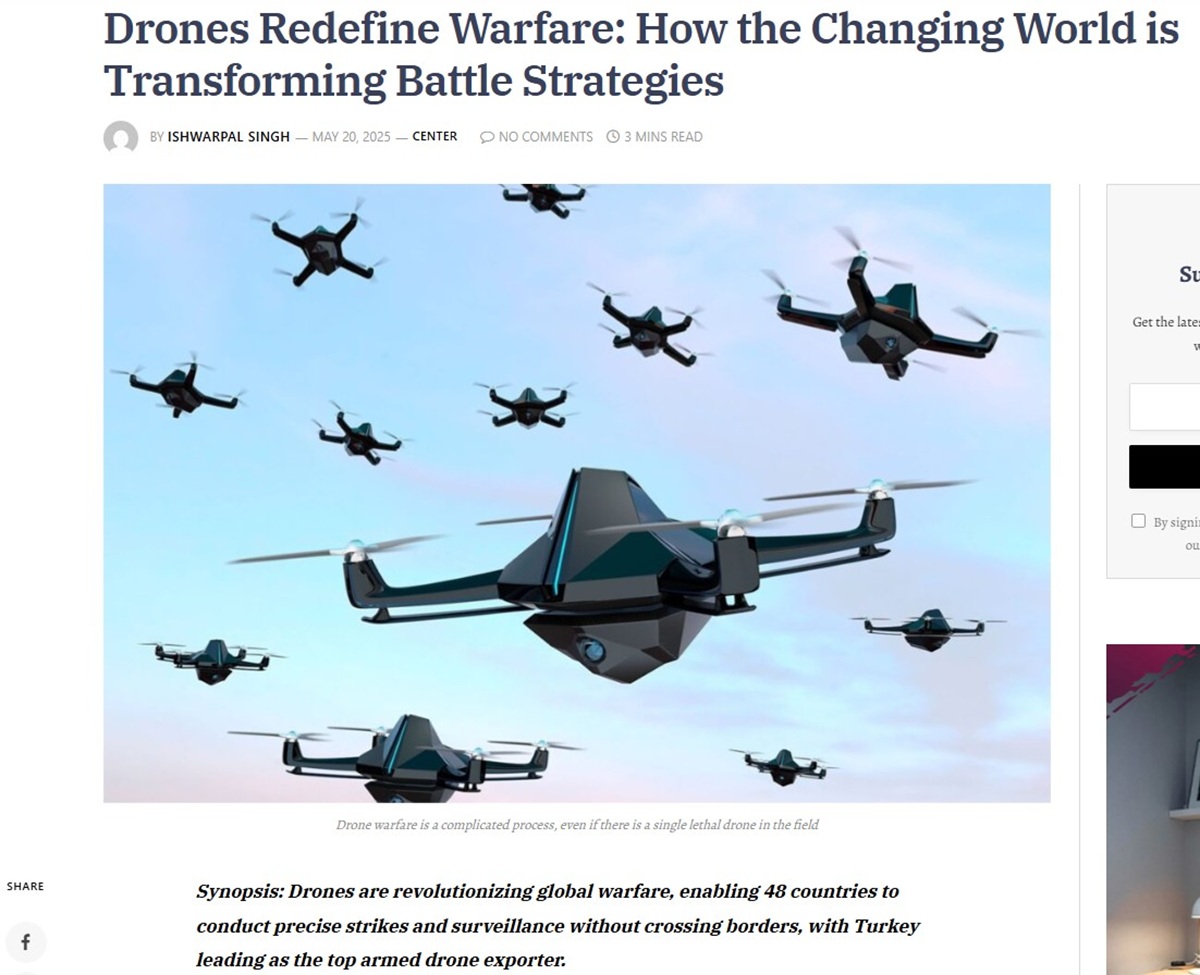
From precision strikes to surveillance, drones are transforming modern battlefields, with Ukraine’s recent attack on Russia underscoring their strategic dominance.
New Delhi: The landscape of warfare is undergoing a seismic shift, with drones at the forefront of military innovation. Ukraine’s audacious drone attack on Russia, launched just 12 days after the New Delhi Post’s special report on drone warfare, has spotlighted their game-changing role. As 48 countries now wield armed drones, Turkey has surged ahead as the world’s top exporter, while India accelerates its own drone ambitions under the ‘Make in India’ initiative.
There is a lot of discussion about drones after Ukraine’s drone attack on Russia, but “New Delhi Post” had realized the growing importance of drone technology in warfare much earlier. See our special report on ‘drone’ published on 20 May, 12 days before the Ukraine attacked Russia on 1 June with drones proved to be true. Here is the same report republished for you with more updates -Editor
Drones Redefine Battle Strategies
Drones have transformed warfare, enabling precise, long-range strikes without risking troops. Ukraine’s recent attack, deploying swarms of low-cost drones to target Russian infrastructure, showcased their ability to disrupt stronger adversaries. According to a 2025 study by the Center for Strategic and International Studies (CSIS), drones accounted for 60% of precision strikes in recent conflicts, offering unmatched cost-effectiveness. Turkey’s Baykar TB2, used by Ukraine, has proven pivotal, with its low cost and high precision altering battlefield dynamics. “Drones level the playing field, allowing smaller nations to challenge military giants,” said Dr. Anit Mukherjee, a defense analyst at King’s College London.
Global Proliferation of MALE Drones
Medium Altitude Long Endurance (MALE) drones, capable of over 24-hour flights, are now operated by 48 countries, up from 40 in 2022, per dronewars.net. Turkey leads exports, supplying 28 nations since 2021, outpacing China (14), the US (6), and Iran (3). Ukraine’s mixed drone inventory, including TB2s and indigenous models, reflects a global trend toward diversified arsenals. The attack on Russia, involving kamikaze drones, highlighted their psychological and tactical impact. “The era of traditional air superiority is fading; drones are the future,” noted General Mark Schwartz, a NATO defense strategist.
Turkey’s Drone Dominance
Turkey’s rise as a drone superpower is reshaping global defense markets. In 2025, its Baykar TB3 achieved a milestone by operating from the TCG Anadolu, Turkey’s first aircraft carrier, signaling naval warfare’s evolution. With exports to Kenya, Bangladesh, and Kosovo, Turkey challenges Western dominance. Its drones’ success in Ukraine, where TB2s destroyed Russian convoys, has cemented Ankara’s influence. A 2025 Agency report noted Turkey’s $2 billion drone export revenue, surpassing traditional arms markets.
India’s Drone Ambitions
India is carving a niche in drone manufacturing, driven by ‘Make in India.’ Companies like Solar Industries (Nagastra-1), Tata Advanced Systems, and IdeaForge produce surveillance and loitering munitions drones. Collaborations with Israel’s Elbit Systems and the Drone Rules 2021 have spurred growth. However, a 2025 DRDO report highlights challenges: only 30% of drone components are indigenized, and R&D funding lags behind global leaders. “India must double its investment in AI-driven drones to compete,” urged Lt. Gen. Rajinder Singh, a defense expert.
Ukraine’s Drone Strike: A Wake-Up Call
Ukraine’s attack on Russia, targeting oil refineries and military sites, demonstrated drones’ strategic reach. Using low-cost, locally made drones alongside imported models, Ukraine struck 1,200 km into Russian territory, per a Ukrainian defense ministry statement. This bold move exposed vulnerabilities in traditional air defenses, prompting Russia to bolster anti-drone systems. The attack’s success has spurred global interest in affordable drone technologies, with nations like India studying Ukraine’s tactics to enhance their own programs.
Conclusion
Drones are no longer auxiliary tools but central to modern warfare, as Ukraine’s strike on Russia vividly illustrates. Turkey’s export dominance and India’s rising capabilities signal a multipolar defense landscape. As nations race to innovate, the drone revolution is redefining power projection, demanding agility and investment to stay ahead.