


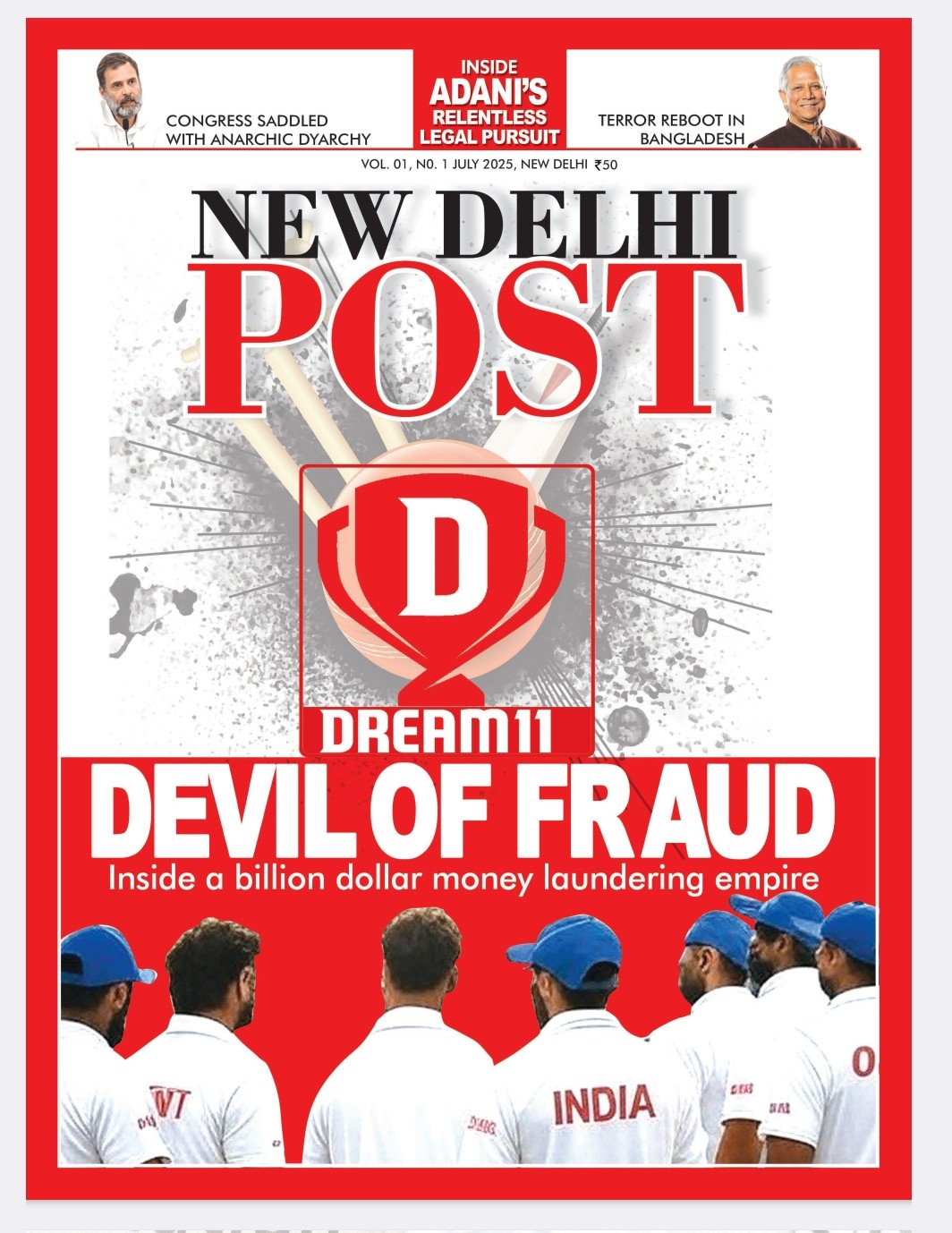
Behind the Fantasy: How Dream11 Engineered an Offshore Network of Round-Tripping, Sham Valuations, and FDI Violations
K. Ashish
What economic offense hasn’t Dream11 allegedly committed? In the annals of India’s financial misdemeanors, after Harshad Mehta, the next name that may well be etched in bold is Dream11.
What do you call a company registered overseas that, as far back as 2015, allegedly bypassed all FDI regulations and funneled 100% foreign direct investment into India—without scrutiny, without consequence? Today, Dream11 stands accused of being involved in round-tripping and money laundering, in a manner that raises serious questions about regulatory oversight and political silence.
Behind the glittering public image of India’s most popular fantasy sports platform lies an ecosystem built not just on digital engagement, but on alleged financial engineering.
According to New Delhi Post Investigation reports, this ecosystem has emerged as a viable channel for money laundering by India’s white-collar elite—politicians, bankers, and top corporate players; And the name at the centre of it all? Dream11.
How a Cricket-Entertainment Giant Used Inflated Valuations and Offshore Shell Companies to Launder Black Money via Round-Tripping Operation
In a six-month-long investigation, The New Delhi Post* has uncovered how one of India’s leading cricket-entertainment conglomerates allegedly laundered black money through a sophisticated web of offshore shell companies and manipulated share valuations.
At the centre of this probe is Dream11 — operated by Sporta Technologies and its U.S.-based affiliate, Dream Sports Inc. Our investigation, spanning over 2,000 pages of internal emails, corporate memos, financial records, and on-ground verification, reveals a pattern of financial irregularities designed to route illicit funds into the formal economy.
Key findings suggest that Dream11 (Sporta Technologies Pvt Ltd) engaged in questionable financial transactions with its Delaware-registered shell entity, Dream Sports Inc., under the guise of online fantasy gaming. Evidence points to a deliberate “round-tripping” strategy — wherein funds sent abroad were rerouted back into India as foreign investments — a classic modus operandi of money laundering.
Most startling is the manipulation of share valuation: a single ₹10 share was inflated to a staggering ₹5,62,246 through unauthorized transfers and artificial revaluation. This inflated equity was then used to facilitate large-scale money laundering through complex cross-border transactions.
In the world of offshore tax havens, Delaware is considered safer and opaquer than even Bermuda, the British Virgin Islands, Switzerland, the Netherlands, or Singapore.
On March 6, 2013, Dream11 Inc. was officially registered at 2711 Centerville Road, Suite 400, Wilmington, DE 19808—an address notoriously known for hosting thousands of offshore shell companies. This is where the world’s largest fantasy sports platform, Dream11, is legally based—or so the company claims.
While this location is described as the legal office of Dream11 Inc., the truth is quite different. This address actually belongs to Corporation Service Company (CSC), a professional registered agent. CSC facilitates the creation of thousands of anonymous entities, often used for money laundering and tax evasion, providing these entities with an offshore foothold in the United States.
Later, the address 960 Holmdel Rd, Building II, Holmdel, New Jersey 07733 was listed as the company’s U.S. headquarters. However, this location is not a corporate office, but the premises of Malhotra & Patel LLC, an accounting firm run by Indian-origin professionals: Meet Malhotra, Atul Malhotra, and Anurag Patel. Similarly, in New York, a man named Amit Duggar plays the same role for Dream Sports Inc.
Critically, no employees of Dream11 Inc. operate from these locations. No business activities are carried out here. These addresses serve merely as mail-forwarding hubs, much like P.O. boxes—classic signs of shell companies.
In such arrangements, it becomes the responsibility of the registered agent to maintain secrecy—hiding the identities of the real individuals behind the company. In the world of offshore tax havens, Delaware is considered safer and opaquer than even Bermuda, the British Virgin Islands, Switzerland, the Netherlands, or Singapore.
The New Delhi Post conducted a detailed investigation—analysing correspondences between Sporta Technologies Pvt. Ltd. and Dream11 Inc. (Dream Sports Inc.) from 2007 to 2022. Every document was scrutinized, each page examined with forensic precision.
This investigation revealed that while Dream11 Inc. was registered in Delaware on March 6, 2013, a shell game was simultaneously being played in India. On October 14, 2013, an existing firm—Adwaiya Realtors Pvt. Ltd.—was acquired and renamed Dream11 Fantasy Pvt. Ltd.
The story doesn’t end there. On October 3, 2014, Dream Sports Inc. was registered in New York, and just two months later, on December 10, 2014, Dream11 Gaming Zone LLP was registered with India’s Ministry of Corporate Affairs (MCA).
While all official formalities were handled by agents in New York and Delaware, in India, the same roles were played by Harsh Jain and Bhavit Sheth—who acted as directors in both geographies. But our investigation indicates they were merely puppets, with the real controlling power hidden in the shadows.
On May 28, 2019, Dream11 Fantasy Pvt. Ltd. was rebranded as Sporta Technologies Pvt. Ltd. By 2024, yet another company, Dream Duo, entered the picture.
Following Dream Duo entry, a carefully crafted narrative was floated—alleging Dream11’s “return to India” on April 7, 2024. But our findings show this was nothing more than a manufactured rumour, a smokescreen to obscure deeper wrongdoing.
Which begs the question—has Dream11 Inc. (Dream Sports Inc.) truly shut down its U.S. operations? The answer is no. Has it transferred the 99.99% shares—originally sent from India to the U.S. in 2015 via round-tripping at a mere ₹10/share—back to India? Still unclear.
So who really “returned”? The puppets, who acted as frontmen in this international masquerade—deceiving agencies like MCA, FEMA, ED, and RBI, while laundering black money across borders using carefully falsified paperwork.
A closer look at the valuation reports reveals even deeper deception. On February 24, 2022, the share value of Dream11 Inc. was artificially inflated—from ₹10 to a staggering ₹5,62,246 per share. This spike was justified using brand partnerships like BCCI, allowing the company to secure ₹774.6 crore in loans from top Indian banks. But in truth, this fake valuation was the foundation of the Dream11 scam.
The Dirty Secret Behind Dream 11 “Share Valuation Scam”
Cricket, Cash, and Concealment: New Delhi Post Uncovers Dream-11 Financial Web
Dream11: Modus Operandi of A Corporate Mirage
Dream11 is the story of a company architected to conceal the identity of an invisible controller — a corporate construct engineered to commit financial crimes from within the elite ecosystem of Indian cricket. Cloaked under the guise of legitimacy, the company used the sport not as a passion, but as a tool to further its objectives.
To lend credibility to its inflated valuation, company reports referenced business contracts with top-tier cricket entities — including players, the ICC, BCCI, and IPL. This illusion of legitimacy helped sell shares with a face value of ₹10 at an astronomical price of ₹562,246.
New Delhi Post is set to expose the modus operandi of Dream11 — revealing how, within moments, the invisible force behind the company inflated its valuation to ₹1,568 crore. Behind the glitz of cricket lies a hidden operation built on deception, distortion, and deliberate opacity.
To understand the financial crimes and money laundering scams involving Dream Sports Inc and Sporta Technologies Pvt Ltd, one must first grasp three key elements.
The most critical among them is the*timeline of events specifically, the dates and years when the Authorised Share Capital was set, the*price per share and the corresponding value of Preference Shares at each stage.
It is essential to trace:
When and how the value of Preference Shares was altered,
On what basis those changes were justified, and
Who benefited from these shifts in valuation.
Furthermore, were these Preference Shares later converted into Equity Shares? If so, what was the conversion price per share, and who gained the most from it?
Dream Sports Inc and Sporta Technologies Pvt Ltd appear to have used this precise sequence as a modus operandi to execute their financial fraud and laundering scheme.
The scam linked to Sporta Technologies Pvt Ltd prominently involves three companies — the first and most notable being Dream11 Inc (now Dream Sports Inc). Through indirect corporate layers, the presence of Anand Jain — father of Harsh Jain — becomes evident, suggesting a **silent but strategic link to Reliance Industries, operating almost like an invisible player in this corporate match.
To understand the entire game of money laundering, it is important to take a look at the chart given below.
Sporta Shareholding Pattern (as of December 31, 2021)
| Shareholder | Shares Held | Face Value (₹) | Share Capital (₹) |
| Dream Sports Inc (Delaware) | 1,031,189 | ₹10 | ₹1,03,11,890 |
| Bhavit Sheth (Jointly with DSI) | 78 | ₹10 | ₹780 |
| Antordaya Commercial Pvt. Ltd. | 2,933 | ₹10 | ₹29,330 |
🟧 Dream Sports Inc — 97.17%
🟩 Antordaya Commercial — 2.76%
🟦 Bhavit Sheth — 0.01%
The Vanishing Founder
In 2013, co-founder Harsh Jain held 99.99% of Sporta Technologies, making him the undisputed owner. By 2021, that stake had vanished — transferred silently to the Delaware-based Dream Sports Inc.
But no PAS-3, SH-4, or board resolution explains this change in ROC records. There is no public record of how or when Harsh Jain transferred his controlling stake. Was it a sale? A gift? A restructuring? Billion crore company changed hands, and Indian regulators were blind to it.
Money Laundering, Wrong Valuation & Round-Tripping via Inflated Share Transactions
On 24th February 2022, a company’s equity shares were valued at ₹5,62,246 per share, despite a face value of only ₹10. Shortly after, 2,933 shares were sold at ₹3,09,313 each. This raises serious suspicion of financial malpractice. Potential motives include:
1. Money Laundering – Converting unaccounted funds into legitimate equity investment at inflated valuations.
2. Round-Tripping – Routing funds through shell or related entities to disguise their origin.
3. Tax Evasion – Using artificially overpriced shares to later claim capital loss.
4.Benami Ownership – Hiding real beneficiaries behind proxy investors.
5. Wrong Valuation for Fundraising – Deliberately inflating share prices to mislead future investors or inflate IPO value.
As of August 31, 2021, foreign promoters held 1,041,264 equity shares in Sporta Technologies Pvt. Ltd, giving Dream11 Inc (Dream Sports Inc) an apparent holding of 97.17% in the company.
Earlier, on March 31, 2021, Chartered Accountant Harsh Chandrakant Ruparelia prepared a valuation report, pegging the per-share price of Sporta Technologies Pvt. Ltd. at approximately ₹309,300. Based on this report, Antordaya Commercial Pvt. Ltd. was issued 2,933 equity shares at this rate.
On December 31, 2021 Dream Sports Inc was issued 279 preference shares at a nominal value of ₹100 each, which were converted into 12,969 equity shares on February 15, 2022, under the guidance of registered valuer Shashank Maloo. The total value of these converted shares was ₹129,690 and were formally issued to Dream Sports Inc on March 28, 2022.
From an initial investment of ₹27,900, the converted equity reflected a valuation gain of ₹72.95 crore, amounting to a return multiple of approximately 2,615 times.
As of March 2021, Dream Sports Inc held 1,031,189 equity shares at a face value of ₹10, giving it 99.99% ownership in Sporta Technologies. By February 24, 2022, each share was valued at ₹562,246, raising the total estimated value of Dream Sports Inc’s holding to ₹5,801.29 crore. This implies a return of 56,250%.
On February 24, 2022, a DCF-based valuation assigned a total equity value of ₹588,766.44 million based on 1,047,169 shares.
On March 28, 2022, in a key financial manoeuvre, Sporta’s Board approved the conversion of 279 CCPS into 12,960 equity shares at ₹10 face value. The valuation report was prepared by Registered Valuer Shashank Maloo (IBBI/RV/07/2019/12701). This allowed Dream Sports Inc to turn a ₹27,900 investment into shares worth ₹1,29,690 — initiating what appeared to be a round-tripping mechanism disguised as corporate restructuring.
A share acquired at ₹100 was now valued at ₹562,246 based on the inflated valuation. Notably, the same individual, Bhavit Sheth, acted as both the applicant for Dream Sports Inc and the approver from the Indian entity, raising potential conflict-of-interest concerns.
This mechanism exploited CCPS instruments: a ₹10 face value share was revalued at ₹562,246—yielding theoretical holdings worth ₹1,568 crore** from a mere ₹27,900 investment, or a return exceeding 56.2 million percent.
At a per-share valuation of ₹562,246, the equity shares post-conversion resulted in an effective*56,000x premium over face value.
The Web of Shells: Multiples Private Equity Fund II LLP
Another key player is Multiples Private Equity Fund II LLP, linked to several prominent bankers, political figures, and industrialists. On January 17, 2017, when the company was still named **Dream11 Fantasy Private Limited, 279 CCPS were issued to investors at a face value of ₹100 with a massive premium of ₹329,961.68 per share, totalling ₹14.77 crore as paid-up capital. These were later converted into equity, making them instrumental in the alleged money laundering pipeline.
The Third Player: Antordaya Commercial and Holding Pvt. Ltd.
Antordaya Commercial and Holding Pvt. Ltd. acquired 2,933 equity shares at ₹309,313 each, making a total investment of ₹90.71 crore
(Rupees Ninety Crores Seventy-One Lakhs Thirty-Four Thousand Two Hundred Twenty-Nine Only).
Behind the Screens of Dream11: A Case Study in Corporate Disguise and Offshore Control
The Curious Case of Dream11: Corporate Structuring or Regulatory Evasion?
New Delhi Post’s investigation uncovers how Dream11, a multibillion-dollar enterprise in India’s online gaming sector, leveraged legal grey areas in corporate and financial regulations — and how it strategically aligned itself with cricket and its governing body, the BCCI, to further its questionable operations.
Behind the Rise of Dream11 A Forensic Look at How Foreign Ownership, Legal Gaps, and Regulatory Ambiguity Shaped India’s Largest Fantasy Sports Company
In August 2013, a little-known entity named Adwaiya Realtors Private Limited underwent a name change and was rebranded as Dream11 Fantasy Private Limited. At the time of this transformation, the company operated under the name Dream Fantasy and had an initial shareholding of 10,000 shares — 9,950 held by Harsh Jain and 50 by Bhavit Seth.
On February 18, 2015, all shares except one (retained by Bhavit Seth) were transferred to Dream11 Inc, a foreign entity. Then, on February 24, 2019, the final remaining share held by Seth was also transferred to Dream11 Inc, which now operates under the name Dream Sports Inc. This completed a 100% acquisition of the Indian fantasy sports company by a foreign-owned entity — all without a clear, sector-specific regulatory framework governing online fantasy gaming in India at the time.
Interestingly, Dream Sports Inc issued a certificate to Bhavit Seth explaining that this legal manoeuvre was necessary to comply with Indian laws — suggesting that if Seth’s shareholding became zero, the Indian company’s existence would become null. However, in practice, Dream11 Inc (Dream Sports Inc), already owned this sole remaining share, and the certificate appeared to be a legal formality designed to mislead Indian regulators.
This essentially meant that Bhavit Seth, with no actual ownership, was officially shown as running India’s largest online fantasy gaming company, while effective control remained with Dream Sports Inc, a Delaware, USA-based shell company.
This foreign influence extended into Indian cricket administration and even to the Board of Control for Cricket in India (BCCI) through commercial partnerships and sponsorships.
The financial structure raises further red flags. While Bhavit Seth was only a symbolic shareholder — whose ownership was fully under the control of a U.S.-based company — he
was simultaneously signing off on critical decisions and resolutions as both a director and an apparent shareholder of Sporta Technologies Pvt Ltd, the Indian operating company.
In meetings of the Board of Directors, Seth would participate on behalf of both the Indian and foreign entities, approving decisions from both sides. His signatures also appear on documents related to loans obtained from Indian banks, prompting a serious jurisdictional question:
In which country would legal accountability for this dual-role individual be determined — the United States or India?
This situation serves as a classic example of how legal technicalities and complex corporate structures can be manipulated to sidestep Indian laws. Despite full control residing overseas, paperwork in India continued to project domestic ownership and governance.
Further scrutiny emerges when reviewing Section 61 of the Companies Act, 2013, which states:
A company may, if so authorized by its Articles of Association, alter its share capital by passing an Ordinary Resolution in general meeting
This implies that while a Board of Directors may propose such changes, the true power lies with the shareholders, who must approve the alterations via a General Meeting. At the times when Sporta Technologies repeatedly increased its authorized share capital, neither Harsh Jain nor Bhavit Seth were actual shareholders. How then were such capital increases legally sanctioned?
This opens serious questions about corporate governance and shareholder manipulation. While Harsh Jain was a visible figurehead, the report suggests that Bhavit Seth may have served more as a puppet, perhaps unknowingly, in a broader game of shadow control and corporate subterfuge — a “sacrificial goat” at the hands of invisible foreign interests.
Therefore, the growth of Dream11 is not just an entrepreneurial success story but a case study of regulatory loopholes, foreign control and potential financial malfeasance in India’s rapidly growing digital economy.
Delaware: The Invisible Fortress of Corporate Secrecy — A Deep Dive into Dream11’s Offshore Structure
What began as a fantasy sports platform has, over time, evolved into a case study in cross-border corporate manoeuvring, exposing serious concerns regarding regulatory compliance, conflict of interest, and the use of shell entities. The inaction of Indian regulatory authorities in identifying or addressing these anomalies only deepens the concern.
As scrutiny intensifies around the integrity of foreign investment routes and the possible complicity of domestic institutions in the affairs of Sporta Technologies, one fact stands out: **Delaware’s corporate opacity may have provided cover, but the façade is now beginning to crack—and the truth is beginning to surface.
Delaware, a small U.S. state, has long held a global reputation—not merely for corporate friendliness, but for offering unparalleled opacity in financial and legal structures. In the shadowy world of offshore tax havens, Delaware is increasingly being seen as safer and more discreet than traditional secrecy jurisdictions like Bermuda, the British Virgin Islands, Switzerland, the Netherlands, or Singapore. This has made it a preferred destination for white-collar politicians, bankers, and capitalists seeking anonymity and minimal regulatory interference.
In 2013, this very environment of regulatory silence attracted the attention of Dream11—a name that would soon become closely associated with Indian cricket and the Board of Control for Cricket in India (BCCI). The brand rapidly gained traction among Indian and international cricketers, but few were aware that behind its rising popularity was a Delaware-registered entity Dream11 Inc, whose operations raised serious questions about legality and transparency.
By 2015, another shell company—with no staff, no physical infrastructure, and not even a chair in its so-called office—mysteriously acquired 99.99% shares of the Indian entity. Despite this suspicious transfer of ownership, no alarms were raised either by Indian regulators or by the BCCI.
The company did not comply with basic regulatory requirements such as Know Your Customer (KYC) documentation with India’s Ministry of Corporate Affairs (MCA), nor was any formal documentation submitted on behalf of the U.S.-based parent company.
At the centre of this opaque network stood Bhavit Sheth, the man who acted as a puppet executive for Dream11 Inc (later renamed Dream Sports Inc). Sheth served as a common director across both U.S. and Indian entities, signing documents on behalf of both, often in the same transaction. Shockingly, he would pass board resolutions in India, approve them as a director of the Indian company, and simultaneously act as a representative of the foreign parent company. These cross-jurisdictional authorizations were often routed via New Jersey, with communication emails traced back to Sheth himself.
What emerges is a pattern of calculated paper fraud, wherein the same individual controlled both ends of legally distinct entities, bypassing oversight mechanisms meant to prevent precisely such conflicts of interest.
Further deepening the concerns are inconsistencies in official registration records. Dream11 Inc has reportedly provided an 11-digit entity number (52985018100) in India’s MCA registry, despite Delaware’s official 7-digit entity ID format, under which the company is identified as 5298501. This discrepancy is not just clerical—it suggests intentional obfuscation of ownership structures and may point to falsified or misleading disclosures.
The trail doesn’t end in Delaware. In New York, another entity under the name “Dream Sports Inc” is registered with DOS ID: 4646396, adding yet another layer to the labyrinthine network of offshore registrations. The purpose of maintaining parallel entities in multiple U.S. states remains unclear, but it certainly complicates efforts at financial and legal scrutiny.
No Shareholding, Yet ₹766 Cr Loan? A Deep Look into Bhavit Seth’s Silent Role
On 22 October 2020, Bhavit Seth, in the capacity of Executive Director, wrote to IndusInd Bank (Opera House Branch, Mumbai) seeking ₹150 crore as working capital credit facility. The repayment was to be made in instalments or on demand, with monthly compound interest, fees, and other applicable charges as per sanction terms.
This letter was just one piece in a larger financial puzzle. Between 2020–2021, major banks including Kotak Mahindra Bank, Barclays, RBL, AU Small Finance Bank, CSB Bank, Axis Bank, and Yes Bank extended credit to the company. Interestingly, at that time, Bhavit was not a shareholder. He held no equity but continued signing documents, functioning solely as a salaried executive director.
The total debt raised touched ₹766.6 crore. No immovable assets were mortgaged. The only pledged security was a fixed deposit, maturing in just six months. No document clarifies in whose name the FD was held.
Further, on 15 May 2021, Yes Bank and Axis Bank released funds via bonds/NCDs through IndiaBulls Housing, Indostar Capital Finance Ltd, and Shriram City Union, again bearing Bhavit’s signature as director.
The question remains: how was such massive credit extended, when the signatory had no shareholding and the collateral lacked transparency?
| Cricket, Corruption & the Dream11 Deal: How Foreign Money Entered Through BCCI Dream11: Sponsorship or Soft Infiltration? On July 1, 2023, BCCI named Dream11 as the lead sponsor of the Indian cricket team. A proud jersey now bears the logo of a company with murky foreign links. Between 2015 and 2022, a 100% foreign-owned entity—Dream Sports Inc—quietly acquired full ownership of Sporta Technologies Pvt Ltd, Dream11’s Indian arm. While founders Harsh Jain and Bhavit Sheth remain public faces, the real financial control appears to rest with invisible offshore players. Paper trails have reportedly been manipulated to obscure foreign influence. Despite this, Dream11 flourished—using the legal grey area between “game of skill” and “game of chance” to popularize online betting under the garb of fantasy sports. Indian law clearly states: if money is involved, it’s gambling. In 2024, Dream11 partnered with Betway SA20, a league run by one of the world’s biggest online betting firms. The deal was confirmed by Cricket South Africa. Did the BCCI or Indian government take note? This unchecked commercial entry raises troubling questions. Are cricket fans being nudged into betting without knowing? Is the sport becoming a vehicle for silent foreign agendas? When fantasy meets reality, the cost might be more than just the game. A deep question had been weighing on my mind — does Reliance have any stake in Dream11? In pursuit of the truth, I carried out my own investigation. And today, I present before you everything I found, exactly as it came to me — without any alterations, without any tampering. The details are as follows: The growing scrutiny around Dream11’s corporate structure reveals potential indirect links to the Reliance business empire through Anand Jaikumar Jain, a long-time associate of the Ambani family and one of India’s most influential businessmen. Known as Reliance’s “right hand” during its early expansion, Anand Jain is also the father of Harsh Anand Jain, the co-founder and face of Dream11 in India. Significantly, both Anand Jain and Harsh Jain are listed as directors in over a dozen companies, suggesting a closely held family network that operates across real estate, media, and digital ventures. One notable entity, Clover Media Private Limited, in which Anand Jain is involved, issued a permission letter for the use of premises at Trade World, B Wing, Kamala City, Lower Parel, Mumbai. This same address has been registered as the official office for Adwaiya Realtors and Dream11 Gaming Zone LLP—two entities closely associated with the Dream11 ecosystem. Anand Jain, Harsh Jain, Bhavit Sheth, and their entire family have deep business ties with Clover Media Pvt. Ltd. and a company called Dream Duo. In April 2024, the return of these familiar faces was publicly promoted as Dream11’s “homecoming” to Indian soil. But our investigation revealed a very different truth. This so-called homecoming was, in reality, a carefully crafted rumour — a narrative designed to conceal a much darker corporate reality. |

