
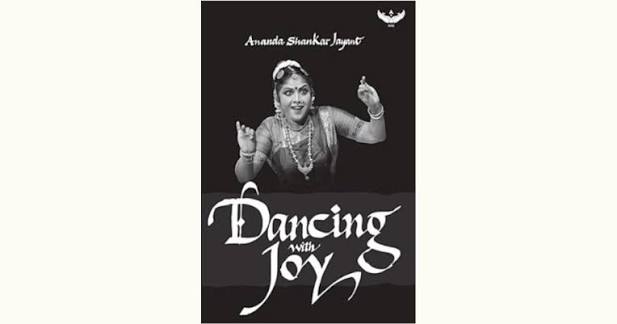
ABOUT THE BOOK
Dancing with Joy is an inspiring memoir by Ananda Shankar Jayant, one of India’s most celebrated classical dancers, whose life unfolds at the intersection of art, intellect and public service. Her journey is one of discipline, grace, resilience and quiet courage.
Central to this remarkable story is her encounter with cancer—met not as an ending, but as another rhythm to be understood, challenged and ultimately mastered. ‘Cancer is a mind game,’ she writes, ‘and dance—my core strength—taught me to ride both the crab and my mind.’
Rich with insight, wisdom and deeply personal reflections, Dancing with Joy is a celebration of the human spirit’s ability to rise above adversity. Through triumphs, setbacks and moments of profound self-discovery, Ananda inspires readers to recognise and nurture their unique gifts while embracing life with purpose and gratitude.
More than a memoir of survival, this is a story of transformation, resilience and the conscious choice to find joy again and again. It offers hope and strength to anyone facing uncertainty, self-doubt, illness or life’s unexpected turns.
ABOUT THE AUTHOR
Dr Ananda Shankar Jayant inhabits the worlds of administration, academia and the arts, straddling them with equal ease, and is celebrated as one of India’s most eminent classical dancers, choreographers and dance scholars, with a highly acclaimed body of artistic work. For her contribution to the field of classical dance, Ananda was conferred the Padma Shri in 2007 and the Sangeet Natak Akademi Puraskar for Bharatanatyam in 2009.
Ananda is a sought-after motivational speaker and actively engages with India’s youth on a wide range of topics. Her TED Talk from 2009 has been widely viewed and remains highly regarded. An arts entrepreneur, Ananda has conceptualised and created Natyarambha, a pioneering Bharatanatyam practice app launched in January 2017 that is now used across the globe.
Ananda’s cutting-edge digital product Kutty Kahani, a video-embedded e-book that brings Indic stories by and for children through the prism of art—was mentioned by the Prime Minister of India, Shri Narendra Modi, in his Mann Ki Baat broadcast on June 18, 2023. Ananda also served in the Ministry of Railways as a senior officer of the Indian Railway Traffic Service.
EXCERPTS
Gurudev Rabindranath Tagore was a mystic, a literary genius who gave India her national anthem. He was modern India’s first cultural ambassador to the world, the first non-European to be awarded the Nobel prize. He was also a genius, whose writings spanned many genres: poetry, prose, plays, songs, dance dramas, novels, travel writing, humour, and children’s writing—all this is very well known. What is lesser known is the impact he has had on modern Telugu literature. Such was his influence that he was considered a member of the Telugu fraternity. He was adored, emulated and imitated freely. Tagore’s Gitanjali was translated into Telugu as early as 1914.
Almost all of Tagore’s works have seen translations into Telugu, and have further spawned a rich literary legacy.
Telugu poets were mesmerized by Tagore. No other Indian body of work has influenced contemporary Telugu literature to the extent to which Tagore’s writings have done.
The sway and effect that Tagore’s writings had on modern Telugu literature, was seen in the evolution of a movement called Bhavakavitvam, the poetry of expression, as distinct from the message-oriented, reformist poetry which was prevalent at that time. This new poetry reached its zenith around the 1920-30s, when the influence of Tagore was dominant, as seen in the works of Telugu stalwarts and luminaries like Gurazada Appa Rao, Rayaprolu Subba Rao, Devulapalli Krishna Shastry, Vedula Satyanarayana Shastry, Abburi Ramakrishna Rao, Bezwada Gopala Reddy, Duvvuri Rami Reddy, Mallavarapu Visweswara Rao, Chalam, Venkata Parvateeswara Kavulu, the poet duo of Balantrapu Venkata Rao and Oleti Parvateesam, and others.
And so, in 2012, as part of the 150th birth anniversary of Tagore, I chose to trace this far-reaching influence that Tagore had on Telugu writing, through the medium of poetry, music and dance.
And thus evolved Kavyanjali—An Ode to Gurudev. Kavyanjali—An Ode to Gurudev juxtaposed an anthology of
Tagore’s poetry with a selection of similar, comparable Telugu poetry by Devulapalli Krishna Sastry, Rayaprolu Subba Rao and the poet duo of Balantrapu Venkata Rao and Oleti Parvateesam, showcasing a synergy of themes, thoughts and ideas in Telugu poetry of the early 20th century inspired by Gurudev Rabindranath Tagore.
This production was in collaboration with the distinguished and well-known Tagore scholar, Dr. Partha Ghose, and the renowned Telugu scholar and writer, Prof. Mrunalini Chunduri, who helped me choose the poetry and understand its context and sub-text.
With Sathiraju Venu Madhav, composing the music for the Telugu poetry that was intertwined and sung alongside select Rabindra Sangeet by Dolan Banerjee, the choreography of this production drew extensively from the grammar and vocabulary of both Bharatanatyam and Kuchipudi, and was an ensemble production.
Structured in four sections—Nataraja, Prakruti, Maataram and Gitanjali; Kavyanjali—An Ode to Gurudev, was an offering of poems in Bengali and Telugu, using both Rabindra Sangeet and Carnatic music, classical dance and English narration, that spanned the arc of Tagore’s poetry and their evident influence on Telugu poetry.
Kavyanjali—An Ode to Gurudev was Shankarananda Kalakshetra’s pranaam to Rabindranath Tagore. Hearing “Sadhu Sadhu” (the ancient way of praise after a performance by an audience—akin to today’s standing ovation), from the full house at Shanti Niketan, and later at Kolkata, seemed like a blessing from Gurudev.