
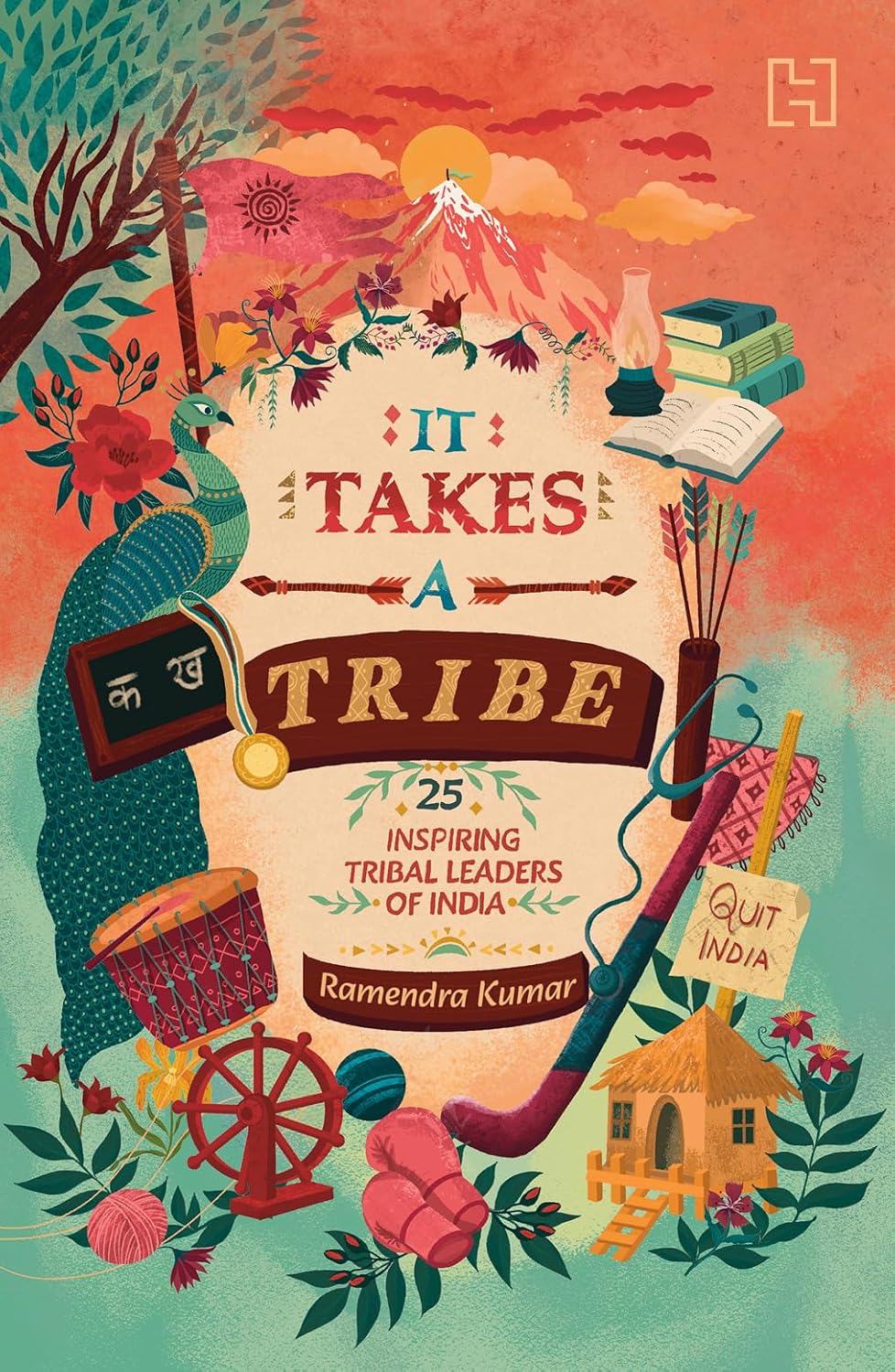
ABOUT THE BOOK
History is often shaped as much by those who remain outside the spotlight as by the names that dominate textbooks. In It Takes a Tribe: 25 Inspiring Tribal Leaders of India, Ramendra Kumar turns his attention to twenty-five remarkable individuals whose stories deserve to be far better known.
What makes the book distinctive is its range. It travels across centuries and across fields, bringing together revolutionaries, environmentalists, sportspersons, artists, educators, social reformers and grassroots changemakers. From Birsa Munda and Mary Kom to Tilka Majhi, Gaura Devi, Vasamalli K, Dhaniram Toto and Poorna Malavath, the reader encounters people who challenged oppression, protected forests, transformed communities and broke barriers that once seemed insurmountable.
The greatest strength of It Takes a Tribe lies in the storytelling. Ramendra approaches each life as a story rather than a catalogue of dates and accomplishments. There is flow, conflict, emotion and, most importantly, a strong human connection. Historical figures cease to be distant names and emerge as individuals with fears, dreams, setbacks and extraordinary determination.
The book is a great read for everyone. A child may be drawn into the drama and adventure of these lives, while an adult may discover histories, communities and contributions that received little attention during their own education. The language is simple without being simplistic, and the narratives are engaging without compromising the seriousness of the subjects. It is this ability to appeal to readers across age groups that gives the book unusual reach.
The book also has immense contemporary relevance. Many of the struggles faced by its protagonists have not disappeared. Questions of environmental protection, displacement, access to education, gender equality, dignity, representation and the rights of indigenous communities remain urgently relevant today.
With twenty-five lives to cover, there are moments when one wishes a particular story could have been explored in greater detail. But the relatively compact narratives also make the book crisp and easy to read.
What stays with the reader is the sheer variety of these lives and how much these individuals contributed, often with little recognition beyond their own communities. Their stories belong not only to tribal history but to the history of India.
That is also what makes It Takes a Tribe such a timely read. It introduces us to people many of us should have known about much earlier and tells their stories with warmth and pace. By the end of the book, one is left wondering why so many of these names are still unfamiliar.
ABOUT THE AUTHOR
Ramendra Kumar is an award-winning author, storyteller and TEDx speaker. He has written 55 books across genres for children and adults, and his work has been translated into 33 languages. A recipient of 41 national awards for children’s literature, Ramendra has served on the jury of the Times of India Women AutHer Awards and as a mentor with the Scholastic Writers Academy. Thirty-four of his stories have appeared in school textbooks. His books published by the National Book Trust have sold over 1.5 million copies. He has participated in leading literary festivals in India and abroad, including the Jaipur Literature Festival. An engineer and MBA, he spent over three decades with SAIL and took voluntary retirement as General Manager, Corporate Communications.
EXCERPT
When it comes to India’s struggle for freedom, the first major incident talked about is the Sepoy Mutiny triggered by Mangal Pandey, an Indian soldier in the British army. He attacked the officers of the East India Company on 29 March 1857 and is regarded as the first freedom fighter. There have been films made, dramas staged, eulogies sung and reams written on him.
However, not much is known about the fearless tribal warrior who led a rebellion against the colonisers more than eight decades before Pandey. His prolonged uprising from 1771 to 1785, which shook the British to the core, became the forerunner of many such revolts.
This is the story of Tilka Manjhi, whose resistance against the cunning oppressors created a template that would inspire tribal rebellions like the Halbas in 1774, the Bhils in 1818, the Kols in 1831 and the Santhals in 1855–56.