



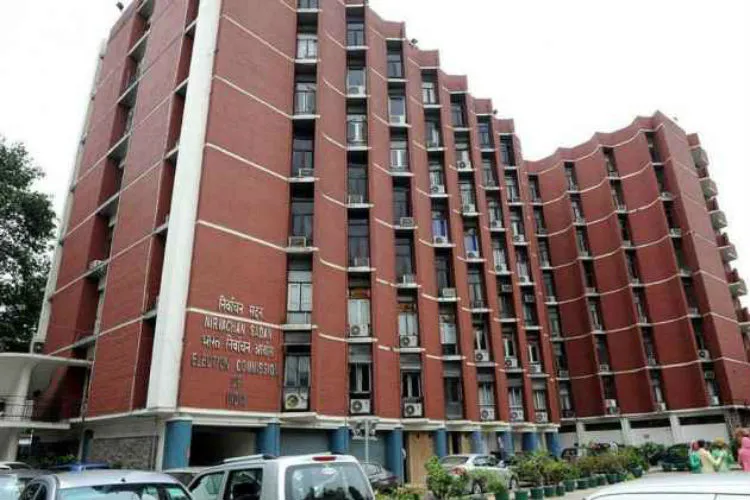
An investigation reveals how the Modi government pushed through a controversial Bill on the appointment of Election Commissioners, bypassing its own legal advice and parliamentary scrutiny
On May 14 this year, a series of critical questions asked by the Supreme Court to a central government lawyer while hearing petitions challenging the law governing the appointment of Election Commissioners made headlines.
Among them was a pointed question about the role of the Leader of Opposition in the selection committee: “…Why do you then include the leader of the opposition? He’s ornamental. It will always be 2:1. Why do you put up this show of independence in the body? Will a member of cabinet go against the prime minister?”
The questions were asked in the context of a three-member committee constituted to select the Chief Election Commissioner and Election Commissioners. The committee presently comprises Prime Minister Narendra Modi, Union Home Minister Amit Shah and Leader of Opposition Rahul Gandhi. It was created under a law passed by Parliament in December 2023.
The Supreme Court appeared concerned that the composition of the committee was tilted in favour of the Union government and that this could have implications for the functioning and independence of the Election Commission of India (ECI).
Ever since it was notified in early 2024, the law has faced sustained controversy and criticism. Officially titled the Chief Election Commissioner and Other Election Commissioners (Appointment, Conditions of Service, and Terms of Office) Act, 2023, its constitutionality has been challenged before the Supreme Court by multiple petitioners, including the Association for Democratic Reforms (ADR), Trinamool Congress MP Mahua Moitra and Congress leader Dr Jaya Thakur. The court raised its questions while hearing the petitions filed by them.
>> Legal Advice Ignored
But the controversy over the composition of the committee tells only part of the story. Previously unreported official documents reveal new details about the manner in which the controversial legislation was prepared and pushed through Parliament by the Union government.
The documents reveal three significant aspects of the process:
- First, the Union law ministry appears to have disregarded advice from one of its own legal advisers to consult “key stakeholders” before the bill was introduced in Parliament.
- Second, a series of actions by Law Minister Arjun Ram Meghwal and officials in the law ministry sought to expedite the bill’s passage through the Rajya Sabha. The actions involved deliberate non-compliance with the Upper House’s regulations, which, they claimed, was due to “urgency” and “shortage of time”. This ensured that parliamentarians neither received authorised copies of the bill in advance, as per official regulations, nor could the bill be sent to a parliamentary standing committee for scrutiny, as per convention.
- Third, the ministry prepared legal and administrative grounds to oppose an alternative proposal for an independent selection committee comprising the Chief Justice of India, Lok Sabha Speaker and Leader of Opposition.
Taken together, these findings raise fresh questions about how the bill was prepared, scrutinised and passed, and appear to lend weight to some of the concerns and legal issues raised by petitioners challenging the law in the Supreme Court.
Nearly five months before the controversial bill was passed by Parliament, Krishna Mohan Arya, a deputy legal advisor in the department of legal affairs, prepared an exhaustive six-page “legal and judicial analysis” of the proposed legislation.
In an internal note dated July 29, 2023, Arya endorsed the provisions of the bill but made an important recommendation. He wrote that “consultation with other key stakeholders is also desirable as per mandate of Pre-Legislative Consultation Policy of the Legislative Department, Ministry of Law & Justice”.
That recommendation was not followed. The Pre-Legislative Consultation Policy lays down how draft legislative proposals should be placed in the public domain and subjected to consultation. It says government departments and ministries should make available the draft legislation, or information containing its broad details, including the justification for the legislation, its essential elements, broad financial implications and an estimated assessment of its impact on the environment, fundamental rights, lives and livelihoods of the people concerned or affected.
Such details, the policy says, may be kept in the public domain for a minimum period of 30 days for proactive sharing with the public. The policy also states that the department or ministry pursuing the legislative proposal may “hold consultations with all stakeholders”.
Significantly, it requires the concerned department or ministry to include a summary of the feedback received from stakeholders, including government departments and the public, along with its response, in the Cabinet note accompanying the draft legislation.
The policy does allow the degree of participation and mode of consultation to vary according to the nature of the subject and its potential impact on those affected. But Arya’s recommendation was clear: wider consultation with key stakeholders was desirable.
Yet the legislative department’s Cabinet note in August 2023 did not acknowledge this recommendation. Instead, it stated that the bill had been circulated to the department of legal affairs for comments and concurrence on 28 July 2023 and that the department had concurred. The Cabinet note did not explain why the bill was not sent to the Election Commission, other government departments and ministries or the general public for their comments.
Senior advocate Vijay Hansaria said that the bill should have undergone an elaborate pre-legislative consultation process. “Because it affects all the political parties, including the ruling party, in such circumstances, it is more a necessity that a larger consultation ought to have been done by including all the opposition parties. In fact, they should have invited comments from the public as well,” he said. Hansaria, however, noted that the failure to consult people at large was not illegal. “But of course, it should have been done. That is my view,” he said.
A set of questionnaires has been sent to the legislative department asking why it did not conduct wider consultation, as advised by the department of legal affairs. This report will be updated if a response is received.
>> A Bill in a Hurry
The controversy surrounding the law is not limited to the composition of the selection committee. The manner in which the legislation was processed in Parliament has also attracted criticism.
Mahua Moitra and civil society group Association for Democratic Reforms (ADR) have asserted before the Supreme Court that the bill was passed without adequate discussion in Parliament. Moitra’s Intervention Application stated that 97 opposition members in the Lok Sabha and 45 opposition members in the Rajya Sabha had been suspended when the bill was passed. “As such, 141 Members of the Parliament neither had the opportunity to deliberate on the bill nor could vote on its provisions,” Moitra asserted.
ADR similarly stated in its petition that an important legislation such as this was passed “without any debate or discussion” in Parliament, which it described as the “important and critical forum to raise issues about the autonomy of the Election Commission”.
The documents reveal three separate actions by the law ministry that may have contributed to the lack of rigorous parliamentary scrutiny of the bill.
First: A procedural waiver
Citing “shortage of time”, the law ministry wrote to the Chairman of the Rajya Sabha seeking a “waiver” from a compliance requirement under Direction 20B of the Directions of the Chairman of the Rajya Sabha.
In effect, the request sought an exemption from the requirement to provide Members of Parliament with copies of the bill two days before it was formally introduced in the Upper House. The request was granted.
Second: No Standing Committee
The second intervention concerned the parliamentary standing committee. On August 7, 2023, Law Minister Arjun Ram Meghwal wrote to the Rajya Sabha Chairman requesting that the bill not be referred to the Department-related Parliamentary Standing Committee on Personnel, Public Grievances, Law and Justice for independent scrutiny and feedback. Meghwal cited “urgency” and requested that the bill be considered and passed by both Houses of Parliament during the same session.
The bill could not be passed during that session. But it was also not subjected to scrutiny by the Department-related Parliamentary Standing Committee, which contains parliamentarians from both the ruling and opposition camps.
Third: Amendments Relaxed
The third intervention came in December 2023. On December 9, again citing “shortage of time”, Meghwal wrote to the Rajya Sabha Chairman requesting that the applicability of Rule 95 of the Rules of Procedure and Conduct of Business in the Council of States be “relaxed”.
Rule 95 requires that notice of official amendments to bills be given one day before the Rajya Sabha considers any bill. Three days after the law minister made the request, the bill was passed by the Rajya Sabha.
The three actions reveal the urgency felt by Meghwal and officials in the law ministry to turn the bill into law. They also meant that parliamentarians did not receive authorised copies of the bill within the prescribed period and that the legislation did not undergo scrutiny by the relevant parliamentary standing committee before being notified as law in early 2024.
>> Alternative Panel Rejected
Amid the political controversy over the law, another aspect of the legislative process stands out: the Union government’s response to an alternative proposal for appointing Election Commissioners.
The proposal came from John Brittas, a CPI(M) Rajya Sabha MP from Kerala, in the form of a private member’s bill. Brittas proposed that the selection committee for Election Commissioners should comprise the Chief Justice of India, the Speaker of the Lok Sabha and the Leader of the Opposition.
The proposal was significant because the committee would have been dominated by independent constitutional functionaries rather than senior members of the Union government.
Official documents show how the law ministry prepared legal and administrative grounds to oppose Brittas’s bill. The legislative department prepared a three-page brief on the Kerala MP’s proposal. The brief noted that the Supreme Court, in a March 2023 judgment, had laid down a selection committee comprising the prime minister, the leader of the opposition in the Lok Sabha and Chief Justice of India for selecting Election Commissioners.
The judgment, the brief said, was “under examination” and an “Immediate decision cannot be taken by the Government without much deliberation”. On this basis, the brief concluded that Brittas’s bill “may be opposed and it may not be accepted, either in its present form, or in any modified form”.
It said the Rajya Sabha MP “may be requested to withdraw his bill” and that if he insisted on its consideration, the bill should be opposed.
Soon after this, the law ministry introduced its own bill proposing a different mechanism for the selection and appointment of Election Commissioners.
The difference between the two proposals was fundamental. Brittas’s proposal envisaged a committee comprising the Chief Justice of India, Lok Sabha Speaker and Leader of Opposition.
The government’s legislation created a committee comprising the prime minister, Union home minister and Leader of Opposition. The latter arrangement gives the Union government two of the three positions on the selection committee.
>> The Government’s Defence
When the law was challenged before the Supreme Court in 2024, the composition of the selection committee became one of the principal issues. The law ministry defended the presence of senior government functionaries on the committee. In an affidavit filed before the Supreme Court, the ministry argued that their presence could not, by itself, be treated as evidence of bias. “…the presence of senior government functionaries on the Selection Committee cannot in and of itself be a ground to automatically assume bias on behalf of the Committee,” the ministry said. It added that “High Constitutional functionaries ought to be presumed to act fairly and in good faith in the public interest.”
Senior advocate Vijay Hansaria, however, endorsed the principle behind Brittas’s proposal as well as the composition laid down by the Supreme Court in its March 2023 judgment. “If a ruling party appoints a person, it will be perceived that they are picking up persons who would be biased towards them. The Chief Justice of India has no direct interest, and the same holds true for the Speaker. Definitely, that ought to have been done,” he said.
Hansaria clarified that he was not insisting that the Chief Justice of India must necessarily be a member of the committee. He acknowledged that it was Parliament’s right to determine the composition. “But at least the composition of the selection committee has to be independent. That is what the constituent assembly has repeatedly said,” he said.
>> Questions Beyond The Panel
The documents add a new dimension to the controversy surrounding the law. The Supreme Court is now examining whether the composition of the selection committee provides adequate safeguards for the independence of the Election Commission. But the documents raise an earlier question: how much consultation and parliamentary scrutiny did the legislation receive before it became law?
An internal deputy legal advisor recommended consultation with “key stakeholders” under the government’s own Pre-Legislative Consultation Policy. The wider consultation was not undertaken. The law ministry subsequently sought a waiver from the requirement to circulate copies of the bill to MPs two days before introduction, requested that the bill not be referred to a parliamentary standing committee, and sought relaxation of the rule governing advance notice of amendments.
At the same time, the ministry prepared grounds to oppose an alternative private member’s bill proposing a selection committee comprising the Chief Justice of India, Lok Sabha Speaker and Leader of Opposition. The government’s own legislation eventually created a committee comprising the prime minister, Union home minister and Leader of Opposition.
The Supreme Court’s questions on May 14 have now brought the independence of that committee back into sharp focus.
The previously unreported documents suggest that the debate over the ECI’s independence cannot be confined to the final composition of the selection committee. It must also include the process through which that composition was legislated: the consultation that did not take place, the parliamentary scrutiny that was bypassed and the alternative mechanism that the law ministry moved to oppose. That is the larger constitutional question now confronting the Supreme Court.