






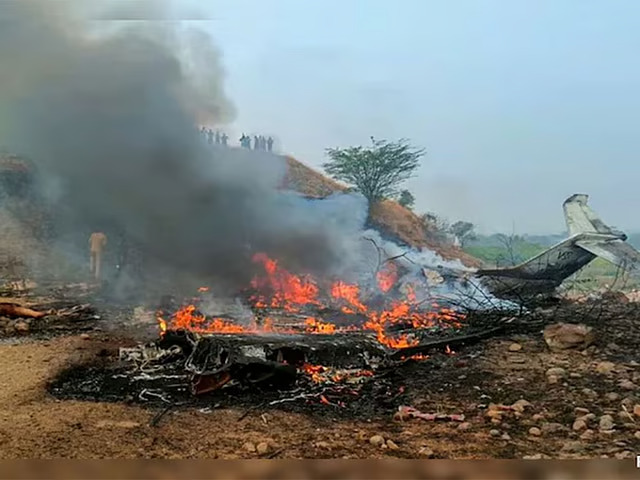
The sudden death of Maharashtra’s Deputy Chief Minister, Ajit Pawar, in a Learjet 45 crash at Baramati on 28 January 2026 has triggered not only formal investigations and widespread political mourning but also a surge of conspiracy theories circulating on social media and within sections of the political class. While official agencies have described the incident as a tragic aviation accident, speculation about hidden motives, foul play and political intrigue has gained traction online and in parts of the public discourse.
Official narrative: accident under investigation
Government and aviation authorities have consistently characterised the crash as an accident. Preliminary reports indicate that the business jet carrying Pawar veered off the runway during an attempted landing and burst into flames, killing all those on board. A formal investigation has been launched by Indian aviation authorities, including the Aircraft Accident Investigation Bureau, to determine the technical, environmental and operational factors that led to the crash.
This process involves detailed forensic examination of flight data recorders, weather conditions, aircraft maintenance logs, pilot credentials and runway operations. It remains the sole authoritative mechanism for establishing the cause of the accident. Despite this, alternative narratives have proliferated rapidly online, often running far ahead of verifiable facts.
Political leaders and speculative claims
Controversy intensified after West Bengal Chief Minister Mamata Banerjee publicly suggested that the circumstances surrounding Pawar’s death warranted scrutiny beyond routine aviation inquiries. Banerjee questioned whether politically motivated forces could be involved, claimed that Pawar had been considering distancing himself from the BJP-led alliance shortly before his death, and called for a Supreme Court-monitored investigation.
Her remarks have been interpreted by some observers as implying, without supporting evidence, that Pawar’s political positioning and alleged plans to recalibrate alliances may have exposed him to political machinations. Although framed as a call for transparency, these statements have contributed to speculation at a moment when factual clarity remains limited.
Social media amplification and unverified claims
On platforms such as Reddit, Instagram and X, increasingly speculative narratives have gained visibility. These range from assertions that the crash was deliberately engineered to claims that official explanations are designed to conceal a targeted “elimination”. Much of this discourse is anecdotal, unsubstantiated and rooted in broader mistrust of political institutions rather than in evidence connected to the crash itself.
Common claims include:
- Assertions that the crash “did not look like an accident”.
- Allegations that Pawar’s political decisions created enemies within his own coalition.
- Broad insinuations of political sabotage without reference to technical data or credible investigative sources.
It is essential to distinguish such unverified claims from substantiated facts. To date, no credible authority, whether legal, technical or journalistic, has produced evidence suggesting foul play in the crash or in decisions related to the flight.
Why these theories took root
Several factors help explain the speed and scale with which conspiracy narratives have emerged.
High political stakes
Ajit Pawar was a pivotal figure in Maharashtra’s turbulent political landscape. His decision to split the Nationalist Congress Party and align with the BJP–Shinde coalition made him a polarising figure. This political complexity has encouraged some commentators to infer deeper motives without evidentiary grounding.
Institutional distrust
Public scepticism towards political institutions and investigative agencies has become increasingly common, in India as elsewhere. High-profile deaths often trigger alternative explanations that reflect broader anxieties rather than facts specific to the incident.
Speed of social media circulation
Digital platforms reward immediacy and emotional resonance. In the absence of verified information, conjecture can circulate faster than official investigations are able to conclude, creating an environment in which speculation appears to fill informational gaps.
Assessing the claims: what we know and what we do not
| Claim | Current status |
| Aircraft accident caused by pilot error | Under investigation; no conclusion reached |
| Crash orchestrated as a political assassination | No credible evidence; speculative |
| Government deliberately concealed facts | No substantiation; official probes ongoing |
| Pawar intended to exit the BJP-led alliance | Alleged in political commentary; unverified |
| Online claims of sabotage | Unverified; based on social media conjecture |
At present, only one fact is indisputable: the crash occurred, and investigators are examining evidence to determine its cause. Assertions of motive, intent or conspiracy remain uncorroborated.
Risks of real-time conspiracy narratives
The rapid spread of conspiracy theories carries tangible risks:
- Erosion of public trust: Premature claims of foul play can undermine confidence in investigative processes before findings are established.
- Politicisation of tragedy: Leveraging an aviation disaster for political messaging deepens polarisation and distracts from factual inquiry.
- Public misinformation: Speculation can obscure genuine aviation safety issues that warrant serious attention and reform.
What happens next
The immediate priority remains the official aviation investigation, which alone can establish whether technical failure, human error, weather conditions or procedural lapses caused the Baramati crash. As of now, authorities have found no evidence of sabotage or criminal intent.
Distinguishing verified facts from unverified speculation is especially critical in the days following a high-profile tragedy. The discourse surrounding Ajit Pawar’s death reflects wider political tensions and the dynamics of social media amplification, but it should not overshadow the methodical work of investigators tasked with determining the truth behind the crash.


