


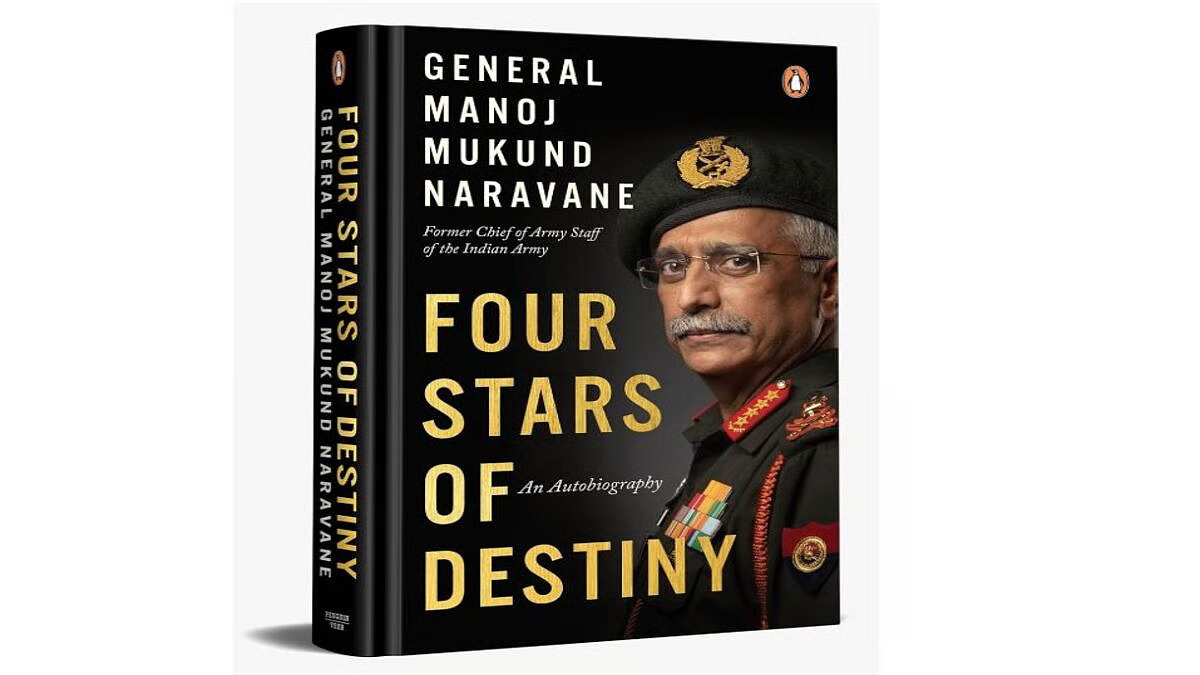
On the release of former Army Chief General Manoj Mukund Naravane’s memoir Four Stars of Destiny, many serious political questions have been raised. The question is whether the book has been published or not.
New Delhi Post has examined the statements given in Parliament and by the government. New Delhi Post found that apart from online resources, the book is easily available in hard copy in the physical marketplace, which common people can buy and read. The investigation also reveals that the statements made about the book by the Lok Sabha Speaker, Defence Minister Rajnath Singh, and Gen Naravane himself do not match the verified facts and, in somecases, appear misleading.
New Delhi Post has found in the investigation that the book was being sold on online websites such as Flipkart, Amazon and on Penguin Random House India itself.
To verify the truth, on February 9, we ordered Four Stars of Destiny on Amazon (Order No. #403-9604343-4245156), with a payment of Rs 704, which was accepted by the company.
Penguin Random House India has been continuously hiding this matter. Gen Naravane’s memoir, Four Stars of Destiny, could only have been published by Penguin Random House India, as the manuscript would be available solely with the author or the publisher and remains fully protected under copyright.
In the online edition, it is clearly stated on page six, following the cover material: “First published in Penguin Veer by Penguin Random House India 2024.” With this declaration, there remains no ambiguity as to whether the book has been officially published.
The book’s subject matter is wide-ranging. It not only raises questions regarding China’s incursions into Indian territory and examines what the author characterises as a defensive posture adopted by the Defence Minister Rajnath Singh and the Prime Minister Narendra Modi on highly sensitive matters of national security, but it also revisits earlier military operations. In Part Two, under the chapter titled “To Foreign Shores: From Regimental Centre to the IPKF,” the narrative reflects on Operation Pawan in Sri Lanka, during which approximately 1,200 Indian soldiers lost their lives while serving with the Indian Peace Keeping Force (IPKF).
The word “China” is said to appear around one hundred times in the book, a detail that reportedly contributed to the displeasure of defence minister and prime minister. The controversy intensified in Parliament when Lok Sabha Speaker Om Birla invoked Rule 349 to prevent Rahul Gandhi from citing the book as a reference.
Part 4, Chapter 4.2 of the book, titled “At Close Quarters: A Nation Responds,” runs from page 288 to page 317 and concludes with the words, “Satyameva Jayate!!” The author presents this section as the most crucial part of the work, containing its most significant disclosures.
In the book, Gen Naravane recounts, with visible anguish, an incident from 8:15 p.m. on August 31, 2020. He writes that four tanks of the Chinese People’s Liberation Army (PLA), supported by infantry, began advancing slowly along the track towards Rezang La. According to his account, Chinese forces fired a lightning round at Indian positions. However, he states that he was unable to respond, as he had received explicit instructions from higher authorities not to open fire without prior clearance.
Over the following thirty minutes, a series of urgent calls took place between the defence minister, the external affairs minister, the national security adviser, the chief of defence staff, and Gen Naravane. To each of them, he says, he posed the same question: “What are my orders?”
In the subsequent pages, the former Army chief describes a profound sense of helplessness. He suggests that at a moment resembling the brink of open conflict with one of the world’s most powerful militaries, the country’s top leadership left him to confront a critical battlefield decision largely on his own.
The situation sounded as if Mahabharata’s Abhimanyu was stuck in a Chakravyuh. For Gen Naravane, the burden of command during an episode of extreme national tension was full of overwhelming odds.
The book runs to 417 pages and is divided into five parts, each comprising separate chapters:
Part 1: Childhood and Adolescence
Part 2: Regimental Life
Part 3: Flag Ranks
Part 4: Four Stars of Destiny
Part 5: Reflections
EXCERPTS
On China: Part 4, Chapter 4.2
“At Close Quarters: A Nation Responds,”
Page: 293-294
Towards the afternoon, movement of PLA armour was also observed in the area of their garrison at Moldo. Seeing this, our tanks at Tara Base were also ordered to move up to Rechin La on the Kailash Range South of the Spanggur Gap. Armour is traditionally used in the plains and desert terrain, and even if in hilly terrain, only on valley floors that are wide and undulating. It is said that ‘tanks hate mountains’ and here we were, sending tanks up in high altitude areas, climbing up the steep hillside like mountain goats, at altitudes of over 15,000 feet. This in itself was an unprecedented manoeuvre, but nevertheless brought home the necessity of having a light tank in our inventory akin to the Type-15 light tanks of the PLA, which were now ranged across us. Some activities had been spotted on the North Bank too, including about 500 PLA troops in riot gear assembling in an area about 500 m to the East of Finger 4. All these movements and probing actions made it apparent that something more was to happen. A whole Regiment worth of PLA tanks was lined up on the track leading up from their garrison towards Rechin La.
At 2015 hours on the evening of 31 August, Jo rang me up, quite worried. He reported that four tanks supported by infantry had slowly started moving up the track towards Rechin La. They had fired an illuminating round but this had had no effect.
I had clear orders not to open fire, ‘till cleared from the very top’. A flurry of calls followed, between the RM, EAM, NSA, CDS and myself over the next half-hour. To each and every one my question was, ‘What are my orders?’ At 2110 hours, Northern Command again rang up, the tanks had continued moving ahead and were now less than a km from the top. I rang up the RM again at 2125 hours, with the latest and once more asked for clear directions. The situation was tense. Telephone lines were buzzing. In the DGMO operations room, various options were being considered and discarded. The situation had to be monitored, not only at Rechin La/Eastern Ladakh but all across the Northern Front, including areas across Eastern Command. The entire Front was on high alert, especially at the known friction points.
Meanwhile, there had been an exchange of Hot Line messages. The PLA Commander, Maj Gen Liu Lin, suggested that both sides should stop any further move and that the two local commanders should meet at the pass at 0930 hours….
Page: 295
Next morning, with only three personnel each. This seemed reasonable and I called up the RM and NSA at 2200 hours to share this news. I had hardly put the phone down when Jo rang up once again at 2210 hours. He said that the tanks had started moving up again and were now only about 500 m away. As per my earlier instructions, they had fired a rocket launcher round into the hillside ahead of them as a warning shot but that had failed to deter them. He recommended that the only way to stop them was by opening up with our own medium artillery, which he said was ready and waiting. Artillery duels were a routine feature on the LC with Pakistan. On any given day or night, perhaps hundreds of rounds would get fired as per the authority delegated to the Divisional and Corps Commanders.
If the situation warranted, some suspicious movement or even to counter Pakistani artillery fire, they were free to open up without having to ask anyone up the chain of command. But this was a totally different ball game. My position was critical, caught between the Command who wanted to open fire with all possible means and the CCS, which had yet to give me clear-cut executive orders. Moreover, time was running out.
I conveyed the criticality of the situation to the RM, who said he would get back to me, which he did, by about 2230 hours. He said that he had spoken to the PM and that it was purely a military decision. ‘Jo ucchit samjho woh karo’ (Do whatever you deem is appropriate). I had been handed a hot potato. With this carte blanche, the onus was now totally on me. I took a deep breath and sat silently for a few minutes. All was quiet save for the ticking of the wall clock. I was in my den at Army House, with the map of J & K and Ladakh on one wall, Eastern Command on another. They were unmarked maps, but as I looked at them, I could visualize the location of each and every unit and formation. We were ready in all respects…
Page: 296
I really want to start a war? The country was in bad shape, reeling under the Covid pandemic. The economy was faltering, global supply chains had broken down. Would we be able to ensure a steady supply of spares, etc., under these conditions, in case of a long-drawn-out action? Who were our supporters in the global arena, and what about the collusive threat from China and Pakistan? A hundred different thoughts flashed through my mind. This was no war game being played in a sand model room of the Army War College, but a life and death situation.
After a few moments of quiet reflection, I called Jo. ‘We cannot be the first ones to fire,’ I told him, as it would provide the Chinese with an excuse, a casus belli, to escalate and paint us as the aggressors. Even at Mukhpari (on the Kailash Range) the previous day, it had been the PLA who had fired first (being only two rounds by the PLA and three rounds by us, it had escaped the attention of the media). I felt that we should maintain this stance. Instead, I told him to move a troop of our tanks right to the forward slopes of the Pass and depress their guns so that the PLA would be staring down the barrels of our guns. This was done forthwith and the PLA tanks, which had by then reached within a few hundred metres of the top, stopped in their tracks. Their light tanks would have been no match for our medium tanks. It was a game of bluff and the PLA blinked first.
On Sri Lanka:
Part Two, Regimental Life, includes Chapter 2.2, “To Foreign Shores: From Regimental Centre to the IPKF,” which appears on pages 84 and 85.
Page 84, 85
Under relentless pressure from the IPKF, the LTTE formulated a new strategy, entering into a ceasefire with the SLA. They were cunningly able to convince the Sri Lankan government that this was an internal affair of theirs that they could resolve among themselves. Accordingly, President Premadasa, who had succeeded President Jayawardene, requested the withdrawal of all Indian troops. This request had to be acceded to as per the terms of the agreement and the IPKF started to fall back from early 1990 onwards. This rearguard action, while technically still at war with the LTTE, was no mean feat, with the LTTE rushing in to occupy the areas being vacated by the Indian Peace Keeping Force IPKF. The last unit to leave Sri Lanka was Lucky Seven on 30 March 1990, and the photos of our gallant Khalsas were everywhere, splashed across the pages of numerous periodicals. India lost close to 1200 personnel, killed in Op Pawan and a memorial to them exists at Sri Jayewardenepura Kotte on the outskirts of Colombo, which was built in 2008. The names of the 1200 soldiers who died are inscribed on black marble along the four sides of the memorial, and I laid a wreath there when I visited Sri Lanka as the COAS in October 2021. No sooner had the IPKF withdrawn than the LTTE reneged on all their promises and civil war broke out all over again. The Indian intervention from 1987 to 1990 had achieved nothing at all. The civil war in Sri Lanka was to continue for another two decades, till the capture and death of the LTTE supremo and founder, Vellupillai Prabhakaran, in May 2009.
(Kumar Ashish is an investigative journalist and editor-in-chief of New Delhi Post)

