






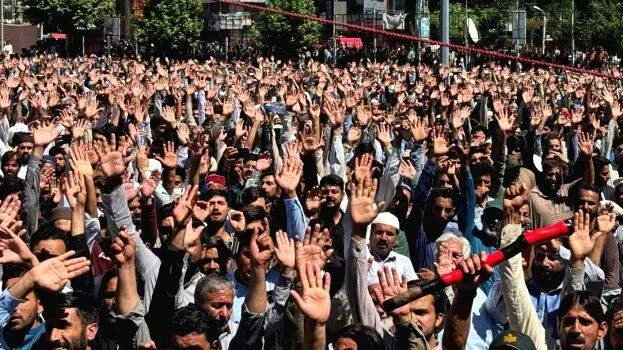
When the cameras finally turned on Pakistan-occupied Kashmir (PoK), Islamabad didn’t answer the questions; it switched off the questioner. A week on, the cover-up has only grown bigger, and it confirms everything India has said about Pakistan’s “Azad” Kashmir for decades.
It has become a familiar reflex for Pakistan’s establishment: when the truth becomes inconvenient, kill the messenger. This time, the messenger was Al Jazeera, and the story it wouldn’t stop telling was the one unfolding in PoK.
On the morning of August 3, 2026, users across Pakistan found Al Jazeera’s English website simply refusing to load. There was no notice, no order, no explanation, just the quiet, deliberate silence of a state that has perfected the art of censorship without confession. The timing revealed everything. A day earlier, Al Jazeera had aired a series of hard-hitting reports from Muzaffarabad, the administrative seat of PoK, documenting protests, allegations of a rigged vote, and a security crackdown that had left the region on edge. By Monday, the network had vanished from Pakistani screens.
A Crackdown Dressed Up as an Election
The protests Al Jazeera was reporting on did not begin in August. They trace back to June 5, 2026, when Pakistani authorities banned the Joint Awami Action Committee (JAAC), the civil society coalition that has been leading demands for electoral transparency, administrative autonomy, and justice for civilians killed in clashes with security forces. Since then, according to India’s Ministry of External Affairs, at least 90 civilians have been killed in the crackdown. MEA spokesperson Randhir Jaiswal did not mince words, calling the subsequent PoK local elections a “farce” and stating that Pakistan had met public discontent with “bullets, blackouts, intimidation and repression” before attempting to “manufacture legitimacy through a hollow electoral exercise.” New Delhi has urged the international community to hold Islamabad accountable.
This is the context Pakistan didn’t want the world to watch, and Al Jazeera’s cameras were among the few pointed at it.
Deny, Deflect & Delete
Pakistan’s response followed a script it has used for years. No government body, neither the Pakistan Telecommunication Authority nor the media regulator PEMRA, has officially admitted to ordering the block. Instead, Pakistan’s Ministry of Information and Broadcasting went on the offensive, accusing Al Jazeera of “selective reporting from handpicked polling stations,” using “carefully chosen timings and scripted statements” to supposedly “misrepresent” the vote, and dismissing the coverage outright as “yellow journalism.” It is a familiar tactic: attack the reporting instead of answering for what it exposed.
And Al Jazeera was not alone. According to reports, Pakistan simultaneously moved against several local and regional news domains, including outlets tied to jailed former prime minister Imran Khan’s party, while continuing to fly hand-picked local and foreign journalists on curated “junkets” to selected sites in PoK. The visits were engineered to project the calm and normalcy that the region’s own residents say do not exist. Controlled access for the compliant, and a blackout for the critical. Islamabad’s media strategy in a single sentence.
A Region Where Journalists Simply Disappear
The website block was only the visible tip of the iceberg. The Committee to Protect Journalists (CPJ) says it is tracking a much wider collapse of press freedom around the PoK protests: internet blackouts, telecom shutdowns, and journalists who have vanished. CPJ has named Razi Tahir and Muhammad Saif, reportedly picked up by men in police uniform from an Islamabad office on August 1 and unaccounted for since, and Syed Farhad Ali Shah, who CPJ says has been on hunger strike after more than a month in detention without charge.
Islamabad then doubled down. This week, it unveiled a new “Foreign Media Facilitation” framework empowering authorities to suspend or revoke the accreditation of any foreign journalist or outlet deemed to threaten Pakistan’s “ideology, sovereignty, security or public order,” wording broad enough to criminalise almost any critical dispatch. CPJ’s Pakistan representative, Waliullah Rahmani, called it “yet another appalling blow to press freedom in Pakistan.” Amnesty International has separately condemned the wider crackdown.
Hypocrisy Islamabad Can’t Outrun
For a state that has spent decades lobbying global forums over Jammu and Kashmir, the contradiction is glaring: Pakistan cannot tolerate a single Qatari news crew documenting what its own occupation actually looks like. New Delhi has long maintained that all of Jammu and Kashmir and Ladakh are India’s integral territory, and that PoK remains under Pakistan’s “illegal and forcible occupation.” This week’s blackout, together with the disappearance of journalists, did more to prove that point than any Indian statement could.
As things stand, the block remains in force, the disappeared journalists remain unaccounted for, and Islamabad still owes the world an explanation that it clearly has no intention of giving.


