

Nitish Kumar
A cutting-edge F-35B stealth fighter jet from the British Royal Navy recently entered Indian airspace, sparking intense speculation: Was it a genuine emergency or a calculated strategic manoeuvre?
The incident occurred just days after India and the United Kingdom concluded the PASSEX naval exercise, an operation aimed at deepening maritime cooperation in the Indian Ocean. But was the jet’s unexpected appearance merely coincidental—or a deliberate test of India’s defence capabilities?
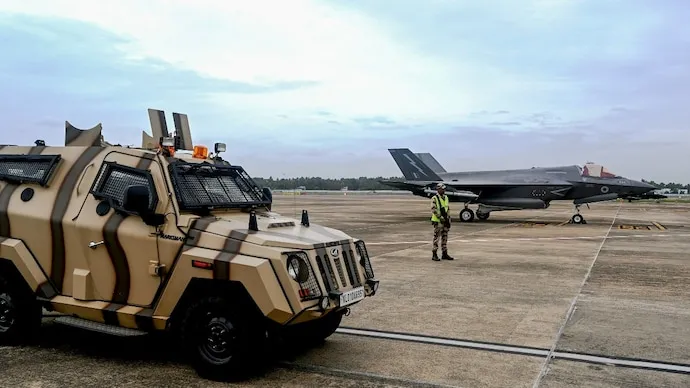
Emergency Landing or Covert Probe?: On the night of June 14, India’s Integrated Air Command and Control System (IACCS)—a comprehensive network that links radars, satellites, AWACS, and other sensors—detected an unidentified aircraft approaching from the sea. It was soon identified as an F-35B Lightning II stealth fighter.
Responding promptly, the Indian Air Force (IAF) scrambled a Su-30MKI fighter jet to intercept the aircraft.
The F-35B pilot, identified only by the call sign “Mike,” contacted Indian authorities on the international emergency frequency, citing “critically low fuel” and requesting permission for an emergency landing. The IAF granted immediate clearance, and the aircraft safely landed at Trivandrum International Airport in Kerala.
But what followed raised more questions than answers.
India’s Response and the Bigger Picture: Despite the F-35B’s state-of-the-art stealth features, India’s IACCS tracked and intercepted the aircraft without delay. This achievement drew widespread attention, with some suggesting it served as a subtle demonstration of India’s growing air defence and surveillance capabilities.
Analysts point to possible explanations: The F-35B might have been equipped with a Luneburg lens (a radar reflector used during peacetime operations) or had an active transponder, both of which would have made it detectable. Yet others suspect a more deliberate motive—suggesting the flight was a covert test of India’s radar systems, potentially without formal diplomatic notification.
Reportedly, as the aircraft entered Indian airspace, Indian radars immediately locked onto it. According to unnamed defense sources, this left the pilot with little choice but to declare an emergency. Since then, the jet has remained grounded in Trivandrum for over 10 days, despite several unsuccessful repair efforts by foreign engineering teams, including specialists flown in from Singapore.
Coincidence or Covert Surveillance?: Several critical questions remain unanswered:
- Was this truly a case of low-fuel miscalculation?
- Why was Indian southern airspace—notably less fortified than the western front—specifically involved?
- Why was a safer or shorter alternate route not chosen?
- Was the jet’s mission related to mapping India’s military infrastructure?
Some defence experts believe this was a strategic reconnaissance mission, possibly designed to test India’s southern airspace response—a region that has traditionally received less military focus than areas bordering Pakistan or China.
India is currently negotiating with Russia to acquire long-range radar systems like the Voronezh (range: 8,000 km) and Container-S (range: 3,000 km), with proposed deployment in Chitradurga, Karnataka. The F-35B incident may now serve to accelerate those talks.
More Than a Landing: A Reconnaissance Operation in Disguise?: According to leaked intelligence sources, the F-35B was allegedly outfitted with:
- Three thermal imaging cameras
- Radar jammers
- Sonar systems
- Submarine-tracking technology
It is believed the aircraft mapped and recorded thermal signatures of key Indian military sites, including IAF bases, DRDO testing facilities, and nuclear reactor zones. A small black chip, suspected to contain highly sensitive thermal and radar data, was reportedly recovered during inspection.
If verified, these details suggest the event was far from a routine emergency—potentially amounting to an intelligence-gathering operation, possibly orchestrated by the UK and its allies. Some reports even indicate the British pilot initially resisted surrendering control of the aircraft to Indian authorities, adding further intrigue to the incident.
India’s Technological Gains and the AMCA Advantage: Indian defense scientists are now conducting a complete teardown and technical analysis of the grounded F-35B. The insights gained could offer significant advancements for India’s indigenous Advanced Medium Combat Aircraft (AMCA) programme—potentially accelerating its stealth capabilities by several years.
This unexpected opportunity has also cast light on India’s need to bolster air defence infrastructure across its southern belt—particularly in Kochi, Trivandrum, and Rameswaram—regions previously seen as less strategically sensitive.
A Strategic Wake-Up Call: The extended presence of an F-35B stealth jet on Indian soil—coupled with India’s swift detection and response—sends a clear global message: India is capable of intercepting even the most sophisticated aerial platforms.
Whether the incident was a technical mishap, a calculated provocation, or a covert surveillance mission, one fact stands out—India is no longer a passive observer in the global defence arena. Its enhanced radar coverage, rapid response capability, and maturing aerospace sector are now impossible to ignore.