
Even before US President Donald Trump took over the White House for the second time, he had ensured a ceasefire in the two-year-old Israel-Hamas war. Since, for the incoming president, it was tactical to please both his friend, Israeli Prime Minister Netanyahu, and Hamas went back on the ceasefire as quickly as they had agreed to it. Since then, Trump has been working on adding, sometimes artificially, the closure of various wars and conflicts, however tenuous and temporary that peace may be, to his famous list of seven or eight, to legitimise his claims for a Nobel Peace Prize à la Obama.
Gaza was projected as a potential Riviera for US millionaires, where, if the Gazans were not in the majority, it would be a better fit. Hence, he aligned with Netanyahu’s strategic objectives. However, the ground reality is different. For Palestinians, the land is not an economic project but an emotional connection. Hence, Trump’s deals and doles can only eke out partial results unless there is a credible possibility and genuine effort towards a viable and sovereign Palestinian state.
This is simply not acceptable to Netanyahu and his ultra-right colleagues, who do not believe in conceding even an inch to the Palestinians, let alone a state, nor are they willing to offer any viable accommodation. An adjacent Palestinian state is anathema to the current ruling dispensation. Hence, Trump’s 20-point Gaza Plan listed the Palestinian issue cursorily at the end, primarily to take the Arab world, especially Saudi Arabia, on board.
The first phase of the Trump plan was carried out successfully, despite ceasefire violations and resultant deaths. Almost all dead and living hostages were returned to Israel, with one body remaining buried under rubble, leaving the conclusion of the first phase hanging. In a war where more than 70,000-80,000 people were killed on both sides (including around 71,000 Palestinians) and the terrain of the small Gaza territory was flattened through carpet bombing, one remaining hostage body became the deciding factor—however ridiculous it may sound.
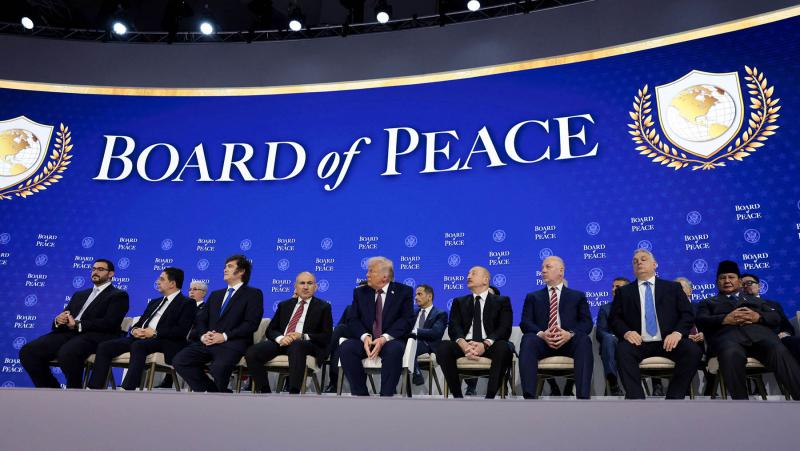
Trump finally put his foot down and moved on to the second phase with the “Board of Peace”, chaired by him personally, announced in Sharm El Sheikh, Egypt with Turkish, Egyptian and Qatari heads of state present as signatories. Netanyahu, though personally invited by Trump, could not join due to a walkout threat by President Erdogan if “Bibi” attended.
An executive board will work under the Board of Peace and above the Palestinian technocratic government. Former UN envoy Nickolay Mladenov will serve as the Board of Peace’s “High Representative” for Gaza, effectively its CEO. Each member of the Executive Board will be responsible for a defined portfolio critical to stabilising Gaza, including governance capacity-building, regional relations, reconstruction, investment attraction, large-scale funding, and capital mobilisation, the White House said.
The plan was broadly conceived by former British Prime Minister Tony Blair, whose credentials following the Iraq war remain highly contested. Trump has sent invites to nearly sixty countries to join the venture, including all major Gulf countries, most of which have accepted. The Pope, as well as Indian Prime Minister Narendra Modi, were also invited. Many have joined or agreed to join, while some have declined.
In his corporate style, Trump also made it a paid subscription of $1 billion, with members serving at the pleasure of the Chairman, whose mood may swing the very next morning. Therefore, many invitees are still mulling over the decision.
The main objection to this Trumpian model is that it directly undermines the United Nations. Trump himself has remarked that he had to “do the job of the UN”. The Slovenian Prime Minister Robert Golob aptly put it: “This interferes very dangerously with the broader international order.”
Former UN Middle East envoy Nickolay Mladenov was appointed as the Board’s representative in Gaza during the second phase of the plan, which includes reconstruction and demilitarisation, with the Board authorised by a UN Security Council resolution until the end of 2027. So far, Saudi Arabia, Qatar, the UAE, Bahrain, Egypt, Argentina, Azerbaijan, Indonesia, Pakistan, Italy, and the UK have agreed to join.
While China discarded the invitation, Russian President Vladimir Putin strategically accepted, pledging $1 billion and potentially more, including funds for Board fees and Gaza reconstruction sourced from frozen Russian assets in the US and Europe. The EU does not appear to be on board. Canada and New Zealand have also declined. Israel, in any case, has rejected the idea, citing a lack of consultation and objections to the participation of several countries, including Türkiye and Qatar, which are preferred by President Trump. The proposed Board is meant to oversee post-war stabilisation and reconstruction, but Israel fears such inclusions could undermine security and legitimise hostile actors.
The composition of the International Stabilisation Force (ISF), along with its mandate and remit, especially regarding the disarmament of Hamas, remains fraught with uncertainty and a lack of clarity on roles, responsibilities and red lines for participating countries. Meanwhile, US General Jasper Jeffers has been appointed commander of the ISF in Gaza.
PM Modi has also received an invitation. While an assessment and SWOT analysis are underway, joining the Board of Peace may not be the most optimal option, even as India continues to propagate dialogue, diplomacy, peace, an end to wars and the establishment of a Palestinian state. However, given India’s commitment to the Palestinian cause, adherence to multilateralism and multipolarity, strategic partnerships with Israel and the US, and the imperative of peace in West Asia, New Delhi cannot afford to remain disengaged.
That said, the remit and intent of an overarching Board of Peace may conflict across the global spectrum, pushing participants into uncharted territory. Since India has been providing humanitarian assistance all along, it may be useful for New Delhi to adopt the medical or health vertical in Gaza, in cooperation with the new Gaza Authority led by Mladenov and the Palestinian Technical Committee.
Meanwhile, India hosted foreign ministers and senior officials from Arab League countries from January 30-31. Apart from reiterating India’s support for Palestine during Prime Minister Modi’s interaction with delegates, the Delhi Declaration clearly welcomed the formation of the Palestinian Technical Committee to temporarily administer Gaza in accordance with UNSC Resolution 2803. It also acknowledged the role played by Qatar, Egypt, and the US in bringing about the ceasefire, while reiterating support for a two-state solution in line with the Arab Peace Plan and various UN resolutions.
Modi also felicitated President Trump for bringing about the Gaza ceasefire and outlining a roadmap to stabilise the situation. Ultimately, it is better to be on the right side of history and principles than personalities. Peace in the region is a prerequisite, and the resolution of fundamental issues, such as Palestine is a non-negotiable imperative. Any effort, including President Trump’s Gaza Peace Plan, deserves to be welcomed. One can only hope it achieves objectives that contribute meaningfully to peace, conflict resolution, and regional stability.
(The author is a former Indian Ambassador to Jordan, Libya, and Malta, and is currently a Distinguished Fellow at the Vivekananda International Foundation and the United Services Institution of India)