






In February 2025, a mob descended on Dhanmondi 32 in Dhaka, the historic home of Bangladesh’s founding father, Sheikh Mujibur Rahman. They came with hammers, crowbars and an excavator. By nightfall, they had torched the building and raised Hamas flags over the wreckage. For most Americans, that scene registered as distant unrest. It should register as a warning. Bangladesh, a Muslim-majority nation of 170 million people positioned between India and Southeast Asia, is deep inside an Islamist resurgence with real consequences for the United States. The organisational network behind it already operates on American soil, in its cities and under its nose.
What Collapsed When Hasina Left
For over a decade, Sheikh Hasina’s government was the firewall against Islamist extremism in Bangladesh. Her administration executed Jama’atul Mujahideen Bangladesh (JMB) leaders, created dedicated counterterrorism units, prosecuted Jamaat-e-Islami war criminals and kept the country’s most dangerous actors behind bars. When she was ousted on August 5, 2024, that firewall collapsed overnight.
Mass prison breaks followed immediately. Over 700 convicted criminals escaped, among them more than 70 known militants who walked out with weapons looted from prison guards. The interim government then released 174 individuals with militant links on bail. The single worst case was Jashimuddin Rahmani, head of the al-Qaeda-linked Ansarullah Bangla Team (ABT), who had been convicted for the 2013 murder of a secular blogger. Within weeks of his release, Rahmani was making open threats against India and calling for separatist violence across the subcontinent. By December 2024, eight ABT-linked militants had been apprehended across Indian states. The contagion was already crossing borders.
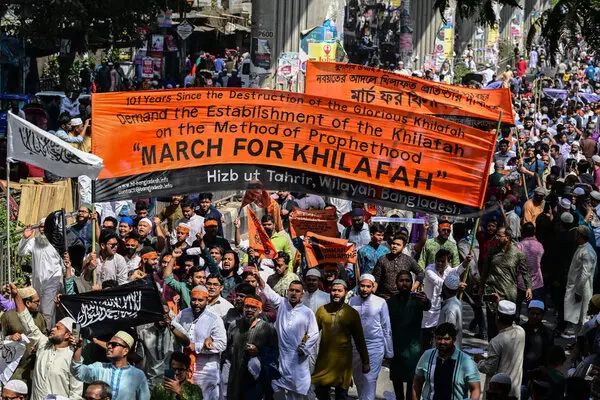
Hizb ut-Tahrir Bangladesh (HuT-B), banned since 2009, re-emerged and demanded that the interim government lift its ban. The interim administration responded by appointing Nasimul Gani, an alleged HuT-B founding member, as home secretary. Think about what that means: the man put in charge of national security had alleged founding ties to a banned Islamist organisation that seeks to abolish the nation-state and replace it with a global caliphate. In March 2025, Hizb ut-Tahrir staged a “March to Khilafat” near Dhaka’s main mosque. College students marched through the capital carrying ISIS flags and demanding a caliphate. The New York Times documented what ground-level observers had been watching for months: open, organised Islamist street power in a country that had once been a reliable Western counterterrorism partner.
From Dhaka to Kabul to Kuala Lumpur
Bangladesh is now producing foreign fighters through a route that the country’s intelligence agencies should recognise. Young men leave for Dubai or Saudi Arabia as labour migrants, exploit the cover provided by Bangladesh’s vast overseas worker population, then move onward to Afghanistan to join Tehrik-e-Taliban Pakistan (TTP). In April 2025, a Bangladeshi national was killed alongside 54 TTP militants in a Pakistani military operation. A separate killing of a TTP-linked Bangladeshi was confirmed in September 2024 during operations in Pakistan’s Khyber Pakhtunkhwa province. In July 2025, two men were arrested in Bangladesh for TTP links, one of whom had been released on bail just months earlier despite multiple prior terrorism charges. His confession identified a key recruiter actively preparing 25 more young men to travel via Saudi Arabia to TTP operations in Pakistan.
In June 2025, Malaysian authorities arrested 36 Bangladeshi nationals in Selangor and Johor for ISIS-linked activity. These men were not passive sympathisers. They were running active recruitment cells, fundraising through international wire transfers and e-wallets, and directing money to ISIS in Syria. Researchers at Singapore’s RSIS have documented this same pattern across Singapore, Malaysia and the Gulf dating back to 2015. Bangladesh sends hundreds of thousands of workers abroad every year. The same migration networks that carried those 36 men to Malaysia connect directly to Bangladeshi-American communities in New York, New Jersey and Michigan. Malaysia is where these cells were caught this time. America is a logical next stop, and Washington should not wait until it happens to start paying attention.
Jamaat’s Network Already Exists in America
The external threat becomes more urgent when we look at what is already operating inside America. Jamaat-e-Islami, the Islamist movement at the centre of Bangladesh’s extremist revival, has a long-established American presence through the Islamic Circle of North America (ICNA), based in Jamaica, Queens, New York. A 2018 congressional hearing described ICNA as having been “hatched” by Jamaat-e-Islami. One of ICNA’s founding figures, Ashrafuzzaman Khan, was convicted in absentia by a Bangladeshi war crimes tribunal as commander of the Al-Badr killing squad that murdered Bengali intellectuals in 1971. Khan ran ICNA’s Queens chapter for years while living freely in New York under that conviction. In 2016, ICNA honoured the Al-Badr killing squad’s founder posthumously for “Outstanding Contribution” to Islam.
A bipartisan 2019 congressional resolution called on the State Department, DHS and USAID to cut all partnerships with ICNA, ICNA Relief and its overseas charity, Helping Hand for Relief and Development, citing Jamaat ties and connections to designated terrorist groups. Congressional letters requested an investigation into ICNA’s potential terror-finance links to Lashkar-e-Taiba, the group behind the 2008 Mumbai attacks. Jamaat itself has held “Go America Go” rallies featuring chants of “Death to American soldiers” and burned effigies of American presidents. Jamaat’s ban in Bangladesh was lifted by the Supreme Court in June 2025, and the party won over 70 parliamentary seats in the 2026 elections. Its American organisational network never disappeared during the years it was banned back home. It remains intact and active inside the United States today.
A Government in Denial
The U.S. government itself has taken notice. The State Department’s 2024 Bangladesh terrorism report confirms that ISIS and al-Qaeda are actively stockpiling weapons and planning attacks inside Bangladesh. The House Homeland Security Committee has separately warned about the resurgence of foreign jihadist networks and the growing exploitation of digital platforms for radicalisation and recruitment. Bangladesh is a live example of both, unfolding in real time. Bangladesh itself has been on nationwide security alert over intelligence regarding planned militant strikes on parliament, security installations and public spaces. Yet the home adviser has publicly denied that militants even exist in the country. Political leaders remain divided on whether extremism is real. A government that refuses to name a threat will never contain one.
Meanwhile, Jama-atul Ansar Fil Hindal Sharqiya (JAFHS), a coalition of Bangladesh’s three most dangerous militant groups formed in 2019, is operating with senior leaders now free on bail. Its stated goals include establishing an Islamic caliphate in Bangladesh, waging war against non-Muslims in neighbouring countries and ultimately conquering South Asia. Its senior founders are the same figures plugged into the TTP pipeline described above. This is not a domestic insurgency with local aims. It is a regional jihadist project carrying the same ideological DNA as the groups America has spent more than two decades fighting.
Without Hasina’s institutional framework, convicted terrorists are walking free; caliphate marchers dominate the streets; Hamas flags fly over a national monument; a Jamaat-linked organisation runs operations from Queens while its parent movement burns American effigies in Karachi; and Bangladeshi ISIS cells in Malaysia are wiring money to Syria. Washington needs serious counterterrorism engagement with Dhaka now: intelligence cooperation, pressure against militant bail releases and a hard look at what Jamaat-affiliated organisations are doing on American soil. The window for prevention is still open. It will not remain open indefinitely.
(Abu Obaidha Arin is a Bangladeshi writer focused on politics, governance, and the societal impact of digital systems)


