


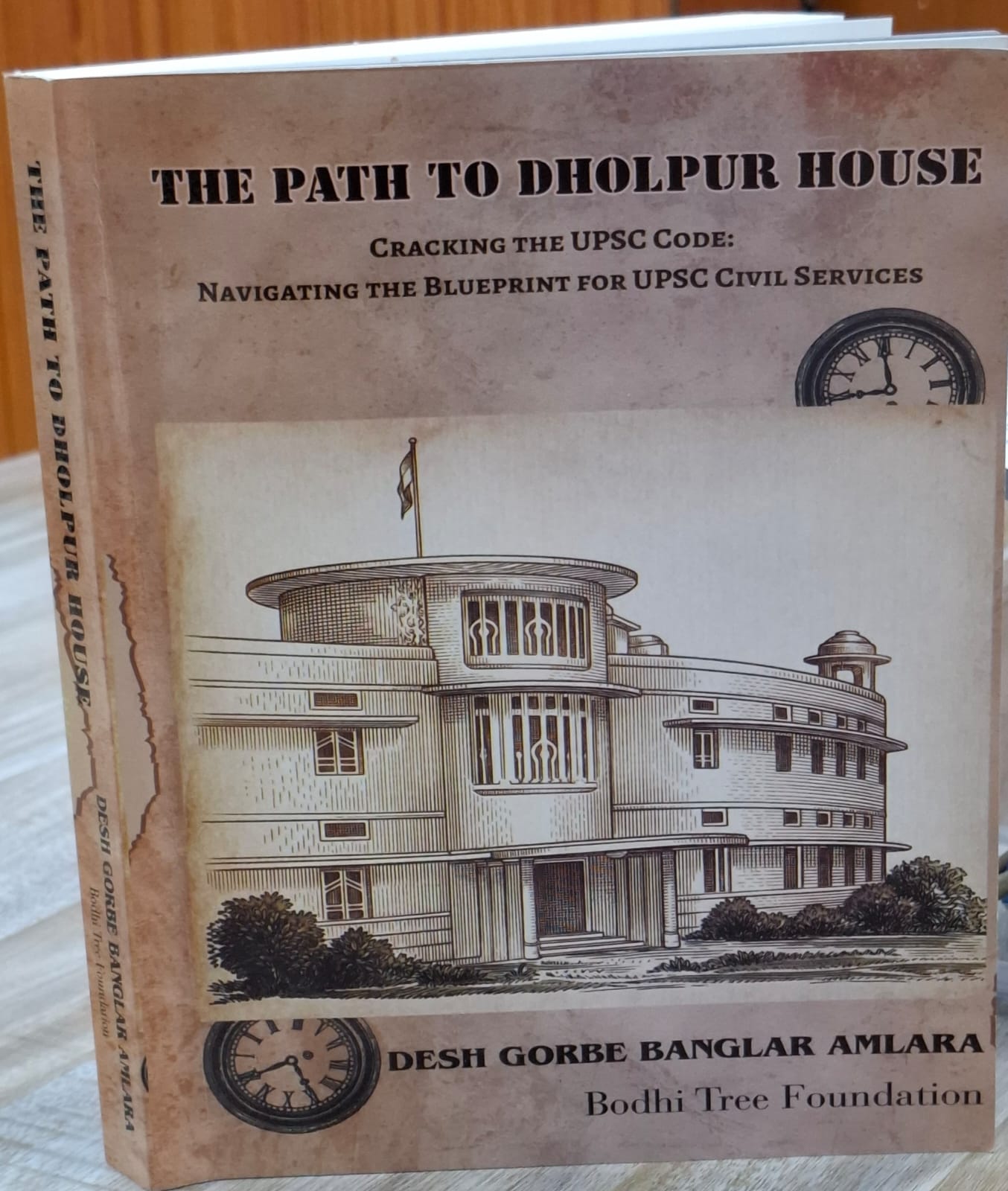
ABOUT THE BOOK
The book, titled The Path to Dholpur House: Cracking the UPSC Code, is a welcome addition to the rich and diverse body of literature on preparation for the UPSC and State Civil Services examinations. It offers comprehensive coverage across disciplines, ranging from History, Geography, Ecology, and Economics to Security Studies, Ethics, Polity, and International Relations. Particularly noteworthy are the chapters on the 1857 Uprising and the Deep State, which are detailed, intellectually rigorous, and analytically dense. Overall, the volume presents a well-curated mélange of themes that are directly germane to the evolving demands of Civil Services preparation.
EXCERPTS
Religion, Rebellion, Retribution: Integrating the complex contours of 1857
It is a standard historical question as to what are/were the causes behind a major rebellion, uprising, or revolution? Whether it be the 2010-11 Arab Spring or the 1945-75 Vietnam War or the World Wars or 1917 Russian Revolution or 1949 Chinese Revolution or for that matter the French Revolution of 1789 and 1848, to name a major few, such a question is repeatedly asked and addressed. Generally, the causes could be partitioned – of course not in water tight compartments – but under social, political, economic, military and religious parameters, among other issues. The complex events of 1857 Uprising are no exception whatsoever.
The exploitative tax regime instituted by the English East India Company [EICo], along with their unwelcome intrusions into the Indian societal fabric through the façade of the Western construct of utilitarian philosophy, coupled with the systematic territorial aggrandizement since the mid-18th century (from Clive’s intrigues at Palashi in 1757 to the blitzkrieg at Buxar in 1764 to the siege at Seringapatam in 1799, followed by Dalhousie’s invidious Doctrine of Lapse spitomized by the blatant confiscation of Awadh in 1856), unleashed by the long term military revolution which commenced in Europe since the 16th century, all in different measures unified to give a decisive blow to the sub-continent’s nationhood and political togetherness. The people of the sub-continent, with variable inputs and capabilities – from various strata – coordinated and contributed to a mega-rising in 1857, which in its most tenuous stretches, went into 1858.
Another perennial question that comes up with respect to the 1857 Uprising is whether it was a mere Sepoy Mutiny or the First War of Indian independence or something else? Was it an insurgency concentrated at the local levels in the sub-continent or did it have a national character? There is no gainsaying the fact that imperial historians would always downgrade the 1857 Uprising as a mere Sepoy Mutiny whereas the nationalist historians would uphold the contributions of some well-known leaders like Nana Saheb, Rani Laxmi Bai, Tatiya Tope and Bahadur Saha Zafar, among others. However, the truth is a challenge to decipher.
Fig. From the Alkazi Collection
V.D. Savarkar in his monumental work on1857 had referred to the Uprising as the Indian War of independence. Even Dr Karl Marx and later to be the Prime Minister of United Kingdom, Mr Benjamin Disraeli, have painted nationalist colours on the wall of the uprising. Whereas, the subaltern historians have tried to bring out the contributions of the lower ranks of the participants in the Uprising – like the Adivasis, the soldiers, the civilians, and the peasants. This variety of historiography or pattern of historical writing which developed in India since the early 1980s owe its origin to the line of thought shaped by Edward Said’s magnum opus Orientalism. The basic idea is to develop a post-colonial historical discourse, thereby breaking the shackles of imperial hegemony of thought ingrained in our psyche; search and re-search the archives, deconstruct ‘established’ narratives, and put forth a history from the perspective of the people who have hitherto remained unheard.
Now to understand and better appreciate the issue, we need to ask another question: Was there any other event in India’s freedom movement which was as amplified in scale and as deep in intensity as the 1857 Uprising? Even the 1942 Quit India Movement could not achieve liberation to the extent that 1857 did. The British were forced out of Delhi, Meerut, Lucknow and many other places of North India for a considerable period of time, for about four to six months. Entire North India and parts of central India revolted against the oppression of the Company Raj in 1857. Well yes, one might counter-argue that the southern part of Indian sub-continent was not affected by the Uprising, but it would be good to remember that the soldiers at Vellore were up in arms in 1806 against the same Company Raj. Moreover, where in any world revolution or movement did the entire geographic landscape burst out in unison? Even the French revolution of 1789 through 1795 was mostly concentrated in major cities and some parts of the countryside with Paris being the epicenter. Furthermore, it may be worthwhile to remember that the combined geographical areas of today’s Uttar Pradesh and Madhya Pradesh (that is North and Central India of 1857) is almost same as the entire area of today’s France.
Continuing with this argument, in the 1917 Russian Revolution, workers and soldiers in Petrograd came out in the open and that triggered the downfall of the Russian Czar. Without the soldiers uniting with the common people, no revolution or uprising can be successful. Similar events unfolded during the French revolution also. The royal guards fought on the side of the civilians in order to capture the Bastille Fort on 14th July 1789. Moreover, there was a culture of forming city-militias in France during that era, which contributed to the successful militarization of the conflict. We can imagine in fine what would have been the repercussions if north and central India had possessed such village and town militias in 1857 !
The 1857 Uprising in India came very close in achieving exactly what happened during the French as well as in the Russian Revolution in so far as the violent overthrow of the oppressive ruling regime was concerned. From this perspective, if 1857 was not the First War of Indian independence, then what was? The next question that comes up in this context is where did the movement actually begin? Was it at Barrackpore or Dum Dum in Kolkata, or was it at Raniganj in today’s West Bengal or for that matter was it at Meerut in today’s Uttar Pradesh or in Delhi, the Indian capital?
Attitude at workplace: the game changer
Introduction
Attitude is simply not part of the syllabus of the UPSC Civil Services Mains examination, but it is more than that, in manifold ways. Whether it is for the entrance examinations or in the training period during probation or way after that, in the entire lifespan of a bureaucrat, ‘attitude’ is what that shapes and defines a Civil Servant. Whether while on the ground zero how one manages the evolving situations or while interacting with different stakeholders, ‘attitude’ is what separates the mature bureaucrat from the abecedarian. In that overall context, treat this chapter to be a fusion of being didactic as well as sharing of experiences.
Fig. Japanese Meiji monarchy (left) and the Emperor of France Louis XVI about to be guillotined (right)
Historically, individuals or groups who responded to change in conditions, shun their ego, changed their ‘attitudes’ and adapted, have succeeded. Those who resisted inevitable change, either perished into oblivion or had to finally yield to the ambient demands. For instance, pushed by the gunboat diplomacy unleashed by the American Commodore Perry, Japanese Meiji monarchy of 1867 adjusted and acclimatized itself to the changing demands of its time. Accordingly, it not just prolonged its existence, it catapulted to a different league whatsoever and dominated the Asian political order till their final submission after the atomic bombs were dropped at Hiroshima and Nagasaki in 1945. Even that was due to a technological gap that the Japanese could not fathom, let alone bridge.
Whereas the French Bourbon monarchy of 1789 vintage failed to move ahead, failed to grasp the demands of the French citizens of a Constitutional Monarchy followed by Republicanism, and therefore faced the guillotine and passed into anachronism.
The Lodis in 1526 as they confronted Babur at Panipat apparently had no attitudinal issues. However, their long drawn approach of neglect in developing a robust defence ecosystem with artillery at the forefront was their eventual undoing. Babur came down from Central Asia with his knowledge of just not the gunpowder, which the Indians in the doab region too had, but also the contemporary Turkish (Ottoman) modes of warfare. Ibrahim Lodi and his soldiers lacked it considerably – an attitude of complacency and conceitedness is sure to blame.
A bigger example is that of the First World War. The ego-inflated commanders of both the warring sides were inflexible in using the armoured vehicles aka Tanks so as to ‘change the game’ of trench warfare – in order to break the stalemate in the war. Direct hand to hand combat with the charge of bayonets was what the commanders were still in an inertia to unleash upon each other. This trait perhaps was a continuance of indulgence in the exaltation of the medieval knights and not accepting the coming of the infantrymen with small arms in the 16th century. That again was an issue of ‘attitude’.
As if a déjà vu, Indian princes of the 18th century (similar to that in early 16th century) failed to rise up to the military technology developed by the Europeans, especially in the field of artillery – and that was the writing on the wall – which though some of them understood, and wished to reform and manage, yet were too late on the day. A centuries old inward looking attitude of development in defence, and overall science and technology for that matter, magnified itself into the doppleganger of Panipat in the 18th and 19th centuries.
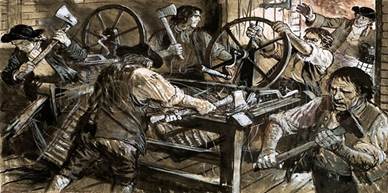
Fig. Representative image of the Luddites
In 19th century Europe, Luddites were breaking machines, as if to stall the inexorable march of the industrial revolution; there actions were of course, in vain. And in the 1980s, certain trade unions took out long processions against the use of computers. What happened? By 2025, we have not only had computer and its several variants, but also smartphones and now Artificial Intelligence (AI) and Robotics to understand, let alone deal with.
Now, in a much more focused sense, if organizational culture changes or the hierarchy changes, then what is to be done? Fundamentally, we need to appreciate and understand the conditions, re-skill or upskill ourselves, be mentally prepared for all eventualities, focus on the job at hand and execute the duties with dedication, gather knowledge on the work we do and also try to expand our horizon of competence, and finally achieve expertise in at least one domain. It is noteworthy that experts are always valued, even in an era of AI.
It is advisable that one needs to learn, then execute, thereafter obtain feedback on the job executed and incorporate the critical feedback in re-learning. And the cycle goes on. You, I, us all, need a POSTIVE ATTITUDE and APPROACH to life. This is imperative to not only qualify an examination or to be become a successful bureaucrat but basically to grow in life. To achieve that, you need to Believe in yourself, as Belief can do wonders. In this context, a question that crops up is “Can the system help?”. Here, by the term ‘system’, we mean the hierarchy of the government and its associated rules and regulations. Well, the answer is to the affirmative. The Conduct rules, Vigilance set up should be seen as structures aiding our Attitudinal approaches. They are by no means obligations or hegemonic, but systems which shape the trajectories of employee attitudes. We can very well term them ‘structures of discipline’ without however ascribing any pejorative connotation to it. If our Attitudes falter from the tenets of Integrity, then Conduct Rules are violated, which in turn might invoke Vigilance Angle. Hence, the ‘structures of discipline’ are very much warranted so as to set up the attitudinal trajectory of a Civil Servant.
Definition of Attitude
Attitude refers to a person’s overall mindset or perspective towards an issue. It is a mental and emotional state that influences how individuals respond to and interact with their environment, other people, and various situations.
“Follow me, we will cross the bridge”: when Napoleon uttered these encouraging words to his crew, he merely did not speak, but literally showed them how to do it. So, he was leading as an example, which in turn infused confidence in his soldiers, who gradually became his followers. Such an act of Napoleon slowly made him the hero and once replicated a few more times, turned him into a legend. And if we need an example from the Indian backdrop, then Netaji Subhash Chandra Bose’s famous one-liner: “Give me blood, I will give you freedom”; which howsoever unrealistic might sound in hindsight, still has every potential to boil your blood and stir up your emotions to the highest orders of patriotism.
Some Key aspects of Attitude are:
- Evaluation
- Belief
- Behaviour
- Stability
ABOUT THE AUTHOR(S)
This volume brings together contributions from fifteen serving bureaucrats drawn from the All India Services and the Central Civil Services.
The book has been conceptualised by Dr Uddipan Mukherjee, PhD (TIFR), IOFS (Civil Services 2006-07), who has authored four chapters in the volume. A widely published and cited scholar, Dr Mukherjee’s work spans physics, history, security studies, warfare, and public administration, with recognition at both national and international levels.
The volume is published by Shib Shankar Mukhopadhaya, chairman of the Bodhi Tree Foundation.
