

We often hear that eye contact is the universal bedrock of non-verbal communication, yet true human connection is far more nuanced than simply staring into someone’s eyes. Eye contact is rarely a static beam of attention; it is a dynamic, fluid dance across the features of another person’s face. Where you choose to direct your visual focus in any given moment fundamentally changes how you are perceived and how your message is received. In the realm of soft skills, executive presence, and interpersonal communication, body language experts map these subconscious micro-behaviours into distinct geometric shapes. The two most powerful patterns every communicator should master are the Social Gaze, which forms an upright triangle, and the Power Gaze, which flips that dynamic into an inverted triangle. By gaining conscious control over these visual formations, you unlock the ability to seamlessly bridge the gap between building warm, authentic rapport and projecting unshakeable authority.
The Social Gaze: Building Connection
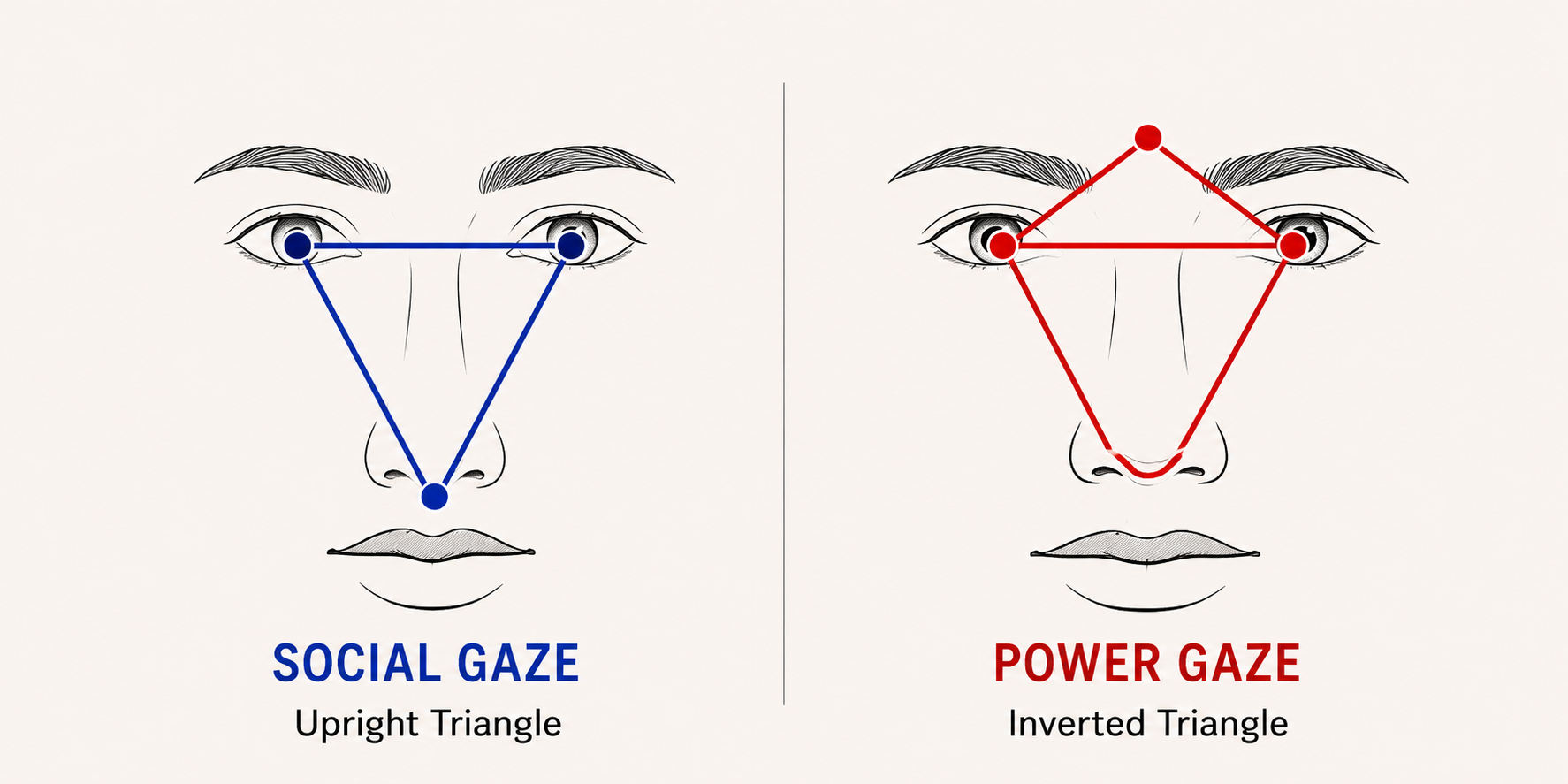
The Social Gaze operates within an upright triangle across the listener’s face. To visualise this pattern, imagine drawing a horizontal baseline connecting the person’s eyes, and then dropping the third focal point down to the bridge of the nose, just above the lips. As you speak or listen, your gaze naturally cycles between their left eye, right eye, and the central, non-intimate focal zone of the mid-to-lower face. Staying safely above the mouth keeps the gaze professional while inviting genuine connection. By intentionally opening your focus to include the central facial features above the lips, you signal accessibility, empathy, and active presence. You tell the other person that you are attuned not just to their words, but to their expressions.
Consider a common workplace scenario: you are enjoying a relaxed coffee chat with a peer, or perhaps mentoring a team member who is navigating a difficult professional hurdle. As they share their experience, your gaze glides naturally from their eyes down to their mouth when they smile or speak. This fluid, upright triangular rhythm lowers defensive walls and generates psychological safety. It conveys warmth and signals that you are an open, approachable partner in the conversation. In any relationship where trust, camaraderie, and emotional alignment are the primary goals, the Social Gaze is your most effective tool.
The Power Gaze: Projecting Authority
In stark contrast, the Power Gaze completely flips this geometry into an inverted triangle. In this formation, the base of the triangle remains anchored across the eyes, but the third focal point moves upward to the centre of the forehead, right between the eyebrows —
the area often referred to as the third eye. By consciously shifting your gaze upward, you entirely bypass the mouth and its emotional signals. This subtle adjustment strips away casual warmth and introduces professional distance, sharp focus, and quiet command. Directing your attention to someone’s forehead creates a subtle, subconscious weight. It asserts control without requiring a single raised voice or aggressive gesture.
Picture a high-stakes corporate environment: an executive addressing a sudden organisational crisis during a board meeting, or a manager establishing firm boundaries during a difficult performance review. When delivering crucial instructions, standing firm on non-negotiable terms, or addressing an objection, the speaker locks their gaze strictly across the eyes and the mid-forehead. Even if their tone remains calm, measured, and conversational, the inverted triangle communicates absolute seriousness and unwavering resolve. It signals that the conversation has moved away from personal sentiment and into the realm of decisive action.
Knowing When to Shift Your Gaze
The true mastery of communication, however, lies in adaptability rather than rigid adherence to a single style. Exceptional leaders and communicators rarely lock themselves into one mode; instead, they shift dynamically between these geometric patterns to guide the emotional temperature of the room. In a complex salary negotiation, for example, a seasoned professional might open with a Social Gaze during initial greetings to establish rapport, mutual respect, and warmth. Yet, the moment they state their strategic value proposition and baseline expectations, they pivot smoothly to the Power Gaze, signalling firm conviction. Once agreement is reached, they transition back to the upright triangle to close the meeting on a collaborative, harmonious note.
What Your Gaze Communicates
Ultimately, eye contact is not about manipulating others, nor is it about asserting dominance for its own sake. The universal message behind the geometry of our gaze is that vision is a powerful instrument of intentionality. Where we look reveals what we value in the moment — whether that is human connection or strategic clarity, deep empathy or decisive authority. By mastering the intentional shift between the Social and Power Gaze, you discover that authentic communication is not merely about the words you speak, but about making others feel precisely what you intend them to feel without uttering a single extra word.