


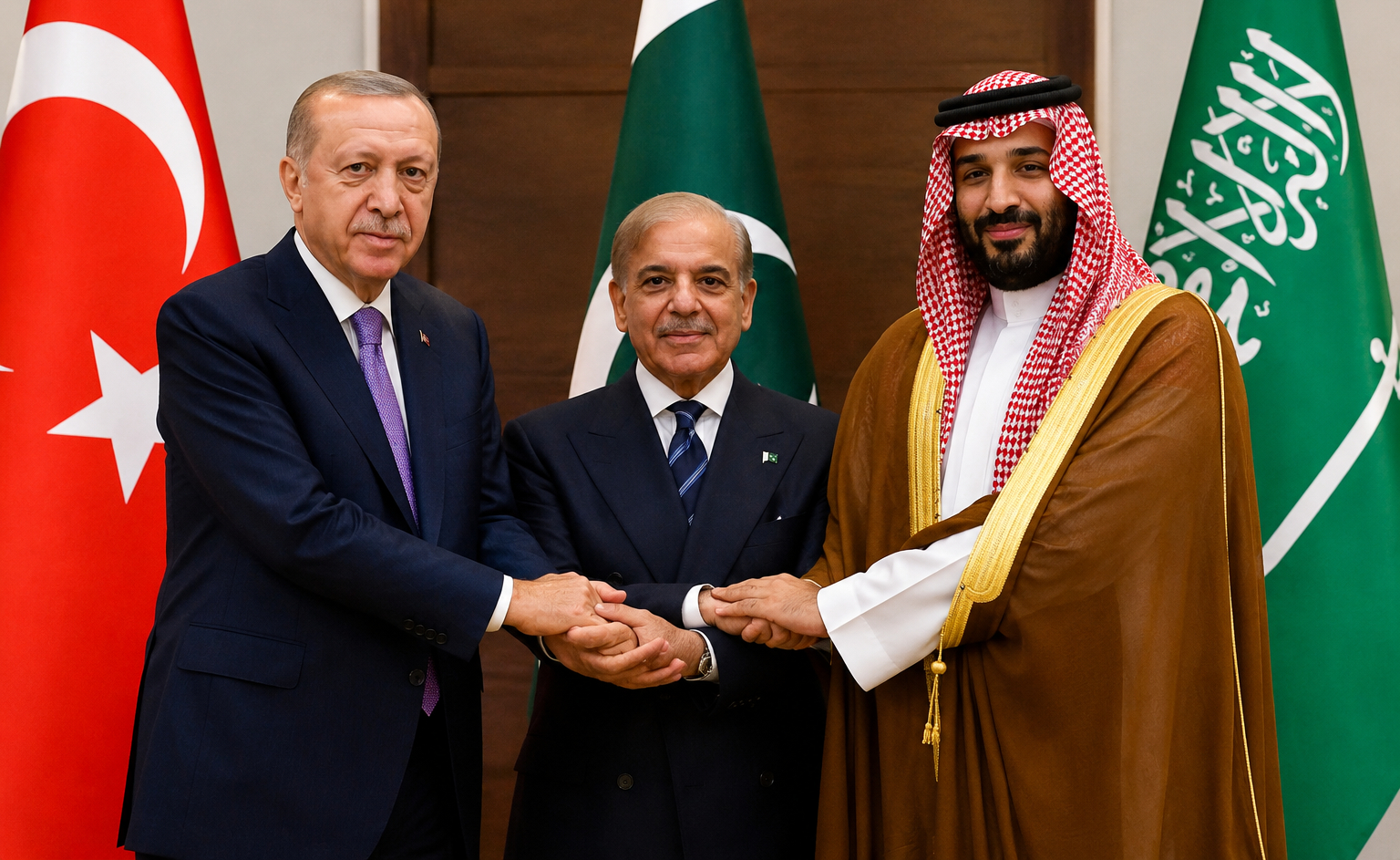
The trilateral defence agreement signed by Saudi Arabia, Pakistan and Türkiye in Mecca on 7 August will be described, almost reflexively, as the birth of a new bloc. An armed attack on one is to be treated as an attack on all three, and the pact joins the three largest military establishments in the Muslim world under a single defensive formula for the first time since the Baghdad Pact of the 1950s. The symbolism of the venue, Islam’s holiest city, only sharpens that reading. New Delhi should resist it, without becoming complacent about what the agreement actually changes.
The Mecca pact is a mutual defence alliance in form. In its content, it is something looser and more revealing: an exercise in regional hedging by three states that do not share a threat matrix and are not prepared to subordinate their foreign policies to one another. Saudi Arabia’s preoccupation is the vulnerability of the Gulf and the reliability of American deterrence after a year of Iranian and Houthi strikes. Pakistan’s strategic horizon still ends at India. Türkiye’s calculations run through the Eastern Mediterranean, Syria and its increasingly competitive relationship with Israel. Their interests overlap; they do not converge. That gap between the collective-defence language and the divergent interests underneath it is the single most important fact for Indian planners, because it tells us what the pact can and cannot become.
Why the Bloc Reading Falls Short
Collective-defence clauses are cheap to write and expensive to honour. The attack-on-one formula creates an obligation on paper, but obligations of this kind are only as credible as the willingness of members to be dragged into one another’s quarrels. Would Riyadh accept entrapment in a Turkish confrontation in the Levant? Would Ankara treat an India-Pakistan crisis as its own war? The honest answer, in each case, is that the members retain every incentive to keep the clause declaratory. That is precisely why the pact is better understood as strategic density, each state acquiring additional partners, capabilities and diplomatic channels, than as an integrated command structure.
For India this matters because the correct response to a hedging arrangement is not a counter-alliance. Mirroring the pact’s form, whether through a hurried tie-up with Israel or a defensive minilateral aimed at the three, would concede the bloc framing that the pact does not yet deserve, and would push a fluid situation towards the very hardening India has an interest in avoiding. The Ministry of External Affairs’ measured line, which closely follows developments, is the right register. The subsequent circulation of a fabricated report claiming India had sought a defence pact with Israel is a reminder of how quickly this space fills with manufactured escalation.
What the Pact Means for India
None of this counsels indifference, because India’s exposure to the Gulf is not marginal. It is structural, and larger than that of any of the three signatories to their own arrangement. Roughly nine million Indians live and work in the Gulf, making it the largest source of the country’s remittances. The bulk of India’s crude and a growing share of its gas originate in or transit the region. The UAE and Saudi Arabia sit among India’s most important trading partners, and the India-Middle East-Europe Economic Corridor, the most ambitious connectivity project New Delhi has signed on to in a decade, is anchored in Gulf ports and Gulf capital. A Gulf that securitises and divides into camps is a direct threat to Indian energy security, diaspora welfare, trade and maritime access. India therefore has a first-order interest in a Gulf that stays plural and interdependent rather than one that sorts itself into rival defence blocs. That interest is best served by India remaining the region’s indispensable bridge, the one major power able to speak simultaneously to the Gulf Arabs, Iran, Israel, and Washington. No member of the Mecca pact holds that position. It is India’s comparative advantage, and it is squandered the moment New Delhi picks a side.
Pakistan’s Networked Advantage
For India, the principal threat is not an immediate military one from Saudi Arabia or Türkiye. Neither has any interest in war with India; both have staked a great deal on the relationship.
The threat is quieter and more corrosive. It is the prospect of Pakistan becoming embedded in a wider security network, one that is technologically more capable, financially better supported and geographically more expansive than anything Islamabad could assemble on its own, running from the Eastern Mediterranean to the Arabian Sea. That embedding works on India through three channels.
Türkiye’s defence-industrial base, its drones, loitering munitions, naval platforms, air defence and electronic warfare, is precisely the ecosystem Pakistan has been plugging into for a decade. Folded into a common framework and underwritten by Gulf money, that pipeline deepens and steadies. India’s conventional edge over Pakistan has always rested in part on Islamabad’s difficulty in acquiring and sustaining top-tier capability; a network that closes that gap erodes the margin.
Pakistan’s military weight has long outrun its economy, and its regional reach has been checked by chronic fiscal fragility. Saudi and Gulf capital dissolves that constraint. A Pakistan whose defence effort is insulated from its balance of payments is a Pakistan that can sustain commitments it otherwise could not, and free resources and attention for its eastern front.
An arc anchored in Ankara at one end and the Arabian Sea at the other gives Islamabad diplomatic cover and a platform from which to internationalise its rivalry with India, in precisely the forums where the Gulf states carry weight. This is the strategic depth Pakistan has always sought, now potentially supplied by partners rather than claimed unilaterally. The nuclear dimension only sharpens the picture: Pakistani officials deny these pacts create an umbrella over Saudi Arabia, and there is no basis for assuming an extended deterrent, but perception is its own reality, and the proximity of the only Muslim-majority arsenal to a collective-defence clause lifts Islamabad’s standing regardless of the legal fine print.
Set against this is a sturdier counter-weight than the alarmist reading allows. Riyadh and Abu Dhabi have invested heavily in their relationships with India, from energy and investment to the strategic partnership architecture of the last two years, and neither capital has any interest in seeing those ties captured by Islamabad’s quarrel with New Delhi. The Gulf’s own diversification logic, the same logic that produced the pact, cuts against exclusivity. The network can lift Pakistan, but only as far as its wealthier members are willing to let their India relationships pay the cost, and that ceiling sits lower than Islamabad would like.
The deeper point is that the Gulf is now home to two competing templates for security cooperation. The Mecca pact is a mutual-defence alliance: an attack-on-one commitment whose value is deterrent signalling and whose cost is the risk of entrapment. The India-UAE Strategic Defence Partnership belongs to a different dimension, the strategic-resilience partnership, which builds interoperability, defence-industrial co-production, intelligence exchange and crisis coordination without the binding collective-defence trigger. One trades autonomy for a security guarantee. The other buys capability and reach while preserving freedom of action. For a power that has made strategic autonomy its organising principle, the resilience model is not a weaker version of the alliance model. It is a deliberately superior fit.
India’s task, then, is not to answer the Mecca pact but to scale the template it already possesses. That means deepening the resilience partnership with the UAE, extending its logic to Saudi Arabia, Oman and Qatar, and thickening the minilateral layer, I2U2 and IMEC above all, so that India’s presence in Gulf security is felt through connectivity, co-production and crisis management rather than through a rival treaty. Multi-alignment is not fence-sitting here; it is the same networked logic the pact’s members are practising, run to India’s advantage.
There is a second, more targeted implication. Because the danger is Pakistan’s embedding rather than the pact as such, India’s most useful lever is the self-interest of the network’s wealthier members. The deeper India’s stake in Riyadh and Abu Dhabi, and the more those capitals value what New Delhi offers in trade, investment, technology and energy, the higher the cost to them of letting the network become a conduit for Pakistani capability against India, and the lower the ceiling on how far Islamabad’s embedding can go. India shapes the Pakistan strand not by confronting the pact but by making itself too valuable to its members for them to underwrite the strand fully.
What Comes Next
The real test of the Mecca agreement lies ahead. If it stays declaratory, its legacy is diplomatic signalling. If it matures into joint exercises, integrated air defence, intelligence sharing, and a defence-industrial partnership, it becomes something India must engage with more seriously. Either way, the direction of travel is clear: the Gulf’s security is no longer to be supplied by a single external guarantor, and regional powers are assembling their own overlapping arrangements to fill the space.
India’s interest is in shaping that networked order from inside it, not in standing outside it building a counter-bloc. The pact is not a wall going up across the Gulf. It is one more strand in a thickening web, and India’s advantage has always been that it can hold more strands at once than anyone else in the room.
