


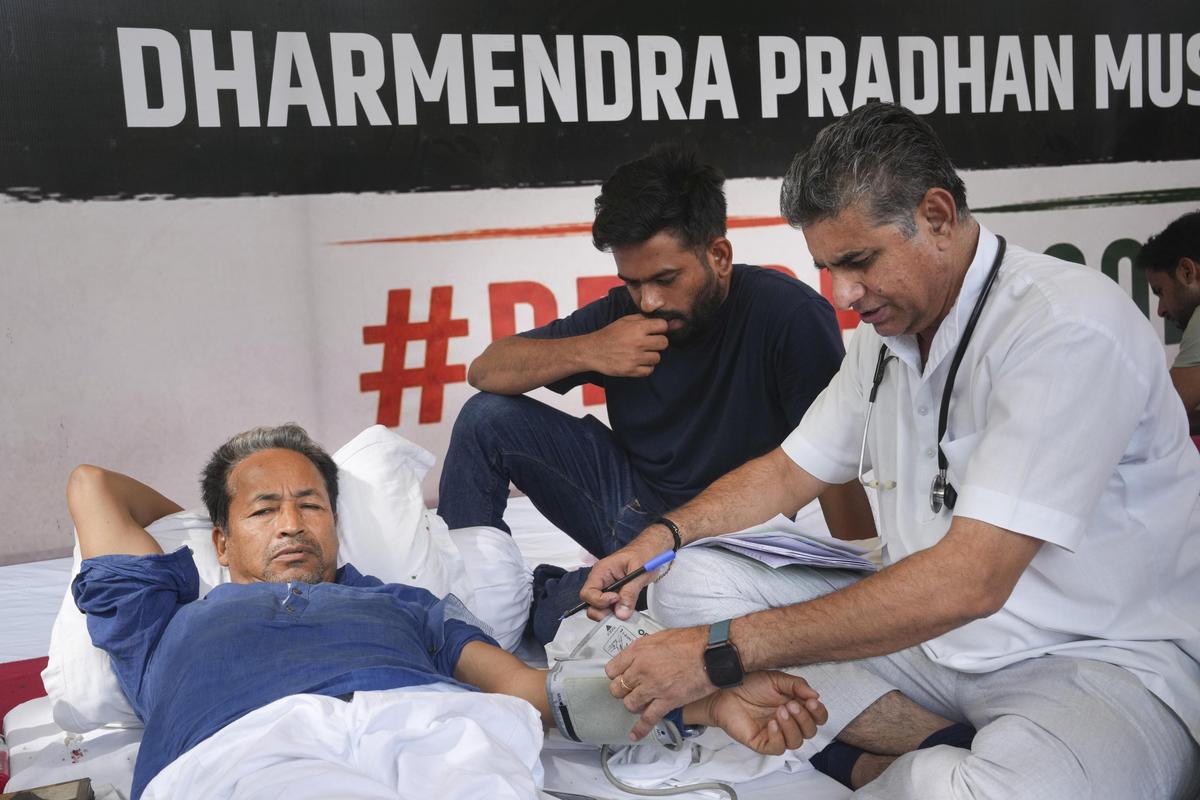
India has long celebrated Sonam Wangchuk as the engineer who transformed frozen streams into artificial glaciers, challenged conventional education and showed that local communities could devise solutions to global problems. Today, that same man is risking his life to force the country to confront a far simpler question: when public institutions fail millions of young people, who is held accountable? His body is growing weaker by the day. The question he has raised is becoming harder to ignore.
A Frail Body, a Troubling Question
At Delhi’s Jantar Mantar, Sonam Wangchuk’s fast has become much more than another protest. With every passing day, it poses an uncomfortable question to the Republic: when examinations affecting the futures of millions are compromised, does anyone in authority accept responsibility?
Wangchuk began his indefinite hunger strike on June 28, 2026, in solidarity with the youth-led Cockroach Janta Party (CJP) movement. The protesters have demanded accountability for alleged paper leaks, evaluation failures and administrative lapses, particularly in connection with the national medical entrance examination. They have also called for the resignation of Union Education Minister Dharmendra Pradhan. Wangchuk has linked these concerns with Ladakh’s continuing demand for constitutional safeguards and stronger protection for its fragile environment.
By July 12, the fifteenth day of the fast, reports indicated that he had lost nearly eight kilograms and that his blood pressure had fallen significantly. Two days earlier, after shedding around 7.5 kilograms, he remarked that his bones had become visible, though he insisted his mind remained energetic.
His resolve is admirable. The medical facts are less reassuring. Prolonged fasting carries the risk of irreversible organ damage, cardiac complications and death. The protest has now reached a point where the race is no longer political. It is between democratic engagement and physical collapse.
An Examination System Losing Public Confidence
For millions of Indian students, an examination is far more than a test of knowledge. It represents years of preparation, family savings, parental sacrifice and, often, the only realistic path to a better life.
When question papers are leaked, examinations are cancelled or candidates are forced to sit again because of administrative failures, the damage extends well beyond logistics. Students lose precious months. Families spend again on travel, accommodation and coaching. Those who prepared honestly are left wondering whether integrity still has any place in a system vulnerable to organised fraud.
The present movement has pointed to a succession of examination controversies and to reports of around 20 student suicides linked to the uncertainty and stress surrounding examinations and retests. The Financial Times reported that as many as 20 students were believed to have died before a medical entrance retest, while an earlier open letter by Cockroach Janta Party founder Abhijeet Dipke referred to 11 recent deaths. Each case deserves careful investigation, and suicide must never be reduced to a political talking point. Even so, the reported scale of the tragedy warrants an independent, transparent and compassionate official inquiry.
For Wangchuk, however, the issue goes well beyond one examination or one minister. His central concern is accountability itself. If millions of students can suffer because public institutions fail, yet no senior official is expected to explain what happened, apologise or accept responsibility, faith in those institutions inevitably begins to erode. Democracy is sustained not merely by elections but by the willingness of those entrusted with authority to answer for their actions.
The Educator Who Refused to Label Children as Failures
Wangchuk’s intervention carries unusual moral authority because education has never been a convenient political cause for him. It has defined his life’s work. A mechanical engineer by training, he co-founded the Students’ Educational and Cultural Movement of Ladakh (SECMOL) in 1988. The organisation began with a deceptively simple proposition: perhaps it was not children who were failing education, but an education system that had failed its children.
For generations, students in Ladakh were expected to learn from textbooks, languages and examples that bore little resemblance to their lives or surroundings. Wangchuk sought to reverse that disconnect. Education, he argued, should grow out of local realities, drawing on the region’s climate, agriculture, water resources, solar energy, architecture and community life.
The same philosophy informed Operation New Hope, a collaborative initiative involving local communities, teachers, civil society and government institutions to improve public schooling across Ladakh. The Ramon Magsaysay Award Foundation later recognised this work for demonstrating how communities could reshape education from the ground up rather than wait for reform to arrive from above.
At the Himalayan Institute of Alternatives, Ladakh (HIAL), Wangchuk distilled this philosophy into what he calls the ‘3Hs’: a bright Head, a compassionate Heart and skilled Hands. Education, in this vision, is not about memorising predetermined answers. It is about understanding real problems, developing the empathy to care about them and acquiring the practical skills to solve them.
From Ice Stupas to the Sixth Schedule
For Wangchuk, the campaign for Ladakh’s constitutional safeguards is not a departure from his earlier work. It is a natural extension of the same philosophy that shaped his schools, his environmental innovations and his public life.
For years, civil society groups in Ladakh have sought statehood, constitutional protection under the Sixth Schedule, safeguards for land and employment, and greater local participation in decisions affecting development. Their concern is that policies governing one of India’s most fragile ecosystems should not be determined without the meaningful involvement of the people who live there.
Wangchuk has consistently argued that the debate is about far more than administrative restructuring. At its heart lies the question of who will shape Ladakh’s future.
The region’s spectacular landscape has become an increasingly valuable economic asset, attracting investment in tourism, infrastructure and commercial activity. While these developments can create jobs and generate income, they also carry risks for an ecosystem already under severe pressure from climate change. Unregulated construction, indiscriminate mining and unchecked commercial expansion could permanently alter a cold desert that has sustained its communities for centuries.
His environmental advocacy has therefore remained inseparable from his educational work. Both are rooted in the belief that development should strengthen local communities rather than weaken them.
That conviction led him to undertake a 21-day climate fast in 2024 and later to join a march towards Delhi highlighting Ladakh’s constitutional and ecological concerns. His activism, however, has also brought him into direct conflict with the authorities.
Following violent protests in Leh in September 2025, in which four civilians were killed, the government accused Wangchuk of making provocative statements that contributed to the unrest. He denied inciting violence, appealed for peace and rejected the allegations against him. On September 26, 2025, he was detained under the National Security Act (NSA) and remained in preventive custody for about 170 days before the Union government revoked the detention in March 2026.
The legal position is important and should be stated with precision. Wangchuk was detained under preventive detention provisions; he was never convicted of treason or any comparable offence. The government maintained that the detention was necessary to preserve public order. Wangchuk’s family and supporters challenged both its necessity and its legality. His release ended the detention but did not amount to a judicial endorsement either of the government’s allegations or of every claim advanced by his supporters.
That distinction deserves emphasis because public debate often blurs the line between accusation, detention and conviction.
The Anna Hazare Parallel, and Its Limits
The image of a fasting activist at Jantar Mantar inevitably evokes memories of Anna Hazare’s anti-corruption movement. In April 2011, Hazare’s fast prompted the UPA government to agree to a joint drafting process for anti-corruption legislation. Later that year, his 12-day hunger strike ended after Parliament accepted, in principle, several key demands relating to the proposed Lokpal.
The comparison with Wangchuk is tempting but should not be overstated. Hazare’s fast did not produce an immediate law. The legislative process continued for more than two years before Parliament finally enacted the Lokpal and Lokayuktas Act in 2013, which came into force in January 2014.
The lesson from that episode is therefore not that a hunger strike automatically compels legislation. Rather, it demonstrates that democratic governments can choose dialogue before a protest reaches a point of irreversible human cost.
Negotiation is not a sign of political weakness. It is an acknowledgement that governments have a duty to engage when a peaceful citizen’s life is visibly at risk. Whatever one thinks of Wangchuk’s demands, allowing the situation to deteriorate without sustained engagement would serve neither the government nor the larger democratic tradition that India has long claimed as one of its greatest strengths.
(Prof Ujjwal K Chowdhury is an academic and a political commentator)
