


By Garima Sarkar & Malaiyandi Sundaram
Tamil Nadu’s 2026 Assembly election might ultimately be remembered as a turning point not only for the state’s internal politics but also for the future of democratic campaigning in India. For more than five decades, the state’s political environment was largely defined by the dominance of the DMK and AIADMK, two parties deeply embedded within Tamil Nadu’s distinctive Dravidian political culture. The emergence of Tamilaga Vettri Kazhagam (TVK) as a major electoral force, therefore, represents far more than a routine change in government. It signals the arrival of a new political era in which technology, data, social media and artificial intelligence have become central actors in the production of political power.
While Tamil Nadu has historically witnessed the transformation of film stars into political leaders, the 2026 election signals that the process of creating political legitimacy now unfolds through digital platforms as much as through cinema screens, public rallies and informal party organisations. In many ways, AI and social media helped generate a new political hero in Tamil Nadu, although the story is more complex than simple technological triumphalism.
From Stardom to Digital Political Capital
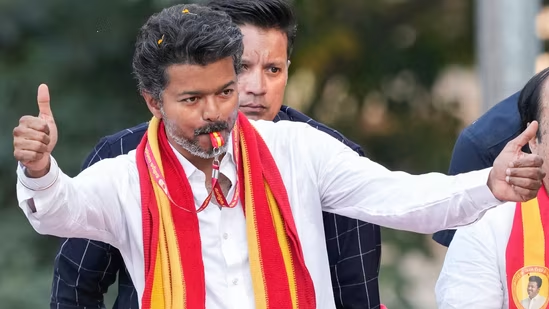
The rise of Vijay was not solely the product of digital technology. Like several successful leaders before him, he entered politics with substantial cultural capital, public recognition and an extensive fan base built over decades in Tamil cinema. Yet what distinguishes his political ascent from earlier cases is the unprecedented environment of political communication in which it occurred.
Tamil Nadu today is among India’s most digitally connected states, with widespread smartphone ownership, deep social media penetration and a population accustomed to consuming political information through digital channels (George, 2026). In such an environment, political visibility is no longer dependent primarily on party cadres, newspaper coverage or television networks. Instead, political visibility is increasingly shaped by algorithms that determine what citizens see, share, discuss and remember**, and** every public speech, campaign appearance and political statement can be instantly transformed into thousands of short videos, memes, posts and discussion threads circulating across multiple social media platforms.
AI-assisted tools further accelerate this process by enabling rapid content creation, translation, personalisation and dissemination of political content. The result is a political environment in which attention itself becomes a critical resource, and digital technologies play an essential role in allocating that public attention.
When Technology Becomes a Democratic Risk
However, the growing role of AI in politics also raises profound democratic concerns. The same technologies that improve campaign efficiency might simultaneously weaken the quality of democratic discourse. Artificial intelligence has dramatically lowered the cost of producing political content while increasing its sophistication.
Deepfakes, synthetic audio recordings, manipulated videos and AI-generated narratives can now be produced quickly and distributed widely. Political misinformation is hardly a new phenomenon, but AI allows it to spread faster, appear more convincing and reach more targeted audiences than ever before.
The danger is not simply that voters might occasionally encounter false information. The deeper problem is that AI contributes to an environment where distinguishing truth from falsehood becomes increasingly difficult. When citizens lose confidence in their ability to identify credible information, trust in democratic institutions begins to erode.
Scholars have warned about the emergence of a “liar’s dividend”, where even authentic evidence can be dismissed as fabricated because the public knows that convincing fake content exists (Citron & Chesney, 2019; Brennan Center for Justice, 2024). In such circumstances, the very foundation of democratic accountability becomes vulnerable.
Why AI Alone Cannot Explain Tamil Nadu
Yet attributing Tamil Nadu’s electoral outcome entirely to AI would be both analytically flawed and politically misleading. Technology can amplify political messages, but it cannot fully explain why citizens choose to support particular leaders.
Tamil Nadu’s political culture remains deeply shaped by historical experiences, linguistic identity, social justice movements, welfare politics and regional aspirations. These factors continue to influence voter behaviour in ways that cannot be reduced to algorithms or digital engagement metrics.
Furthermore, AI and social media tools were not exclusive to any one party. Most major political actors adopted some form of digital strategy during the campaign. If technology alone determined electoral success, the outcome would have been far more predictable. Instead, the election reflected a broader political moment in which many voters appeared willing to consider alternatives to the established political order. Technology might have accelerated this process, but it did not create the underlying political demand for immediate change.
Limits of Digital Hero-Making
This distinction is important because it highlights the continuing relevance of voters’ agency. Discussions about AI often portray citizens as passive recipients of algorithmically curated information, manipulated by technologies beyond their control. Such perspectives underestimate the complexity of democratic decision-making.
Voters interpret political messages through their own experiences, identities, values and expectations. They evaluate leaders not only through social media content but also through everyday realities such as employment opportunities, public services, governance performance and political credibility.
Vijay’s rise, therefore, cannot be attributed solely to technology. It also reflects the ability of a new political actor to connect with an electorate that was searching for alternatives within a changing political environment.
Democracy in the Age of AI: The Tamil Nadu Lesson
The broader significance of Tamil Nadu’s 2026 election lies in what it reveals about the future relationship between technology and democracy. AI and social media undoubtedly played a crucial role in generating unprecedented levels of visibility and political engagement around a new leader. In that sense, they helped create a new political hero for the digital age, yet they did not replace the fundamental processes of democratic politics.
Elections are still ultimately decided by citizens rather than AI-generated algorithms. Political legitimacy eventually depends on citizens’ trust, persuasion and public acceptance rather than technological sophistication alone. AI can shape who gets noticed, whose messages travel furthest and who dominates public attention, but it cannot entirely determine how voters interpret those messages or whether they choose to act upon them.
Tamil Nadu’s election, therefore, offers a valuable lesson for democracies everywhere, especially in India. We should neither exaggerate nor underestimate the power of technology. To claim that AI alone produced the outcome would diminish the agency of millions of voters who made conscious political choices. To ignore the role of AI would be to overlook how profoundly digital infrastructures now shape political communication.
The reality lies somewhere between these extremes, and the 2026 election indicates that modern politics is increasingly being conducted within AI-mediated attention economies, where algorithms influence visibility and narratives while citizens continue to exercise judgment within those environments.
The challenge for democracy is not simply to regulate technology but to ensure that technological innovation strengthens rather than undermines the human foundations of political life. Tamil Nadu’s voters might have embraced a new political hero, but their decision also reminds us that even in the age of AI, democracy remains ultimately dependent on citizens’ choice.
(Dr Garima Sarkar is an assistant professor of Comparative Politics and Public Policy at the Jindal School of International Affairs, O.P. Jindal Global University. Malaiyandi Sundaram is a student of Diplomacy, Law and Business at the same university)
