

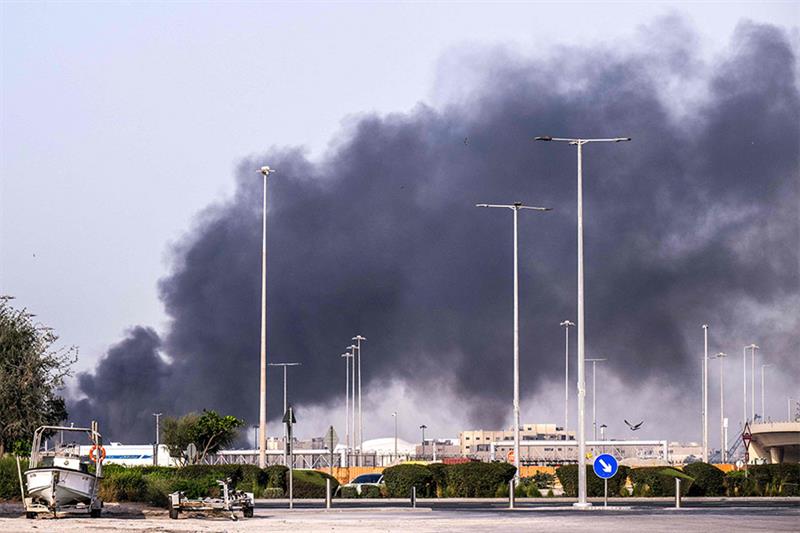
Recent events in the Gulf, leading to the 28 February 2026 US-Israeli strikes on Iran and Iran’s retaliatory missile attacks on Gulf targets, including the UAE, have understandably sharpened concerns among residents, investors and businesses in the United Arab Emirates.
Headlines often present these developments as a straightforward confrontation between Iran and the Gulf states. A closer look at history, economics and regional dynamics reveals a more complex reality.
Despite political differences, Iran and the UAE remain deeply connected through geography, trade, finance and longstanding cultural ties. These structural links have historically encouraged managed coexistence rather than prolonged confrontation. Whether those bonds prove durable under the current acute pressure is the defining question of this moment.
Geography: Neighbours Across Vital Global Corridor
The UAE and Iran sit opposite each other across the Strait of Hormuz, one of the world’s most critical maritime chokepoints.
According to the US Energy Information Administration, approximately 20 per cent of global petroleum consumption and more than a quarter of global seaborne oil trade passes through this corridor each year, making stability in the Gulf essential not only for the region but for the global economy.
Because both countries depend heavily on maritime commerce and regional trade routes, geography has historically encouraged pragmatism and restraint even during periods of tension.
Strong Economic Interdependence
Bilateral trade has grown substantially despite international sanctions and political disagreements. Key indicators illustrate the depth of this relationship (fiscal year ending March 2024, Iranian customs data):
• Iran imported more than $20 billion worth of goods from the UAE, making the UAE Iran’s largest single source of imports.
• Iranian non-oil exports to the UAE exceeded $6 billion in the same period.
• Total bilateral trade is estimated at $25-27 billion annually, with Iran’s roads minister projecting growth towards $30 billion.
It is worth noting that the UAE is Iran’s second-largest overall trading partner after China, though it remains Iran’s largest supplier of imports.
Dubai’s ports and logistics networks serve as one of the region’s most important re-export hubs for goods entering Iranian markets — from machinery and electronics to consumer products.
For Iran, the UAE provides access to global supply chains; for the UAE, Iranian trade reinforces Dubai’s role as a major commercial gateway for the wider region.
Financial and Business Connectivity
Dubai has become a key financial and commercial platform for Iranian businesses. Thousands of Iranian traders, logistics firms, and service companies operate from the UAE, supported by the country’s modern infrastructure, free-zone ecosystem, and global connectivity.
This relationship operates within the constraints of US sanctions on Iran. These economic networks create mutual incentives for stability and continued engagement, though they remain vulnerable to geopolitical disruption.
Cultural and Social Ties
Economic relationships are reinforced by deep cultural links. The Iranian community in the UAE numbers more than 500,000 residents, many of whom have lived and conducted business in Dubai for generations.
Iranian merchant families were among the early contributors to the growth of Dubai’s historic trading districts in Deira and Bur Dubai, and the two societies remain connected by around 300 weekly flights.
These people-to-people ties strengthen a long tradition of cross-Gulf commerce and cultural exchange — ties that successive political tensions have not fully severed.
Understanding the Current Escalation
The current moment is more acute than recent precedent. On 28 February 2026, coordinated US-Israeli strikes on Iranian military facilities, nuclear sites and leadership targets triggered Iranian retaliatory missile attacks on targets across the Gulf, including locations within UAE territory.
The Strait of Hormuz has also been the subject of renewed blockade warnings, disrupting global shipping and pushing oil prices sharply higher.
Analysts at institutions including the International Institute for Strategic Studies (IISS) and Chatham House have noted that while Iran’s regional posture has long involved strategic signalling towards Western military presence, the severity of the current escalation goes beyond previous cycles and introduces genuine uncertainty about near-term stability.
The outcome will depend significantly on whether credible ceasefire or de-escalation mechanisms can be established quickly.
The UAE’s response has reflected notable restraint. While firmly defending its sovereignty and strengthening air-defence systems, the country has simultaneously emphasised diplomacy, de-escalation, and regional stability.
This approach reflects the UAE’s broader strategic philosophy of combining firm security measures with economic pragmatism.
Why UAE Remains a Stable Regional Hub
Even during acute regional tensions, the UAE demonstrates structural characteristics that distinguish it within the Gulf and underpin investor confidence:
• Strong state capacity: Advanced air-defence systems, including the THAAD battery deployed at the UAE’s request, efficient governance, and rapid crisis-management protocols.
• A diversified economy: Global trade, logistics, finance, aviation, tourism, and technology reduce dependence on any single sector or political relationship.
• Global connectivity: Dubai and Abu Dhabi function as major hubs linking Asia, Europe, and Africa, with deep integration into global capital markets.
• Pragmatic diplomacy: The UAE maintains working relations across regional divides, including Western alliances and Gulf neighbours, while prioritising stability and economic continuity.
These factors have historically allowed the country to sustain normal economic activity and investor confidence even during periods of geopolitical stress. Whether that resilience extends through the current and more severe episode remains to be seen.
A Relationship Shaped by Realism
The UAE and Iran do not always agree politically, but geography, commerce, and human connections ensure that their relationship remains complex and deeply interdependent.
History suggests that even adversarial regional dynamics have not extinguished the pragmatic links between these two neighbours.
The structural incentives for stability, shared waterways, bilateral trade approaching $30 billion, and more than half a million Iranians living and working in the UAE, remain significant and enduring.
In the Gulf region, where neighbours cannot change geography, stability ultimately depends on managing tensions while preserving the economic and social ties that bind.
Understanding these deeper dynamics helps explain why, even during difficult moments, relations between Iran and the UAE have continued to be shaped by pragmatism, resilience and coexistence, and why those qualities remain the most important variables to watch in the weeks ahead.
(Rakesh K. Chitkara is a public policy advisor and strategic affairs commentator based in Dubai. He writes on geopolitics, global trade, energy security and India, USA and Middle East economic relations. He is currently representing the World Agriculture Forum, Netherlands, in the UAE)