


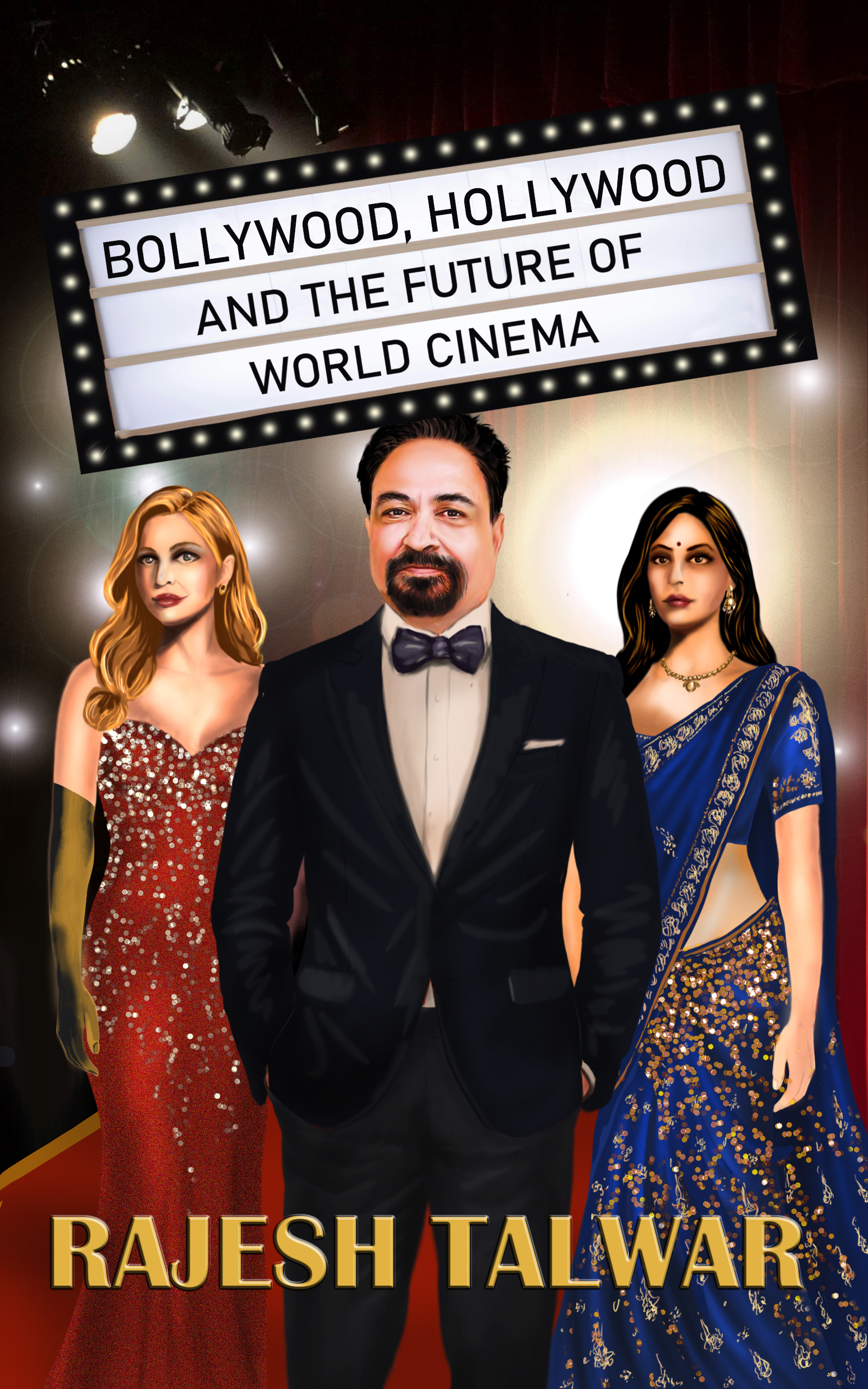
About the Book
From the co-creator of Smoky Sky Songs, an animated feature film on toxic terror, comes this unusual and compelling book, “Bollywood, Hollywood and the Future of World Cinema”. In A Bollywood Miscellany, the essays range widely — from Amitabh Bachchan’s second innings and iconic film dialogues to ‘Tiger’ saving democracy in Pakistan, Madhuri Dixit promoting numerical literacy in schools, and much more.
The second section, Bollywood, Hollywood and the Others, moves beyond Hindi cinema to examine films from other linguistic traditions, including Telugu, Malayalam and Tamil cinema. The essays explore Charlie Chaplin’s influence on Raj Kapoor, ask whether Satyajit Ray might have achieved even more, and propose imaginative collaborations with Japanese filmmakers in animation. They also analyse A. R. Rahman’s contradictions, Anurag Kashyap’s realism, notable casting triumphs, the rise of K-pop, and why Indian music continues to struggle globally.
The third section turns to the Justice Hema Committee Report, unpacking its disturbing findings and examining its implications not only for Malayalam cinema but for the wider Indian film industry, including Bollywood. As yet, no other book has examined this landmark report in comparable depth.
The final section, The Future of World Cinema, looks ahead to the formula films of tomorrow, India’s cinematic potential, the continuing relevance of awards such as the Oscars, the impact of artificial intelligence, and how, if Indian cinema can get its act together, it could one day rival Hollywood.
Excerpts:
THE CONTROVERSIAL DEPICTION OF LORD RAM IN ADIPURUSH
the big-budget film adipurush hit the screens in January 2023. The publicity for the film started a little before Dussehra the previous year to build up hype. The lead actor Prabhas even flew down to attend the Ram Leela at Red Fort, together with the President of India and the Chief Minister of Delhi. A teaser of the film was also released in Ayodhya with much fanfare. However, it ruffied feathers because it depicted Lord Ram with a moustache, Hanuman with a beard, and Ravana with spiky hair, aside from other aberrations.
Should the makers of Adipurush expect the Indian audience to be forgiving and overlook such distortions? I don’t believe they can, or should. For if this is accepted, what will prevent future filmmakers from giving Lord Krishna a moustache or Lord Shiva a beard? Filmmakers cannot just play around with established iconography, as doing so risks offending religious sensibilities.
Whenever any writer tells a story, at the outset, they usually include physical descriptions of the characters as and when they appear. The Ramayana and Mahabharata too tell a story, and these two great epics are no exceptions to this rule. Neither Tulsidas’s nor Valmiki’s Ramayana suggests anywhere that Lord Ram kept a moustache. Had that been the case, at least some of the thousands of temples across the land would have had at least a few statutes depicting him with a moustache.
In fact, the sculptures depicting Lord Ram in thousands of temples across India and abroad all show him to be clean shaven, which is in conformity with the written text. When calendar art was first introduced in India, the depictions similarly showed him to be cleanshaven, in line with the depictions in temples and the ancient texts of the Ramayana.
Clearly, the filmmakers and the director of Adipurush did not intend to disrespect Lord Ram and the other divine figures featured in the Ramayana. Why would they wish to sabotage their own film? Yet, with the controversy that followed, some film critics believed this was a singular case where a flop could be predicted even before the film has been released. In other words, public outrage following the issuance of the teaser guaranteed the film’s failure. The subsequent box office debacle has only confirmed that forecast.
Possibly, the filmmakers did not wish to disrespect Lord Ram in any way, but they have certainly disrespected the cinema-watching audience. This kind of carelessness is common enough, though. For instance, in the film Shabaash Mithu, Taapsee Pannu played the cricketer Mithali Raj, despite bearing little resemblance to her. Similarly, in Chakda ‘Xpress, a biopic on the female fast bowler Jhulan Goswami, who is nearly six feet tall, a much shorter and fairer Anushka Sharma was cast in the lead role. Filmmakers assume that the audience does not care for authenticity. They are wrong here. One of the reasons why M.S. Dhoni: The Untold Story succeeded was because his character was portrayed by the late Sushant Singh Rajput, who was also from Bihar and possessed a not dissimilar build. This is not to diminish Sushant’s outstanding performance in the film in any manner. For now, filmmakers do not appear to care for authenticity. But money talks, and sooner or later, successive box office failures will eventually force them to care and have greater respect for audiences, who are more discerning and demanding than ever before.
About the Author
Rajesh Talwar is an award-winning author of 44 books across multiple genres, including plays, novels, children’s literature, self-help titles, and non-fiction works on social justice, law and culture.
His plays range from contemporary events to historical retellings, while his novels explore themes as diverse as aesthetics, terrorism and the complexities of the Indian legal system.
His notable non-fiction works on legal and political subjects include Courting Injustice: The Nirbhaya Case and its Aftermath (Hay House, 2013) and The Mahatma’s Manifesto: A Critique of Hind Swaraj (Om Books International, 2025). Among his well-known children’s books are The Bearded Prince, The Three Greens (Orient BlackSwan, 2017) and The Boy Who Wrote a Constitution (Ponytale Books, 2022).
Rajesh has worked in senior positions with the United Nations across three continents over two decades and regularly contributes to both Indian and international publications. He has undertaken academic study, of varying duration, at Nottingham, Harvard, Cambridge, Oxford and Hindu College, Delhi University.
He studied filmmaking at the London Film Academy and is currently producing and co-directing an AI-generated animated feature film on toxic terror titled Smoky Sky Songs.
