


ABOUT THE BOOK
In May 2025, India’s Operation Sindoor reverberated across the subcontinent with unmistakable force, returning the country to global focus as a consequential emerging power.
The operation was New Delhi’s calibrated response to the April 22, 2025, terrorist attack in Pahalgam, Kashmir, orchestrated by Pakistan’s deep state. Widely lauded as proportionate and effective, it triggered intense debate in strategic circles, even before its pause on May 10, 2025, over whether it would inflict a temporary setback or a lasting blow to Pakistan’s terror infrastructure, long regarded as the world’s epicentre of extremism.
Drawing on decades of experience, the authors examine the events preceding the conflict, chronicle the conduct of operations, and analyse the wider implications of Operation Sindoor for regional and global security in a nuclearised environment. The volume also traces India’s evolving Dynamic Response Doctrine and its departure from the Cold Start Doctrine.
A compelling read for defence enthusiasts, strategic thinkers, and students of contemporary Indian geopolitics, the book offers rare insight into historical parallels, future trajectories, and India’s changing posture on the global stage.
EXCERPTS
PAHALGAM; A PARADISE DISRUPTED
Maj Gen Bipin Baksh
“Agar firdaus bar roo zameen ast, hamin asto, hamin asto, hamin ast.”
“If there is paradise on earth, it is here, it is here, it is here.” -A famous couplet
“They told me, ‘Go tell Modi’.” Ms Pallavi Rao recounts the response of the murderous group of terrorists who shot her 46-year-old husband, Mr Manjunath Rao, when she begged them to shoot her and her son too. The family trio were on their first-ever trip outside Karnataka, to celebrate the success of their son, Abhijaya, in his second PUC (Class XII) exam, with a score of 97%.
Pahalgam Valley of Kashmir, often called the “Mini
Switzerland”, had been alive with the laughter of tourists on that fateful morning of April 2025. Families from across India had come to experience the breathtaking meadows, ride ponies through pine forests, and feel the crisp mountain air. Among them were newly-weds, retirees, children on their first mountain trip, and seasoned travellers seeking solace in Kashmir’s famed beauty. Little did they know that danger lurked in the pine forests on the higher mountain ranges above Baisaran Valley, which extends from the main Pahalgam axis, climbing up towards the misty Himalayan Range that separates Kashmir from Ladakh.
Baisaran Valley: A Remote Scenic Location
Baisaran valley is located 45 km to the Southeast of Srinagar as the crow flies. It is a remote area with no motorable roads, no habitation; hence there is no security forces presence and it is not even visited by tourists or locals in winter months. The remoteness of the area made it approachable for terrorists coming on foot through the jungles on the Pir Panjal Range to the Warwan Valley to the East of Pahalgam, to execute the terror attack without encountering any posts of the security forces. As most of the other tourist spots in Srinagar and Gulmarg were well covered by security forces, it appears that the remoteness of Baisaran Valley was the main reason for its selection as the point of strike.
Moreover, the entire Pahalgam Valley is a peaceful area, and these areas have no habitation and no history of terrorism, and are thus largely outside the routine security envelope provided to the inhabited areas, except during the Amarnath Yatra period of June/ July every year.
Pahalgam Valley itself is an offshoot of the main Kashmir Valley, forming the connection from the valley floor to the Himalayan Range massif, and is the main route to the Holy Amarnath Shrine. The other route to Amarnath cave takes you through Srinagar, skirting around the famous Dal Lake, towards Sonamarg, from where the pony route emanates along the mighty Himalayas towards the holy cave.
Figure 2.1: Map of Baisaran and Pahalgam Valley
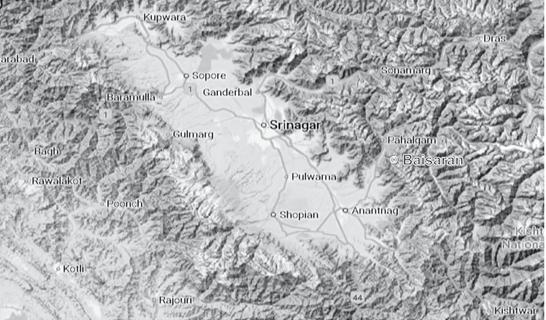
Baisaran is about 3 km northwest of Pahalgam, accessible via a 45-minute hike or pony ride through pine forests. This is one of the many picturesque spots on the slopes rising towards the Himalayas, all of which are unoccupied and only visited by tourists in the summer months. No one imagined that in the afternoon of 22 April 2025, this paradise would be transformed into a scene of terror and tragedy—the deadliest and most deplorable attack on civilians in India since 2008.
For many, the trip to Pahalgam was a long-awaited dream. Shubham Dwivedi, a 31-year-old newly-wed from Kanpur, had arrived with his wife and extended family, eager to explore the valley’s famed horse trails. Lieutenant Vinay Narwal, an Indian Navy officer from Haryana, was on his honeymoon, his wife Himanshi glowing with post-wedding joy. Prasant Kumar Satpathy, an accountant from Odisha, travelled with his wife and nine-year- old son, savouring every moment of their holiday.
Tourists from Karnataka, Maharashtra, Gujarat, Bengal, and Andhra Pradesh mingled in the meadows. Children played, couples
posed for photos, and local pony operators guided groups up the gentle slopes. The attack took place when the tourists were far from habitation in this remote meadow, which was fenced on all sides with a single gate for entry and exit. As mentioned earlier, the area was reachable only on foot or horseback, as there was no motorable road to the meadow. The terrain peculiarity slowed down responders from the Security Forces5 on the one hand while lending proximity to the remote mountain region for an easy escape for terrorists on the other hand. The terrorists deliberately attacked only non-Muslim men, leaving women and children traumatized. To identify non-Muslims, the attackers ordered the victims to recite verses (kalima) of the Quran, and killed those who refused or were unable to recite the verses correctly. It was evidently an attempt to provoke the Indian nation while trying to draw a schism between different religious communities in India.
During the attack, an officer from Intelligence Bureau, Shri Manish Ranjan, and an Indian Navy Officer, Lt. Vinay Narwal, were also killed and there were some men who were injured and hospitalised in critical condition.6 Among the survivors who escaped was Col Bhat, a serving Indian Army officer, who showed great presence of mind by guiding his group of tourists and his family away from the terrorists, finding an exit from the meadow through the side fence and ensuring safety of the group till the security forces arrived.
The Resistance Front (TRF), an open proxy of the Pakistan- b a s e d m i l i t a n t g r ou p o f L a s- hk a r- e – Ta i b a , i n i t i a ll y t o o k responsibility for the attack and repeated the claim after a few hours. However, they subsequently changed their stance, saying that the claim was on account of a cyber glitch! This attack was the first large-scale attack on tourists over a considerable period of time. In earlier instances, terrorists had kidnapped tourists to negotiate terms with the Indian Government.7
Brutality, Eyewitnesses, and the Chaos
The attackers, dressed in military-style uniforms, moved swiftly and deliberately. Witnesses described how they singled out victims based on religion:
• Tourists were asked to recite the Islamic kalima.
• Hindu men were forced to remove their trousers to check for circumcision.
• Those unable to recite Islamic verses or prove Muslim identity were shot at close range.
As the gunfire intensified, crowds fled in all directions. Some ran toward the main gate, only to find militants waiting. Others, like Prasanna Bhat and his family, scrambled for cover. He was among the few who evaded fate and survived, with the help of his brother, a serving Army officer. Bhat shared:
We could see a terrorist approaching in our direction, so we decided to run the other way. Fortunately, we found a narrow opening under the fence, and most of the people hiding slid through the fence and started running the other way.
Bhat’s brother, an Army officer, Colonel Prashang Bhat, quickly assessed the situation and led 35-40 people down a slippery, muddy slope toward a water stream that offered some protection from gunfire. Many slipped and fell but managed to escape. Prasanna relates their experience:
We managed to take cover in a narrow pit under the trees a few hundred metres from the location, desperately praying for our lives. The sound of gunshots continued to echo through the valley for half an hour until 3 pm.9
A local pony operator, Syed Adil Hussain Shah, tried to wrestle a gun from one of the attackers to protect the tourists. He was shot and killed—a rare moment of heroism amid chaos.
Photo 2.1: A photo of four attackers at Baisaran Valley
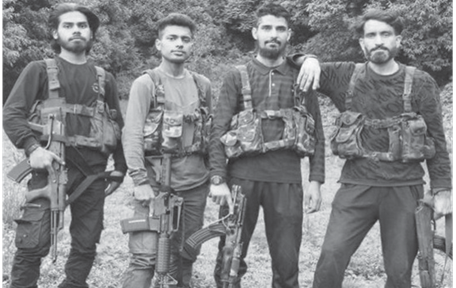
Source: India TV News, 23 April 2025.
Witness Accounts: Terrorists’ Appearance and
Behaviour
Witnesses provided several consistent details about the terrorists involved in the Pahalgam attack:
• Military-style uniforms: The attackers were described as wearing military-style uniforms, which contributed to the initial confusion among tourists and locals, as some mistook them for security personnel.
• Armed and organised: They carried automatic weapons and moved in a coordinated manner, suggesting prior planning and familiarity with the terrain.
• Concealed identities: Their faces were either partially covered or obscured, making identification difficult for survivors during the chaos.
Eyewitnesses described the terrorists’ actions and demeanour as follows:
• Deliberate targeting: The attackers singled out victims based on religious identity. Those unable to prove Muslim identity were shot at close range.
• Calm and ruthless: Witnesses noted that the terrorists acted with chilling calmness, showing no hesitation or remorse as they moved from group to group. Their actions were methodical, and they appeared unmoved by pleas for mercy.
• Aggression against resisters: When a local pony operator, Syed Adil Hussain Shah, attempted to intervene and protect tourists, he was shot and killed on the spot, demonstrating their intolerance for any resistance.
• Verbal threats and taunts: Survivors recalled the attackers making statements like “Go tell Modi”, after sparing some victims, using threats and taunts to instil fear and send a political message.
The violence of the assault was unprecedented and unpredictable. As mentioned by eyewitness, the attackers were carrying M4 carbines and AK-47s and they escaped into the nearby forests before security personnel arrived.10 After the first gunshots were fired at the Baisaran meadow that day, two terrorists who had earlier mingled with the tourists, herded the startled crowd towards two other armed terrorists, who then segregated and killed the people based on religion, a senior government official said about the incident.
Besides the extremely brutal nature of the killing, the terrorists evidently wanted to traumatise the women and children who would be haunted by the gruesome sights of murder. At the same time, the terrorists sought to perpetrate a chilling religious divide— trying to sow seeds of communal disharmony in India’s diverse population.
Evidence Against Pakistan
The most recent acknowledgement by third parties about Pakistan’s role in fomenting trouble all over the globe and particularly in India comes from the statement of the Secretary of State, USA, who designated The Resistance Front (TRF) as a Foreign Terrorist Organisation (FTO) and as a Specially Designated Global Terrorist (SDGT). He also clarified in the statement that it was TRF which had claimed responsibility for the Pahalgam attack. India acknowledged and appreciated the leadership of Secretary of State Mr Marco Rubio in this regard, in the press release of 18 July 2025. The text of the Indian press release reiterates that TRF took responsibility for the Pahalgam massacre and also conveyed that the subject designation of TRF is a timely and important step reflecting the deep cooperation between India and the United States on counter-terrorism. Evidently this confirms to the world that Indian investigative agencies, as well as the intelligence agencies of USA, have been able to collect adequate evidence and intelligence about the culpability of Pakistan-based terrorist groups in this deplorable attack on tourists in Kashmir.
Figure 2.2: Pakistan Minister admits training and funding terror camps on 25 April 2025, “Doing the dirty work of the United States for three decades”
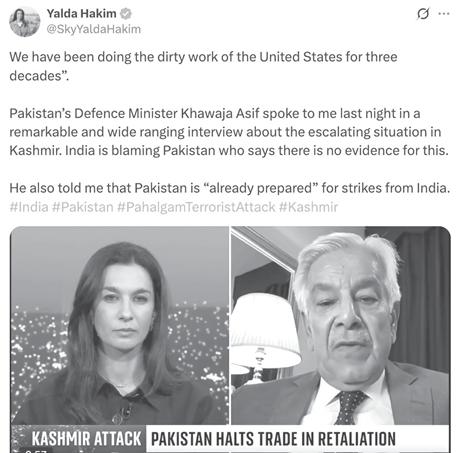
Source: Sky News interview posted on X, 25 April 2025.29
Pakistan Defence Minister Khawaja Asif in an interview with Sky News, UK, announced to the world about his country’s history of supporting, training, and funding terrorist organisations, terming this as the “dirty work for the West”, and commenting that this was a mistake for which Pakistan had suffered. During the interview on 25 April 2025, the news presenter Yalda Hakim had asked Asif about Pakistan’s stance on terrorism in the aftermath of the terrorist attack in Pahalgam.
“You do admit, sir, that Pakistan has had a long history of backing and supporting and training and funding these terrorist organisations”, asked Hakim.
“Well, we have been doing this dirty work for the United States for about three decades, you know, and the West, including Britain”, replied Asif.
“That was a mistake, and we suffered from that, and that is why you are saying this to me. If we had not joined the war against the Soviet Union and later on (joined) the war after 9/11, Pakistan’s track record, was an unimpeachable track record”, he said.
Prior to this incident too, questions had often been raised by international media about the evidence that would connect Pakistan to terror attacks, as Pakistan has always been in a denial mode despite irrefutable evidence provided on several occasions. On this occasion too, there was a huge perception management exercise launched by Pakistan in various Western nations to swing an anti-India narrative on Op Sindoor. Recently, in a publicly available video of a press conference in Washington, Shashi Tharoor’s son, Ishaan Tharoor, from the Washington Post, had asked him about the evidence linking Pakistan to the attack.
Here the gist of the answer given by Shashi Tharoor.
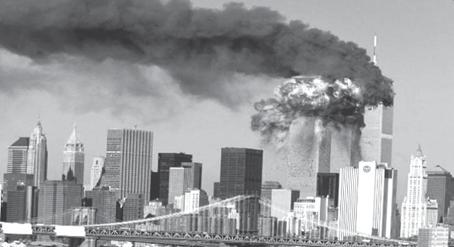
• 9/11 attack in New York: India had a 37-year pattern of repeated terror attacks from Pakistan accompanied by repeated denials. Americans haven’t forgotten that Pakistan didn’t know allegedly where Osama bin Laden was until he was found in a Pakistani safe house right next to an army camp in a Cantonment city in Pakistan.
Photo 2.3: 9/11 Attack on World Trade Center by Osama bin Laden
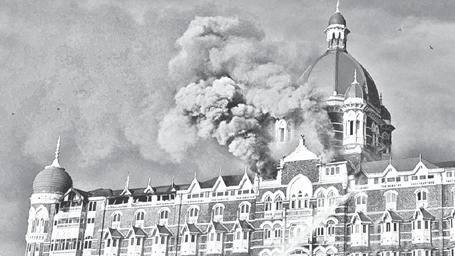
• Mumbai attack 2008: Pakistan denied having anything to do with it. One of the terrorists was captured alive, his name, his identity, his address in Pakistan, everything was revealed on interrogation. He confessed where he was trained, and how the attack was carried out. The US intelligence, as well as ours, recorded the chilling voice of the Pakistani handler, giving minute-by-minute instructions to the killers in Mumbai, telling them where to go, and informing them that there were people hiding on the third floor of that hotel and they should go find them there.
Photo 2.4: Mumbai terrorist attack 26/11
• Pahalgam attack: Within 45 minutes or so of the Pahalgam attack, a group called the Resistance Front claimed credit. The Resistance Front of the Lashkar-e-Taiba (LeT), a banned organisation listed by the United Nations, enjoys safe havens in the town of Muridke Pakistan. The evidence about the Resistance Front and its doings was presented by India to the UN Committee on Terrorism in December 2023 and repeatedly again in 2024. However, as Pakistan too is a member of that committee, the Resistance Front was not listed by the UN, although its identity was known and publicised. The Resistance Front repeated that claim 24 hours later; then their handlers must have woken up to the gravity of the situation and told them to take it off their site. However, the credit claim was on record and the world has seen it. When India retaliated with strikes by the Indian Army and the Indian Air Force on Pakistani terrorist camps, funerals were conducted for the deceased terrorists of some key organisations, including the Jaish-e-Mohammed, in particular, and the LeT. These funerals were attended by Pakistani generals and police officers in uniform, as can be seen in the photographs of the funeral shared on the social media.
As per information released by India31 during the media briefings, there were several key figures among the LeT terrorists who were killed in the 7 May strikes at Muridke. The list included Khalid Abu Akasha, an LeT operative who facilitated arms smuggling from Afghanistan. He was a member of LeT’s Central Committee and closely linked to leaders such as Yahya Mujahid and Qari Yakub Sheikh. Another key figure killed was Mudassir Khadian Khas, who oversaw the Muridke camp as security-in- charge for Al-Khidmat Committee, and was a son-in-law of the militant ideologue Hafiz Saeed. Besides them, Mohammad Hassan Khan, son of Jaish-e-Mohammed (JeM) PoJK commander Mufti
Asghar Khan Kashmiri; and Maulana Masood Azhar’s brother- in-law Hafiz Muhammad Jameel, a Bahawalpur-based JeM Shura member, were also neutralised.
According to the reports, the funeral in Muridke saw the presence of Lieutenant General Fayyaz Hussain, Major General Rao Imran, and Brigadier Mohammad Furqan of the Pakistan Army, alongside Punjab Inspector General of Police Usman Anwar, Legislator Malik Sohaib Ahmed, and other senior officials. Their attendance, it was noted by India, “highlights the complicity of state actors in sheltering and celebrating global terrorists”.
While briefing the media on 8 May 2025, Foreign Secretary Vikram Misri referred to the photograph of Abdur Rauf,32 leading the funeral prayers (see photo 14 from the page inserts of this chapter) at Muridke, and to the photographs of several other slain terrorists, whose coffins were draped in the Pakistan national flag. “If only civilians were killed in these attacks, I wonder what message this picture actually sends to all of you”, Mr Misri said. “As far as we are concerned, the individuals eliminated at these facilities were terrorists. Giving terrorists state funerals may be a practice in Pakistan. It doesn’t seem to make much sense to us”, he added.
Even PM Modi referred to this funeral in his address to the nation on 12 May 2025. “Top Pakistani army officers came to bid farewell to the slain terrorists. This is strong evidence of state- sponsored terrorism”, he said.
Correlation between Pahalgam and Previous Attacks
As recounted above, the Pahalgam terror attack of April 2025 was one of the most brutal and targeted assaults on tourists in the history of Jammu and Kashmir. This incident in the Kashmir division came after a considerable gap since 2019, the more recent terrorist incidents being in Jammu Division, to include Rajouri (2023), Reasi (2024), and Kathua Ambush (2025).
Attacks against tourists have been extremely rare, as brought out in detail in the Introduction Chapter of this book. The last significant attack was against pilgrims at Reasi, near Katra, which coincided with the swearing-in ceremony of the Modi Government on 9 June 2024 in the presence of foreign dignitaries. Just an hour before the oath ceremony was to take place at the forecourt of the Rashtrapati Bhavan, 9 pilgrims were killed and 41 injured as their bus was fired upon by terrorists when they were returning from Shiv Khori Temple towards Mata Vaishno Devi shrine. They were religious pilgrims in the Jammu Division, not normal tourists visiting Kashmir Division, who had never been attacked in this manner earlier.
A discernible pattern can be observed while considering big terrorist attacks in Jammu and Kashmir during the past few years. Many of those incidents were synchronised with major national events or times when Prime Minister Narendra Modi was busily involved in important governmental activities or foreign visits. The timing has generated debate regarding whether such attacks are strategically designed to achieve maximum psychological and political impacts. On this occasion, it was US Vice President J D Vance who was in India at the time of the attack in Pahalgam. In case of the previous incidents, PM Narendra Modi was on foreign visits.
The previous history of attacks has been recounted in Introduction. However, in the last two years preceding the Pahalgam attack, some issues are of note, namely, the series of incidents in South of Pir Panjal during the last three years, since the move of a division strength of Rashtriya Rifles, a Uniform Force, from Reasi to Ladakh after the Galwan Crisis 2020. None of these attacks generated the kind of international attention the perpetrators of these attacks desired and, in the meanwhile, normalcy was rapidly returning to Kashmir after the abrogation of
Article 370. The train service to Kashmir was just about to start, and therefore secession of Kashmir from India was becoming a rapidly fading dream for the Pakistan Army. If we now correlate the venomous speech of the Pakistan Army Chief on 15 April 2025 (see Figure 1.3), and the number of Pakistani Sunni Muslims killed in the Jaffar Express hijack incident of March 2025, the motivations for the Pahalgam attack become starkly evident.
In the Jaffar Express incident, 21 civilians and 4 paramilitary soldiers were killed as reported to Al Jazeera by Pakistan security forces,34 a total of 25 Pakistani citizens. Nearly 70 passengers, the women, children, and elderly hostages, were released by the Balochi hijackers, evidently after some kind of ethnic and religious profiling which could be expected in any hijack situation. We may now correlate that the tourists were killed at Pahalgam after carrying out a specific religious profiling. Among the people killed there were 25 non-Muslim Indian citizens and one Muslim. The attackers left after killing 25 non-Muslims, while they had the opportunity to inflict more casualties before the arrival of Indian security forces.
The evidences pieced together by India’s NIA, and other security agencies, was presented to the world in the aftermath of the attack, and a majority of the nations expressed solidarity with India, while condemning the heinous terrorist atrocity. The stage was set for India’s response, it was probably not about whether there would be retribution, but about when would the hammer strike.
ABOUT THE AUTHORS
Maj Gen (Dr) Bipin Bakshi, retd, is a decorated paratrooper, former DDG of MP-IDSA, inspector general of NSG, and UN peacekeeper. He is currently a distinguished fellow at CLAWS.
Air Marshal Rajesh Kumar, retd, is a former Commander-in-Chief of the Strategic Forces Command. He retired from the Indian Air Force after four decades of service.
Anil Trigunayat is a former Indian ambassador to Jordan, Libya and Malta. Currently, he is a distinguished fellow at Vivekananda International Foundation and United Services Institute of India.
Brig Akhelesh Bhargava, retd, is a life member of CLAWS. He is a renowned Army AD expert, experienced in many weapon systems and served in multiple theatres.
