


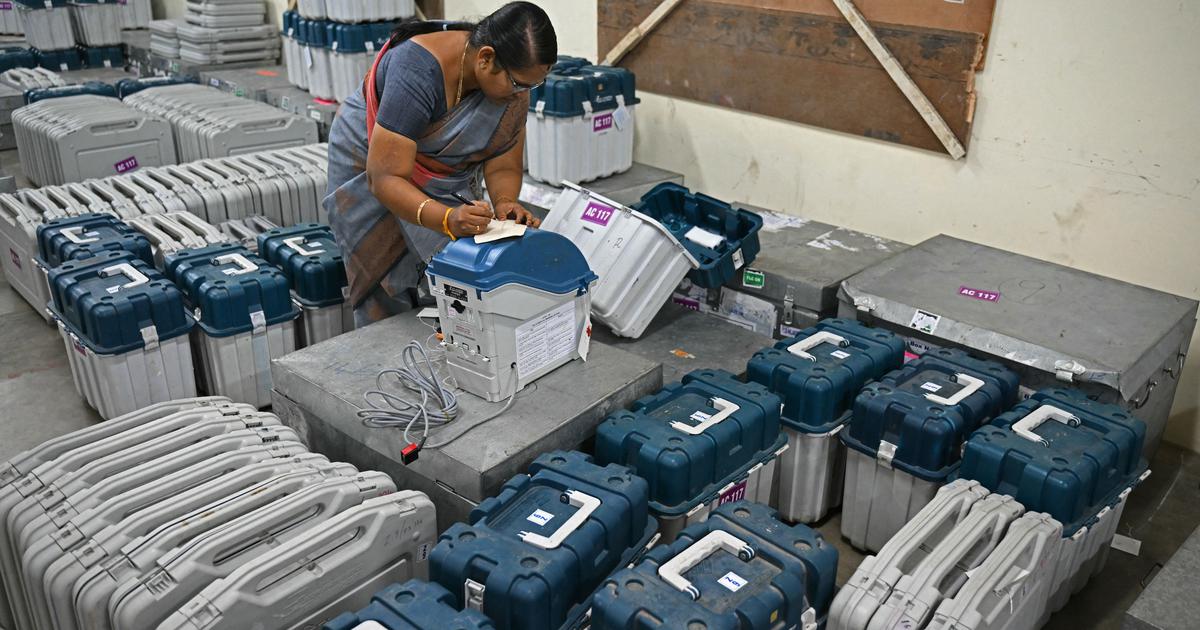
For the moment, set aside the political din around Electronic Voting Machines (EVMs): Rahul Gandhi’s “vote chori” slogan, opposition sound bites and the routine dismissal of concerns as conspiracy. What demands attention instead is a growing body of documentary evidence relating to the 2024 Maharashtra Assembly election. An investigation grounded in Right to Information (RTI) disclosures and official records raises serious, unresolved questions about the integrity of India’s electoral machinery.
The material points to a disturbing sequence of anomalies: excessive procurement of EVM components, unexplained changes in machine models, irreconcilable discrepancies between official records, and vote counts per machine that defy physical feasibility. Taken together, these findings challenge the repeated official claim that the EVM-based electoral system is beyond scrutiny.
The findings, documented by this author, now form the basis of a detailed legal complaint of 577 pages. The complaint has been sent to the chief election commissioner, the Maharashtra State Election Commission, the governor of Maharashtra, the director of the Central Bureau of Investigation, and the state’s chief secretary.
As of publication, the Election Commission of India (ECI) has not responded to the specific allegations. None of the authorities named has issued a formal clarification even after ninety days, nor is there any public indication that a preliminary inquiry has been initiated or even contemplated. The silence persists even though the evidence relies entirely on official records and election data.
1.PROCUREMENT PUZZLE
Inventories That Appear, Disappear and Multiply
A serious fault line runs through Maharashtra’s electoral inventory, raising doubts about the devices used to determine democratic outcomes. An examination of procurement records, RTI replies and inventory registers reveals major contradictions in the supply, tracking and accounting of EVMs and Voter Verifiable Paper Audit Trail (VVPAT) units.
These are not marginal clerical slips. They involve hundreds of thousands of machines and entire model categories appearing in official records without a clear explanation. RTI responses and technical complaints reveal an opaque procurement trail marked by unresolved mismatches between records maintained by the sole authorised manufacturer and those held by state election authorities.
The issue begins with basic arithmetic. During the 2019 Lok Sabha elections, Maharashtra operated 96,653 polling stations, each requiring one Ballot Unit (BU), one Control Unit (CU) and one VVPAT. By 2024, the number of polling stations had increased modestly to 1,00,427.
Even allowing for a generous reserve and training buffer of 20 to 25 per cent, the state’s requirement would reasonably cap at approximately 1.25 to 1.30 lakh complete EVM sets.
However, the actual supply figures do not conform to this logic.
RTI data from Bharat Electronics Limited (BEL), the authorised manufacturer, show that Maharashtra received:
- Between April 2018 and March 2019: 2,03,808 BUs, 1,18,500 CUs and 1,18,508 VVPATs.
- Between February and December 2023: a further 2,03,870 BUs, 1,33,500 CUs and 24,537 VVPATs.
This places cumulative deliveries between 2018 and 2023 at approximately 4.07 lakh BUs, 2.52 lakh CUs and 1.43 lakh VVPATs. In effect, the state possesses more than four times the number of individual units required to equip every polling station, even after accounting for reserves.
The obvious question remains unanswered: why was such extensive fresh procurement undertaken in 2023 when Maharashtra already held a substantial surplus from the 2018-19 cycle? No public explanation has been offered. There is also no clarity on the fate of the earlier stock. Whether machines were redistributed, decommissioned or warehoused remains undocumented.
The delivery timeline intensifies these concerns. Between June and August 2023, large consignments were dispatched within narrow windows shortly before the election:
- 1,08,810 BUs and 66,640 CUs were delivered to 19 districts between 27 June and 10 August 2023.
- 25,580 VVPATs of varying models were delivered to five districts between 29 June and 2 August 2023.
The introduction of multiple model variants weeks before polling is operationally unusual, particularly given that manufacturers acknowledge system-level differences across versions. The question that follows is unavoidable: why were voting system models altered so close to polling?
2. THE MODEL MISMATCH
Machines That Officially Do Not Exist
The most technically troubling inconsistency concerns VVPAT model classifications.
BEL’s RTI response is explicit: only Model M3 VVPATs were supplied to Maharashtra between February and December 2023. The manufacturer states that no hybrid or mixed variants, such as M2M3, were dispatched.
Maharashtra’s own RTI records contradict this data. Receipt logs from June to August 2023 list three distinct models:
- PK-M3: 15,571 units received on June 29 and July 3, 2023
- PK-M2M3: 8,966 units received on July 22 and 29, 2023
- NCS-M2M3: 1,043 units received on August 2, 2023
In total, 25,580 VVPATs categorised as mixed or hybrid models appear in state inventories, despite the manufacturer stating that such variants were never supplied.
These machines have no acknowledged procurement trail. Their origin is undocumented. This moves the issue beyond inventory inconsistency into the possibility of unauthorised substitution, redistribution or alteration of machines, precisely the risks electoral safeguards are designed to prevent.
Only three explanations are possible:
- The manufacturer’s (i.e. BEL’s) RTI disclosure is incomplete or inaccurate.
- State-level records are incorrect or manipulated.
- Machines entered the system outside authorised procurement channels.
Each possibility constitutes a serious breach of electoral accountability.
3. MATHEMATICS OF IMPOSSIBILITY
When Devices Break the Limit of Time
Another consequential finding emerges from an analysis of Form 20 data, corroborated by RTI disclosures. Of the 1,00,427 EVMs deployed across Maharashtra’s 288 Assembly constituencies, approximately 57,001 machines recorded vote totals that exceed what is physically possible within the prescribed twelve-hour polling period.
According to established procedures, an EVM can record a maximum of approximately 360 votes during polling hours. Yet booth-level scrutiny across 31 examined districts reveals thousands of machines registering between 550 and 1,250 votes. When aggregated, these excess counts amount to roughly 1,13,66,725 votes.
The calculation is straightforward. Each voter must be identified, sign or provide a thumbprint, receive clearance from the polling officer, cast a vote, and exit. Even under ideal conditions, this process takes two to three minutes per voter. This sets a hard limit:
- At two minutes per voter, an EVM can process 30 voters per hour.
- Over twelve hours, the maximum is 360 votes per machine.
RTI responses from multiple districts reveal another disturbing pattern. Several districts furnished figures that were plainly incorrect. Others reported EVM counts that directly contradicted both manufacturer records and state-level inventories.
More concerning is what was not submitted. A cluster of districts—significantly, those recording the largest victory margins—provided only partial data or failed to respond altogether. This selective opacity is not a clerical lapse, it strikes at the foundation of electoral transparency.
District-level EVM records form the first and most critical link in the audit chain. When these records are missing, incomplete or internally inconsistent, the chain breaks. Without verifiable trails from polling station to district to state, post-election audits become mathematically and procedurally impossible.
Across dozens of districts and hundreds of Assembly constituencies, another anomaly stands out: numerical repetition. The documents repeatedly flag similar vote-count thresholds appearing across wide geographic areas.
Another anomaly compounds the concern. In hundreds of booths, vote counts cluster narrowly between 550 and 580 per EVM, suggesting abrupt halting or artificial capping just above plausible limits. This pattern recurs across districts.
A former district election officer, speaking off the record, described the figures as “a numerical red flag that no serious audit can ignore”. Achieving such totals would require a sustained rate of 15 to 17 votes per minute for twelve uninterrupted hours, without queues or delays.
Procedural lapses are also visible. Many Form 20 sheets lack the mandatory signature of the Returning Officer, undermining their legal validity and raising questions about custody and verification.
Taken together, the pattern is consistent:
- Vote totals exceeding physical limits by 50 to 250 per cent.
- Missing Returning Officer signatures on statutory forms.
- Clustering of counts just above feasible thresholds.
- Abrupt cessation of counting across groups of booths.
When machines record more votes than voters can physically cast, the safeguards of the electoral process are no longer demonstrable.
4. LAST BUT NOT LEAST
The ECI maintains that EVMs are tamper-proof. That claim collapses if the machines deployed cannot be reconciled with those officially procured. When serial numbers, models, firmware versions and movement records do not align with the manufacturer’s supply ledger, integrity becomes unverifiable.
Once the inventory itself is in doubt, the chain of custody disintegrates. The electoral process relies on documented procurement, logged storage, sealed transport and pre-poll authentication. If state records list machines the manufacturer does not acknowledge, every subsequent step rests on an assumption rather than verification.
The evidence from Maharashtra may not prove a conspiracy. It demonstrates opacity. In a democracy, opacity is corrosive. Model inconsistencies, unexplained machine categories, inflated stocks and mathematically impossible vote counts point to a system whose foundational records cannot be reconciled.
These findings demand answers from the ECI, the manufacturer and state authorities. They warrant an independent, forensic audit of EVM procurement, storage and deployment. When numbers do not add up, public trust is the first casualty.
The Maharashtra case is not ideological. It is evidentiary. It asks why the world’s largest democracy continues to shield its electoral technology from independent scrutiny, even as its own paper trail contradicts itself. These are numerical questions, not rhetorical ones. Until every machine is accounted for, the mandate remains in doubt.
GFX 1
THE 1.13 CRORE QUESTION
- crore excess votes indicated
31 districts showing abnormal counts (580–1,250 votes per unit)
Some key constituencies indicating unusually high ‘excess votes’
Amravati: 3,07,032
Nagpur: 4,55,735
Jalgaon: 4,98,520
Nashik: 8,69,110
Pune: 10,81,274
Ahmednagar: 6,73,004
Solapur: 6,17,327
Thane: 4,85,547
Kolhapur: 7,26,911
Sangli: 4,64,642
Mumbai Suburban: 3,68,994
Aurangabad: 3,94,660
GFX 2
LAST-MINUTE EVM INFLOW
When
- June-August 2023
- Weeks before voting
What Moved
- BU: 1,08,810
- CU: 66,640 → 19 districts
- VVPAT: 25,580 → 5 districts
Why It Matters
- Bulk deliveries in tight windows
- Introduction of multiple model variants
- Manufacturers acknowledge system changes
Takeaway
- New machines, new models—right before polls
- High operational risk. Low transparency
GFX 3
MODEL DISCREPENCIES: BEL VS State Records
BEL Statement:
• Only M3 model EVMs supplied to Maharashtra in 2023
• No M2 / M2M3 / hybrid variants supplied
Maharashtra Inventory Records:
VVPAT Models Listed by State (2023):
• PK-M3: 15,571
• PK-M2M3: 8,966
• NCS M2/M3: 1,043
Total mixed-model VVPATs: 25,580
RED FLAGS
• Manufacturer record and state inventory cannot both be correct
• Model type determines firmware + security protocol
• Model mismatch is not a clerical variable
TAKEAWAY
Model identity is a security parameter, not paperwork
GFX 4
UNANSWERED QUESTIONS
What Official Records Fail to Explain
KEY POINTS (CRISP):
• Where did the 2018–19 surplus machines go?
• Why was fresh procurement in 2023 needed despite excess EVMs?
• How did non-BEL models enter official inventory?
• Why do BEL and state ledgers not match?
• How did EVMs exceed statutory time limits?
• Why are Form 20 records unsigned?
• How many EVMs actually exist in Maharashtra?
• Which models were officially supplied?
• How did thousands of VVPATs appear without procurement trails?
• Who authorised model changes weeks before polling?
GFX 5
RESTORING TRUST, ONE MACHINE AT A TIME
Six Non-Negotiable Actions for the ECI
1. Court-Monitored Forensic Audit
All EVMs received, moved and deployed in Maharashtra since 2018
2. BEL–State Record Reconciliation
Serial-wise matching across BEL, state and district inventories
3. Public Disclosure of Surplus EVMs
Storage locations, serial numbers and movement logs
4. Machine-Wise Voting Time Audit
Votes recorded vs time available vs statutory voting time per elector
5. Constituency-Wise VVPAT Disclosure
Complete release of VVPAT deployment and usage data
6. Accountability for Procedural Breaches
Unsigned Form 20s to trigger suspension, inquiry and prosecution
