


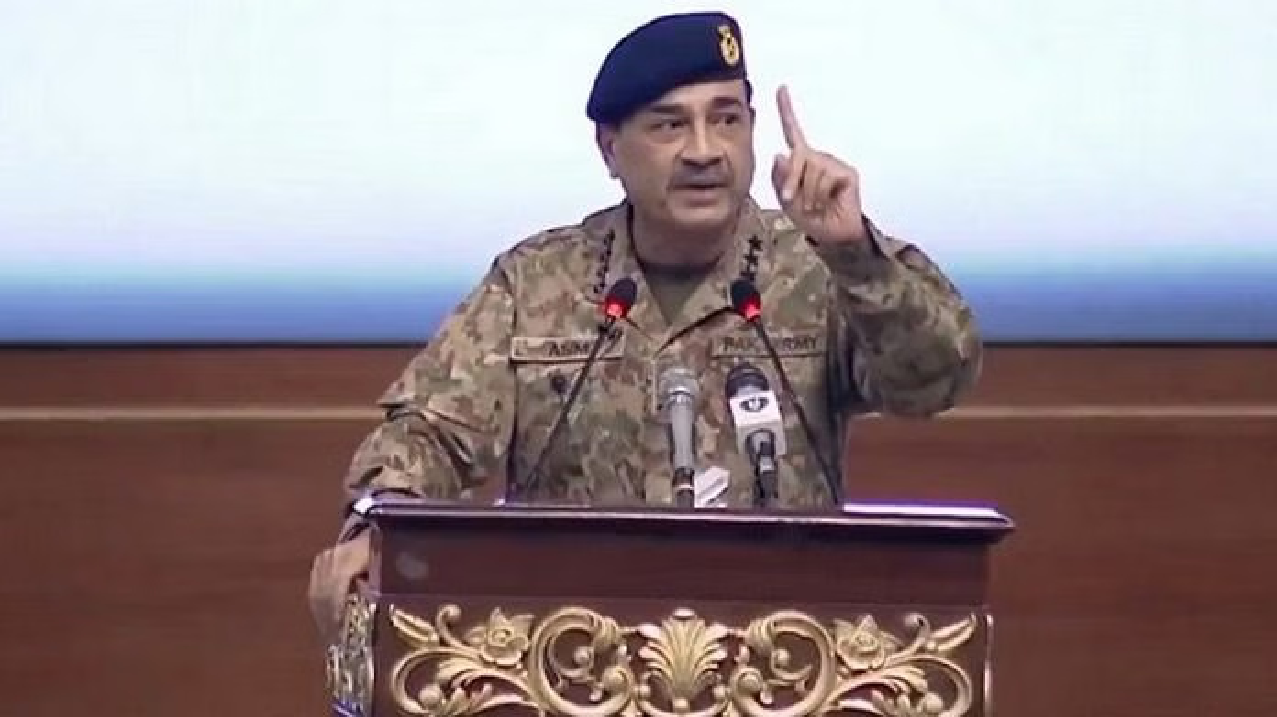
🔺 Asim Munir, Pakistan’s ‘Hafiz-e-Quran’ Army Chief Who Called Kashmir the ‘Jugular Vein’ Before Pahalgam Attack
As General Asim Munir hardens Pakistan’s Kashmir rhetoric, India watches with alarm — especially after a deadly terror attack days later in Pahalgam.
📣 A Provocative Statement Before Bloodshed
Just days before the Pahalgam terror attack that killed over two dozen civilians in Jammu and Kashmir, Pakistan’s Army Chief General Asim Munir stirred tensions with a high-voltage statement. Speaking at an Overseas Pakistani Convention in Islamabad, Munir declared in Urdu, “Kashmir is our jugular vein; it will be our jugular vein; we will not forget it.”
The statement, met with thunderous applause, immediately sparked diplomatic outrage in India. Indian officials dismissed it as inflammatory, asserting that Jammu & Kashmir is “an integral part of India” and “no foreign land can ever be a jugular vein.”
🧠 The ‘Munir Doctrine’: Military Meets Religion
General Munir’s rhetoric isn’t random—it’s part of what observers are calling the ‘Munir Doctrine’: a blend of military assertiveness, religious nationalism, and strategic realignment.
He’s not just Pakistan’s Army Chief—he is its first Hafiz-e-Quran, a fact he publicly embraces. His speeches often reference Islamic values, martyrdom, and ideological purity, marking a shift in Pakistan’s military communication under his leadership.
This ideological edge has increasingly coloured Pakistan’s posture on Kashmir, with Munir claiming even the controversial 1999 Kargil War as a “chapter of martyrdom for national security.”
🛡️ Rising War Talk and Kashmir as a Core Priority
On Kashmir Solidarity Day (5 February 2025), Munir delivered a chilling message from Muzaffarabad:
“Three wars have already been fought for Kashmir, and if ten more are needed, we will fight them.”
He framed Kashmir not just as a political dispute, but a sacred national cause, central to Pakistan’s future and identity. Since assuming command in November 2022, Munir has made repeated visits to the Line of Control, declaring the army is “ready to take the fight back” and “defend every inch of Pakistan.”
🌐 Recasting Pakistan’s Global Image
Interestingly, the Munir Doctrine also includes geo-economic reorientation. Analysts say Munir is pushing for Pakistan to move away from choosing sides between the US and China, instead aiming for a more balanced regional middle power status.
But this modernist view is coupled with an Islamist-nationalist domestic narrative, creating contradictions that make his doctrine unpredictable and potentially dangerous for regional stability.
⚠️ Dangerous Timing, Explosive Consequences
The timing of Munir’s Kashmir statement—followed by the Pahalgam attack—has raised suspicions in Indian strategic circles. While there’s no official confirmation of state complicity, the rhetorical escalation has added fuel to a regional tinderbox, with India adopting a strong retaliatory stance diplomatically and internally.
Experts warn this signals a volatile new phase in the India-Pakistan conflict, where military messaging, religious ideology, and real-world violence may dangerously intertwine.
