


Toxic waste disposal of Union Carbide raises chilling question: Where have hundreds of kilograms of poison gone?
Four decades after the 1984 Bhopal gas tragedy killed nearly 20,000 people and left half a million with irreversible health damage, its ghost has returned.
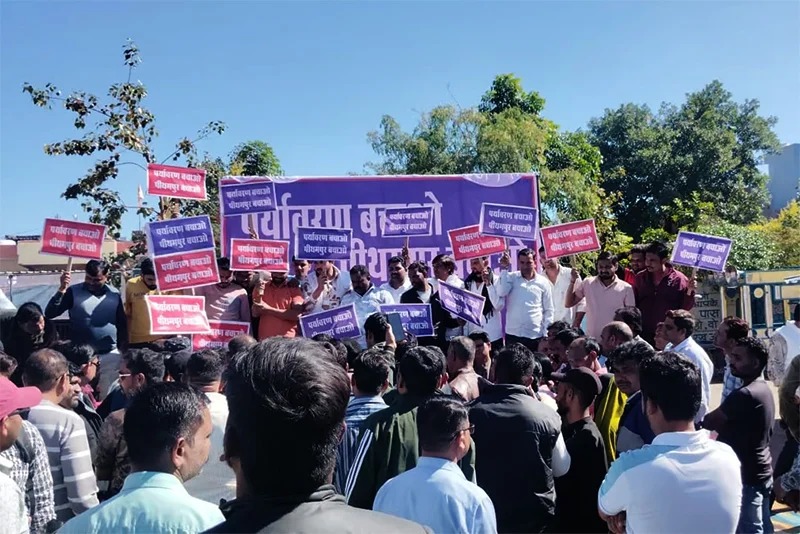
The immediate catalyst was an operation in June last year. Toxic waste weighing 337 metric tonnes (MT) from the defunct pesticide plant, Union Carbide, was incinerated at the private waste treatment facility at the Ramky TSDF facility in the Pithampur industrial area in Madhya Pradesh. This waste had been moved from Bhopal in January amidst fierce protests. Two people even attempted self-immolation.
Monitored by the Central Pollution Control Board (CPCB) and the Madhya Pradesh Pollution Control Board (MPPCB), the incineration, along with 19 MT of contaminated soil and packaging material, was declared a success. Emissions, officials state, were within prescribed safety limits.
But the process left behind almost 900 MT of ash containing several heavy metals. While officials focused on stack emissions, reports confirmed this residual ash itself had mercury levels higher than permissible limits. An entire 900 MT of toxic ash is stored in leak-proof bags at the Pithampur plant. Plans to bury it in a specially constructed landfill cell on the premises were met with strong opposition, forcing judicial intervention. In August last year, the Madhya Pradesh High Court directed the state government to find an alternative disposal site away from human habitation. By December, the court put its own order in abeyance and directed the state government to comply with the order dated December 3, 2024, subject to the opinion of the expert committee constituted by the court.
The scale is critical: the 337 MT waste incinerated is believed to be about one per cent of the total toxic waste still lying in the abandoned Union Carbide factory.
Mercury: The Potent Ghost
Mercury is a neurotoxin and a known carcinogen. Once released, it does not degrade. It bio-accumulates, capable of causing long-term contamination of soil, groundwater, air and the human body for generations. According to waste characterisation studies conducted over the years, Bhopal’s toxic waste contains 700 to 900 times more mercury than permissible safety limits, mixed with other persistent organic pollutants and heavy metals.
Yet, in successive trial incineration reports, most notably those from 2015 and 2025, the official data present a baffling anomaly. Mercury, once documented in alarming concentrations, appears to have almost vanished. This inexplicable disappearance has become the key bone of contention.
Toxic Gap in the Data
Objections are led by Dr K. Babu Rao, a retired senior scientist from the Indian Institute of Chemical Technology, and Dr Asif Qureshi, a professor at IIT Hyderabad. Both have independently questioned the credibility of the mercury data presented by the pollution control authorities.
Dr Rao argues the CPCB’s handling of the incineration trials violates India’s obligations under several international environmental conventions, including the Minamata Convention on Mercury, the Basel Convention, and the Stockholm Convention. “These conventions demand extreme caution, transparency, and accountability in handling toxic substances like mercury,” Dr Rao points out. “Yet fundamental principles were ignored.”
The most serious lapse is the absence of a mercury mass balance audit, which is a basic requirement under the CPCB’s own guidelines for hazardous waste incineration. It is an accounting exercise: how much mercury enters the system, and where does it all exit? Without this balance sheet, there is no way to track the poison’s pathway, making any claim of “safe disposal” scientifically hollow.
The numbers reveal a disturbing story. According to the CPCB’s own 2015 report, mercury concentrations in different categories of Union Carbide waste ranged from 152 mg/kg to as high as 904 mg/kg. Based on the quantities of waste listed for incineration, scientists calculate that the total mercury load should have been between 49 kg and 221 kg.
But the 2025 MPPCB report presents a stark contradiction. It lists mercury in the input waste as “not detected”. If this 2025 data is correct, a terrifying question arises: Did all that mercury simply escape into Bhopal’s environment over the past decade? If so, how?
Dr Qureshi, in a detailed scientific critique, calls this conclusion implausible. Mercury in contaminated soil is not easily lost to the atmosphere under normal conditions. “And no known environmental case studies show such a massive depletion in such a short time,” he notes.
Even within the narrow frame of the incineration trials, the math fails. The 2015 characterisation showed that 10 MT of hazardous waste contained between 1.5 kg and 6.8 kg of mercury. In 2025, three trial runs incinerated 10 MT each. That mercury had to go somewhere. Official reports claim no mercury was detected in the stack emissions. Only 0.917 grams were reported in the discharge ash.
So where did the remaining kilograms go? Dr Qureshi provides a technical possibility: activated carbon and sulphur are added to the flue gas to trap mercury before it reaches the bag filters. If so, the mercury should now reside concentrated in the bag filter ash, itself a hazardous waste stream. But this ash and its fate are neither clearly reported nor discussed. “In effect”, he writes, “one contaminated waste may simply have been converted into another contaminated waste without clarity on its final fate”.
Unmeasured Pathways
Equally troubling is what was not monitored. During both the 2015 and 2025 trials, authorities did not measure mercury concentrations in the ambient air around the incinerator, despite mercury’s well-known tendency to vaporise at high temperatures. This omission violates standard safety protocols. While officials point to ambient air monitoring during a different batch incineration in 2022 showing no mercury, it only deepens the central mystery: if it was not in the air, and was not in the waste, where is it?
Public health data adds a visceral layer of concern. A 2010 study published in the Journal of Indian Society of Toxicology detected mercury, lead and chlorinated solvents in breast milk samples collected from mothers living three kilometres from the Union Carbide site. This proves these poisons have entered the human food chain. The long-term exposure pathways for the people of Bhopal remain poorly understood and, critics argue, deliberately uninvestigated.
Courtroom Battle
These scientific concerns have entered the courtroom. In December 2025, the Madhya Pradesh High Court kept its earlier order allowing waste disposal in abeyance. It directed the state to comply with its December 2024 order, subject to the opinion of an Expert Committee including officials from the MPPCB, CPCB, and the National Environmental Engineering Research Institute.
But survivor groups say this committee has failed to answer the most critical question. In a detailed letter dated May 9, 2025, the Bhopal Group for Information and Action submitted the mass balance analysis by Dr Qureshi showing that between 4.5 kg and 20 kg of mercury from just 30 tonnes of waste remains unaccounted for.
The state’s position remains one of bureaucratic assurance. The MPPCB, in a September 2025 affidavit to the high court, maintained that leachability tests showed heavy metals, including mercury, were “within prescribed limits” for disposal in a secured landfill. It argued that even if leachate contacted water sources, dilution would keep concentrations within permissible levels.
The high court, however, seems profoundly unconvinced by this logic of dilution. In a sharply worded order, it rejected the idea that a containment facility near human habitation could be considered safe merely because the State claims the science is sound. Citing Bhopal’s own history, the judges noted that “no amount of caution is in excess” when dealing with toxic waste. The ghost of 1984 explicitly informed the judiciary’s scepticism.
Unresolved Present
Until the mercury is accounted for—kilogram by kilogram, pathway by pathway—the question will not go away. For the people of Pithampur and Indore, now on the frontline, the fear is palpable. President of the Pithampur Bachao Samiti, Dr Hemant Hirole, says the government is misleading the people and the courts. Monika Solanki, vice president, warns, “This hazardous waste will contaminate all the water sources, affecting even the Yashwant Sagar reservoir of Indore.”
In Bhopal, a city that paid the ultimate price for official assurances and corporate negligence, missing mercury is not a technicality, it is a warning. For survivors, scientists and a growing number of citizens, the path is clear: make the polluter, Union Carbide and its owner Dow Chemical, pay for a complete, transparent, and internationally supervised cleanup under the Polluter Pays Principle. Until that happens, the ghost, in the form of unaccounted mercury, will continue to haunt.
Rakesh K Chitkara, who was a vice president, South Asia of Dow Chemicals, further sums it up well: “India’s environmental failures are no longer about capability; they are about the will. The Bhopal case remains unresolved, not due to technical difficulties, but rather due to a persistent reluctance to disclose fully, make firm decisions, and conclude transparently. Missing data, deferred accountability, and endless procedural loops may satisfy files and affidavits, but they do not satisfy science or the public trust.”
(The author is a Madhya Pradesh-based veteran journalist)