
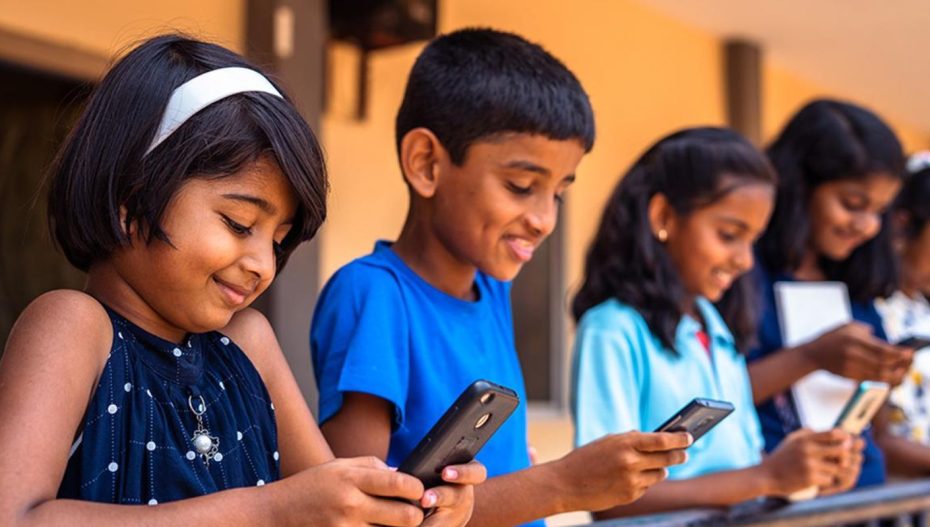
Not schools. Not parents. Not even peers. It’s Reels, Shorts, and whatever comes after. Are we okay with that?
When did the babysitter stop being the neighbour’s daughter and start being a server farm in California? Indian parents once worried about playground gossip, Bollywood songs, or cable television. Today, the real “playground” is virtual. It scrolls endlessly in 15-second bursts—platforms where algorithms decide what children see, who they imitate, and even what they dream of becoming.
Childhood is no longer unfolding in parks or classrooms. Increasingly, it is being outsourced to machine-learning models built not for wisdom or values, but for engagement and profit.
The New Classroom: Infinite Scroll
The numbers are sobering. According to Common Sense Media’s 2024 report, American teenagers spend an average of 4.8 hours daily on short-form video apps. In India, an IAMAI survey found that over 40% of children aged 9–17 are daily users of Reels or Shorts. Teachers in Delhi and Kolkata confirm that students often consume more content than parents even imagine. Ofcom’s UK study puts teens’ TikTok use at 3.5 hours a day.
Unlike television, where families once gathered around the same serial, algorithm-driven feeds mean no two children grow up in the same media universe. A 13-year-old in Patna who pauses on cricket clips may soon be nudged into endless match highlights, betting tips, and fantasy league ads. Another child in Bengaluru who lingers on beauty hacks might find their feed filled with diet fads, cosmetic promotions, and body-shaming videos within weeks.
This is not passive entertainment. It is personalised programming of identity.
Childhood Built for Engagement
The economics are brutally simple: platforms profit when children stay hooked. Every swipe generates data. That data trains the algorithm to predict the next most clickable video. It is not a teacher assessing needs, but a statistical model optimising for “engagement.”
Psychologists call it dopamine-driven conditioning. Jean Twenge, author of iGen, notes that “short-form video rewires attention spans,” creating brains trained for instant gratification and allergic to boredom. Research from Stanford and Harvard echoes this: heavy users report higher anxiety, lower patience, and shorter attention spans.
In Indian homes, parents already observe this. Children are restless without a screen, impatient with books, and quick to mimic every viral “trend”—whether it is a dance move, a prank, or a dangerous stunt. In 2023, two schoolboys in Uttar Pradesh were injured while filming a Reel imitating a risky “train surfing” trend. The incident was dismissed as “kids being kids,” but it was in fact a lesson in algorithmic influence: the challenge spread because the system rewarded danger with visibility.
Childhood curiosity, once spread across play, books, and slow discovery, is now collapsed into swipe-sized fragments.
Who Bears Responsibility?
Parents admit they are overwhelmed. A 2024 Pew survey found that 67% of parents of teens feel they have “little control” over what their children consume online. In India, many mothers and fathers—especially in smaller towns—say their children know far more about navigating apps than they do.
Teachers face the spillover daily. A school in Delhi reported students repeating conspiracy theories about COVID they had absorbed from TikTok. In Mumbai, educators worry about “Andrew Tate influence” seeping into teenage boys’ views of women. In Lucknow, teachers say students measure their worth in “likes” and “shares,” not marks.
Regulators lag even further behind. India banned TikTok in 2019, but Instagram Reels and YouTube Shorts immediately filled the vacuum. China has capped screen-time for under-18s. The EU has fined TikTok. The US still debates its Kids Online Safety Act. Yet meaningful algorithmic transparency is missing everywhere. As one British MP said bluntly: “We are letting private companies raise our children.”
The Cost of Outsourcing Childhood
The dangers are already here:
- Mental Health: A 2023 JAMA Pediatrics study linked heavy short-form use with higher rates of depression and anxiety among adolescents.
- Consumerism: Micro-targeted ads and influencers blur the line between entertainment and marketing. Children become shoppers before they become readers.
- Polarisation: Algorithms feed children only what they “like,” locking them into political, cultural, or gender-identity silos early.
- Erosion of Empathy: When a feed mirrors only one’s preferences, children rarely encounter other perspectives.
The result? A generation fluent in memes but unable to sit through a novel. Quick to mimic viral dances, but struggling with sustained human connection.
Childhood in the Age of the Algorithm
In India, the smartphone has become the all-purpose toy, tutor, and entertainer. A low-cost Android handset in a Tier-2 town can deliver more Reels in a week than Doordarshan broadcast in a decade.
Even schools struggle to keep pace. In Kerala in 2024, one government school banned smartphones on campus after students were caught filming Reels during class hours. But bans are porous. For every restriction, children find workarounds, often more sophisticated than those imagined by teachers or parents.
Globally, governments have experimented with responses. India banned TikTok. The EU fined TikTok in 2021. China imposed strict limits in 2022. Yet in 2025, the core issue remains unresolved: algorithms are still black boxes. Parents, educators, and regulators remain outsiders to the very systems shaping young minds.
So the central question is this: are we prepared to let childhood itself be rewritten by code?
Are We Okay With That?
There are only two paths forward.
One is acceptance: to shrug and acknowledge that children will be shaped by algorithms, just as earlier generations were shaped by cinema or television.
The other is resistance—through regulation, digital literacy, and cultural change. That means demanding transparency, so platforms disclose how they curate content for minors. It means embedding digital literacy in Indian schools, where children learn not just algebra and history, but also how algorithms manipulate attention. It requires parents to move beyond bans, towards co-viewing and open conversations. And yes, it may mean time limits, controversial though they are—because, like China’s, they at least force a serious reckoning.
If nothing changes, the answer to the question “Who is raising our children?” is already clear. It is not families, not schools, not communities. It is the algorithm—and it is raising them in its own image: fragmented, restless, and optimised for clicks.
The final question, then, is not technological but moral: are we okay with that?
Parents’ Survival Guide
- Co-View, Don’t Just Control
Scroll together. Ask: “Why do you like this?” or “What are they trying to sell?” This builds awareness, not rebellion. - Teach Digital Literacy Early
Explain algorithms simply: “Apps show you what keeps you watching, not what’s true.” Even 10-year-olds get it. - Time Is Power
Set screen-free zones (dinner, bedtime) and occasional screen-free days. Consistency beats random bans. - Model What You Preach
Kids copy you. If you’re glued to your phone, they will be too. Replace scrolling with shared activities—walks, games, cooking. - Diversify Media Diets
Books, music, long-form videos, podcasts, board games—variety keeps the algorithm from owning all their attention. - Use Tech Wisely
Parental controls, daily limits, and family-pairing tools aren’t perfect—but they help. - Keep Conversations Open
Don’t scold. Discuss what they see online. A culture of dialogue ensures they’ll come to you when things turn harmful.