

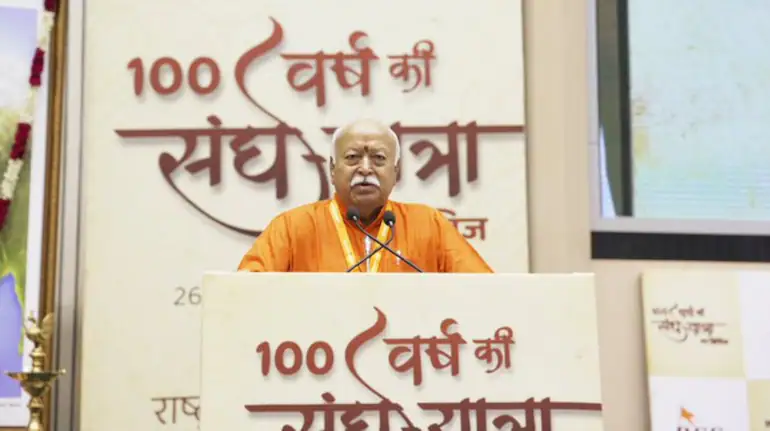
The Rashtriya Swayamsevak Sangh (RSS) celebrates its centenary in 2025, a hundred years since Hindutvawadi former Congress member K B Hedgewar founded the organisation in Nagpur on September 25, 1925. Marking the occasion, Sarsanghchalak Mohan Bhagwat convened a three-day dialogue at Delhi’s Vigyan Bhawan, bringing together Sangh workers, office-bearers and on the final day, members of the media. The event drew attention for two reasons: both Bhagwat and Prime Minister Narendra Modi turn 75 this year—an age associated in the BJP’s politics with retirement—and the RSS, traditionally a highly private body, hosted a rare public dialogue.
That the RSS chose such an open forum signals its strategic intent. Historically, the RSS has preferred to deliberate in private, forging consensus behind closed doors and under a veil of secrecy. By stepping into the public eye during its centenary, the organisation projected both confidence and an awareness of contemporary political optics.
Unsurprisingly, the issue of retirement at 75, once highlighted by both the RSS and Modi, resurfaced. Bhagwat’s response typified the organisation’s pattern: while the principle is upheld publicly, leaders, including himself and Modi, show little inclination to follow it. Asked about the rule, Bhagwat stated he had never asked anyone to retire at 75, adding that he himself would not. For now, retirement at 75 remains a symbolic talking point rather than a policy.
Equally scrutinised was Bhagwat’s framing of RSS-BJP relations. He emphasised that while minor differences exist, there is no fundamental conflict. Yet history suggests otherwise. After the 2024 Lok Sabha elections, the Sangh’s mouthpiece, Organiser, carried its ideologue Ratan Sharda’s critique of the BJP’s “arrogant strategy”, blaming its decision to contest all 543 seats in Modi’s name for the party’s setbacks. Bhagwat, in what was seen as a veiled jab at the prime minister, remarked that “a true sevak never becomes arrogant”. The Sangh also criticised the BJP’s “smash-and-grab” manoeuvres in Maharashtra, engineered by leaders in Delhi. Such episodes illustrate an uneasy balance between collaboration and reproach, carefully calibrated to prevailing political contexts.
This strategic calibration is also visible in the Sangh’s shifting role in temple politics. In the Ayodhya Ram temple movement and earlier in the Krishna Janmabhoomi and Vishwanath temple issues, the RSS played a decisive role in mobilising support. Yet, during the centenary, the RSS declared that it would not participate in any agitation over temples in Mathura or Kashi.
This retreat was neither sudden nor accidental but a deliberate policy. With BJP governments securely in power at both the Centre and in Uttar Pradesh, active RSS involvement could appear redundant, or worse, undermine the BJP’s authority. In earlier decades, when non-BJP governments held power, the Sangh saw mobilisation as essential; today’s restraint shows that its decision to act or withdraw is dictated less by ideology than by the political climate of the moment.
Reservation and social justice expose similar inconsistencies. Over time, the RSS has alternately questioned and endorsed reservation. During the centenary dialogue, Bhagwat avoided clarity, though Sangh leaders have often debated the duration, scope and methods of caste-based quotas. At Hyderabad in April 2024, Bhagwat stated, “The Sangh Parivar has never opposed reservation being given to some families; reservation should continue as long as it is necessary.” Yet, in 2015, ahead of the Bihar assembly elections, Bhagwat had called for a review of reservations. More recently, he has suggested that caste quotas be implemented “with sensitivity”. These oscillations, once again, reveal that the Sangh’s stance is not fixed but situational, adapting to shifts in political and social realities.
Contradictions also surface in its interpretation of Indian Independence and its Constitution. In January 2025, Bhagwat claimed India’s “true freedom” arrived with the consecration of the Ram temple in Ayodhya, implicitly diminishing the significance of August 15, 1947. Such assertions place religious milestones above constitutional or historical markers of Independence. Similarly, the Sangh’s approach to the constitution alternates between questioning its provisions and professing allegiance, depending on circumstance.
On language, too, the pattern is familiar. The RSS occasionally speaks of protecting India’s many languages, yet just as often insists on giving Hindi primacy. The approach is pragmatic rather than doctrinal, demonstrating again the Sangh’s capacity for flexibility.
What the centenary dialogue laid bare was a consistent pattern—across retirement, temple politics, reservation, Independence, the Constitution, and language–the Sangh’s positions shifted with context, appearing flexible yet frequently contradictory. Bhagwat reversed earlier calls for leaders to retire at 75. On temples, he distanced the Sangh from causes it had historically championed. On reservations, he sought a balance between older scepticism and current affirmations. On Independence, he advanced a narrative subordinating constitutional milestones to religious symbolism.
These contradictions, however, are not simply rhetorical. They illustrate the Sangh’s political method: an ability to navigate India’s complex socio-political terrain by balancing ideology with expediency. Its ideological framework is not monolithic but dynamic, recalibrating with context and necessity. This capacity to adjust without abandoning its Hindutva core has enabled the organisation to endure and thrive for a century.
The RSS at 100 is, therefore, both a celebration of longevity and a study in paradox. Its contradictions, whether over retirement, relations with the BJP, reservation or constitutional interpretation, reveal not weakness but strategic elasticity. This helps explain how the Sangh has remained influential across generations, governments and shifting political landscapes.
The centenary dialogue becomes, in this sense, a window into the RSS’s enduring paradox: a century-old body with a rigid ideological core, yet remarkable flexibility in practice. These very contradictions may be its greatest strength, ensuring survival and influence in India’s turbulent sociopolitical arena.
(The author is a veteran journalist and also a political analyst)