


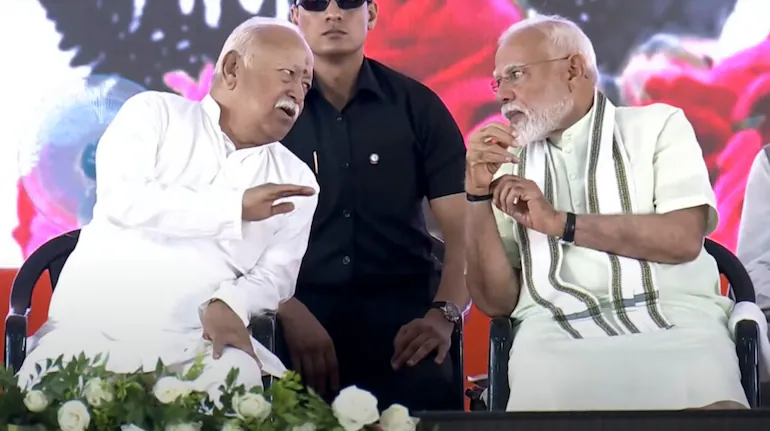
For more than a decade, the growing assertiveness of the Rashtriya Swayamsevak Sangh has drawn attention far beyond India’s borders. That scrutiny intensified after The New York Times published a detailed investigation in its December 29, 2025, edition, titled From the Shadows to Power: How Hindu Nationalism Remade India. The report, which traces the organisational, ideological and political expansion of the Sangh ecosystem, has since triggered sustained debate both internationally and within India.
The report argues that the political rise of Narendra Modi has coincided with, and significantly accelerated, the institutional penetration of the Rashtriya Swayamsevak Sangh (RSS). Its influence now reaches across government, electoral politics, sections of the judiciary and civil society, the newspaper notes. Built patiently over decades as a disciplined, cadre-based organisation, the RSS today anchors one of the most formidable ideological networks in contemporary India.
According to the investigation, Sangh-affiliated organisations have acquired unprecedented legitimacy and visibility during Modi’s tenure, increasingly blurring the boundary between civil society activism and political authority.
No longer confined to cultural or social work, the Sangh has evolved into a force that shapes political narratives, policy priorities and grassroots mobilisation. By systematically organising youth and embedding Hindu nationalist ideas at the local level, the RSS has supplied both ideological direction and manpower to the electoral machinery of the Bharatiya Janata Party (BJP).
With more than 83,000 shakhas connected through local structures and digital platforms, the RSS remains central to shaping its vision of citizenship and national identity. Whether that vision reinforces India’s democratic framework or places it under strain lies at the centre of the global debate.
The report observes that RSS leaders increasingly project moderation and inclusivity in public statements. On the ground and online, however, such nuance is often absent. A new generation of hardline voices competes for attention, amplified by social media ecosystems that reward provocation and normalise intimidation and violence.
Predictably, the report has polarised opinion. Supporters of the Sangh and the BJP have dismissed it as a manufactured narrative, accusing a left-leaning Western press of intellectual hostility and of deploying exaggerated comparisons with fascist regimes to generate alarm. Others, including academics and civil liberties groups, regard the investigation as an accurate reflection of developments visible across the country.
Sangh supporters insist that the RSS is a nation-building organisation unfairly maligned by foreign media. Critics counter that its growing acceptance in public life has coincided with the marginalisation of minorities and the steady erosion of India’s secular foundations.
Much of the debate revolves around religion, specifically Hinduism and the political ideology of Hindutva. Yet as the controversy unfolds, a deeper contradiction becomes apparent. Many who speak most aggressively in the name of Hindutva show little engagement with its philosophical traditions or historical evolution. Assertion has replaced argument, and hostility has displaced reflection. Religion is increasingly reduced to a marker of identity, stripped of ethics, reason and moral enquiry.
Religion, by definition, presupposes a moral order grounded in balance and truth. As physicist and Harvard scholar Willie Soon once argued while discussing the fine-tuning of the universe, time itself follows mathematical discipline rather than emotional impulse. Public discourse in India, by contrast, is increasingly shaped by the treatment of faith as a weapon rather than a guide.
Over the past decade, incidents undermining social harmony have grown more frequent, many involving members of the Hindu majority. Even a cursory review of events from 2025 reveals a troubling pattern.
In December, a 24-year-old MBA student from Tripura, Angel Chakma, was fatally stabbed in Dehradun after protesting a racial slur directed at his younger brother. Despite repeatedly stating that he was Indian and not Chinese, the attackers showed no restraint. His father, Tarun Chakma, later said the family was devastated not only by the loss, but by the indifference that followed.
Around the same time, Japanese tourists visiting Dashashwamedh Ghat in Varanasi were publicly humiliated by locals who accused them of polluting the Ganga. The visitors folded their hands and apologised, yet the abuse continued, revealing an unsettling strain of xenophobia cloaked in religious rhetoric.
Another episode unfolded in Bareilly, Uttar Pradesh, on December 28. A nursing student celebrating her birthday at a café had invited friends from both Hindu and Muslim communities. The presence of two Muslim youths provoked a group of Hindu activists, who created a disturbance. Initial police action targeted the Muslim attendees, allegedly on the basis of a selectively circulated video. Only later, following further investigation, were five activists of the Bajrang Dal arrested for entering the café, threatening patrons, raising slogans of “love jihad” and attempting to incite communal tension.
The birthday host later contradicted the viral narrative, stating that the video did not present the full picture and that the disruption had been instigated by outsiders. The episode demonstrated how misinformation, reinforced by institutional bias, can swiftly criminalise routine social interaction between communities.
These were not isolated incidents. Opposition to Valentine’s Day celebrations, moral policing and vigilantism carried out in the name of cultural nationalism has a long history. Taken together, they point to a form of nationalism emptied of confidence and sustained instead by coercion. This, the New York Times suggests, is the context in which Hindu nationalism has reshaped India’s public sphere.
The response from Sangh supporters has been combative. Senior journalist Deepak Chaurasia described the report as a conspiracy, arguing that the newspaper’s real discomfort lay not with the RSS but with India’s growing self-assurance. He alleged the involvement of a “deep state” determined to malign India’s largest Hindu organisation by portraying it as secretive and extremist.
Within Sangh circles, there is unease that foreign media are projecting the RSS as an organisation that has quietly infiltrated India’s institutions and is dismantling secularism from within. Sangh ideologues counter this by arguing that India is not a secular state in the Western sense but a panth-nirapeksh one, meaning neutral among faiths rather than indifferent to religion.
Yet broader social data complicates these assertions. Communal violence in 2025 spanned multiple states. In March, clashes in Nagpur over demands to remove Aurangzeb’s tomb left one person dead and dozens injured. Maharashtra Police recorded nearly 800 incidents of violence in the first quarter alone.
In April, protests against the Waqf Amendment Act turned violent in Murshidabad, West Bengal, leading to three deaths, arson and displacement. In October, communal clashes during Durga Puja idol immersion in Cuttack, Odisha, injured more than 25 people, prompting curfews and internet shutdowns.
Violence was also reported during religious processions in Andhra Pradesh, Muharram observances in Rajasthan and Christmas-related tensions in parts of north India. Human rights groups estimate that close to 1,000 hate-related incidents were reported to police stations in the first half of 2025. Government data records 269 cases of communal violence across 28 states and Union Territories during the year.
Manipur presented an especially grim picture. Ethnic violence between the Kuki and Meitei communities continued without respite, with September alone witnessing the killing of 11 people in a single flare-up. These developments have inevitably shaped international perceptions of India, lending context to the New York Times assessment.
Amid this scrutiny, the RSS is reportedly considering organisational restructuring. Sources indicate that proposals may be placed before the All India Representatives’ Assembly scheduled for March in Samalkha, Haryana. As the Sangh’s activities expand, leaders believe structural changes are necessary to support social mobilisation and organisational consolidation. Even if approved, implementation is unlikely before 2027.
The RSS began its journey on Vijayadashami in 1925, when Keshav Baliram Hedgewar founded it in Nagpur with the stated aim of organising Hindu society. Its emphasis on unity, discipline and nationalism has long invited comparisons with other mass movements of the early twentieth century. Critics continue to draw parallels with the politics of Adolf Hitler, who mobilised identity and grievance into state power. While historical contexts differ, they argue that the underlying logic of aggressive majoritarianism remains unsettlingly familiar.
India appears to have entered such a phase.
(The author is a veteran Delhi-based journalist and political analyst)