





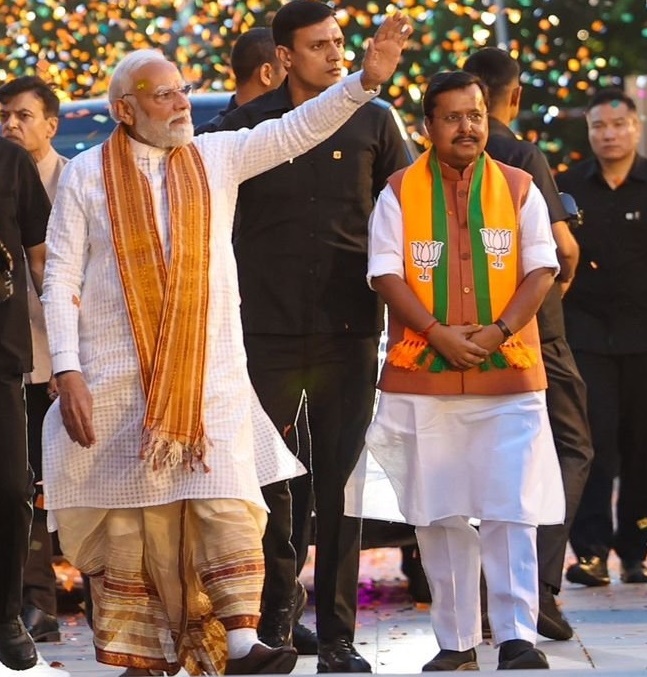
The results of the 2026 Assembly elections in West Bengal, Assam, Kerala and Tamil Nadu have done far more than change governments. They have altered the political grammar of contemporary India. These elections were not merely regional contests fought over local grievances, welfare promises or leadership personalities. Together, they have produced a larger national narrative — one that strengthens Prime Minister Narendra Modi and the BJP’s claim that they now represent the dominant political force across the Indian Union, while simultaneously exposing the deep structural weakness of the opposition and the uncertain future of regional parties.
For nearly a decade, Indian politics has revolved around one central question: can the opposition create a credible counterweight to the BJP’s electoral machine and ideological narrative? The latest results suggest that the answer, at least for now, remains uncertain.
The BJP’s most consequential victory has undoubtedly come in West Bengal. Bengal was not merely another state election. It was symbolic terrain. For decades, Bengal remained politically and culturally resistant to the BJP’s brand of politics. The state represented a unique mix of Bengali regional identity, Left intellectual traditions, minority politics and sub-national pride. Yet the BJP has now broken that psychological barrier. The party’s victory signals that it is no longer confined to the Hindi heartland. It has successfully entered one of India’s most politically conscious and historically resistant regions.
Politically, the victory gives the BJP something even more important than state power, that is, legitimacy. The party can now argue that its appeal cuts across language, geography and culture. Prime Minister Narendra Modi’s declaration that the BJP now stretches “from Gomukh to Gangasagar” was not merely rhetorical triumphalism. It reflected the party’s belief that it is steadily becoming the default national political force in India.
The Bengal result also represents a personal and strategic setback for Mamata Banerjee. For years, she was projected as one of the few opposition leaders capable of confronting Modi politically and rhetorically. Her defeat weakens not only the Trinamool Congress but also the broader imagination of a federal anti-BJP coalition. The INDIA bloc was always dependent on strong regional satraps holding their respective fortresses. Bengal was among the most important of those fortresses. Its fall dramatically changes opposition morale.
In Assam, the BJP’s third consecutive victory under Himanta Biswa Sarma demonstrates the consolidation of saffron politics in the Northeast. Assam once witnessed fragmented mandates, unstable coalitions and identity-driven politics centred around ethnicity and migration. The BJP has managed to convert these anxieties into a durable political constituency.
More importantly, Assam confirms that the BJP’s political dominance is no longer solely dependent on Narendra Modi’s charisma. Regional leaders within the party are now capable of independently delivering victories. Sarma has emerged as perhaps the BJP’s most effective regional strategist outside the Hindi belt. That matters enormously for the party’s future because it indicates organisational depth beyond a single leader.
The Assam result also exposes one of the opposition’s greatest vulnerabilities: fragmentation. Muslim votes, anti-incumbency sentiments and local dissatisfaction were insufficient to defeat the BJP because the opposition failed to remain united. This pattern is increasingly becoming a national phenomenon. The BJP benefits not merely from its own strength but from the inability of its rivals to create coherent political coalitions.
Yet the most politically intriguing result may have come from Tamil Nadu. Unlike Bengal and Assam, Tamil Nadu did not produce a BJP victory. But it still transformed the national political conversation. The rise of actor-turned-politician “Thalapathy Vijay” and his party TVK (Tamilaga Vetri Kazhagam) has destabilised the Dravidian political order that dominated the state for nearly six decades.
The weakening of both the DMK and AIADMK reveals a deeper churn within regional politics. Voters increasingly appear willing to abandon traditional loyalties in favour of personality-driven alternatives. Tamil Nadu’s verdict suggests that even the most entrenched regional systems are no longer immune to political disruption.
For the INDIA bloc, this development creates another complication. The opposition alliance depends heavily on powerful regional parties such as the DMK, TMC and others to compensate for Congress’s organisational decline. But if these regional parties themselves begin losing authority within their states, the anti-BJP national coalition becomes structurally weaker.
At the same time, Tamil Nadu also shows the limits of BJP expansion. Despite the party’s national dominance, it still struggles to emerge as a principal force in parts of southern India where strong linguistic and regional identities continue to shape political behaviour. The BJP’s challenge now is not merely electoral entry but emotional integration into southern political consciousness.
In Kerala, the Congress revival carries immense symbolic significance, yet it simultaneously exposes the deeper contradictions within the opposition camp. Congress’s victory revives the party in one state even as the broader opposition ecosystem weakens nationally. Kerala’s verdict was less a pro-Congress wave and more a verdict against Left fatigue, corruption allegations and anti-incumbency.
Still, the defeat of the Left Front has national implications. For the first time in decades, the organised Left has effectively disappeared from state power in India. This marks the end of an important ideological chapter in Indian politics. The decline of the Left has also created a vacuum in opposition discourse. Economic inequality, labour politics and class-centred mobilisation have steadily lost electoral centrality to identity politics, nationalism and welfare populism.
Collectively, these four elections reveal three major trends shaping India’s political future.
First, the BJP has successfully transformed itself from a northern ideological party into a genuinely pan-Indian political machine. Even where it does not win, it increasingly shapes the narrative, polarisation and campaign agenda. The party’s organisational discipline, welfare messaging, leadership projection and ability to merge nationalism with local politics continue to give it a decisive advantage.
Second, the opposition still lacks coherence. The INDIA alliance remains more a collection of anti-BJP sentiments than a unified political project. Its constituent parties often compete against one another regionally while attempting national cooperation simultaneously. That contradiction remains unresolved.
Third, regional politics itself is entering a period of instability. Leaders once considered electorally invincible now appear vulnerable. New personalities, new caste combinations, welfare promises and digital-era campaigning are rapidly reshaping state politics. The era of permanent regional bastions may be ending.
The broader national consequence of these elections is therefore unmistakable. Narendra Modi enters the next political phase not merely as the head of a ruling party but as the central axis around which Indian politics continues to rotate. The opposition’s problem is no longer simply defeating the BJP electorally. Its larger challenge is intellectual and emotional: creating a national narrative powerful enough to compete with Modi and the BJP’s idea of political inevitability.
(The author is a veteran journalist and also a political analyst)


