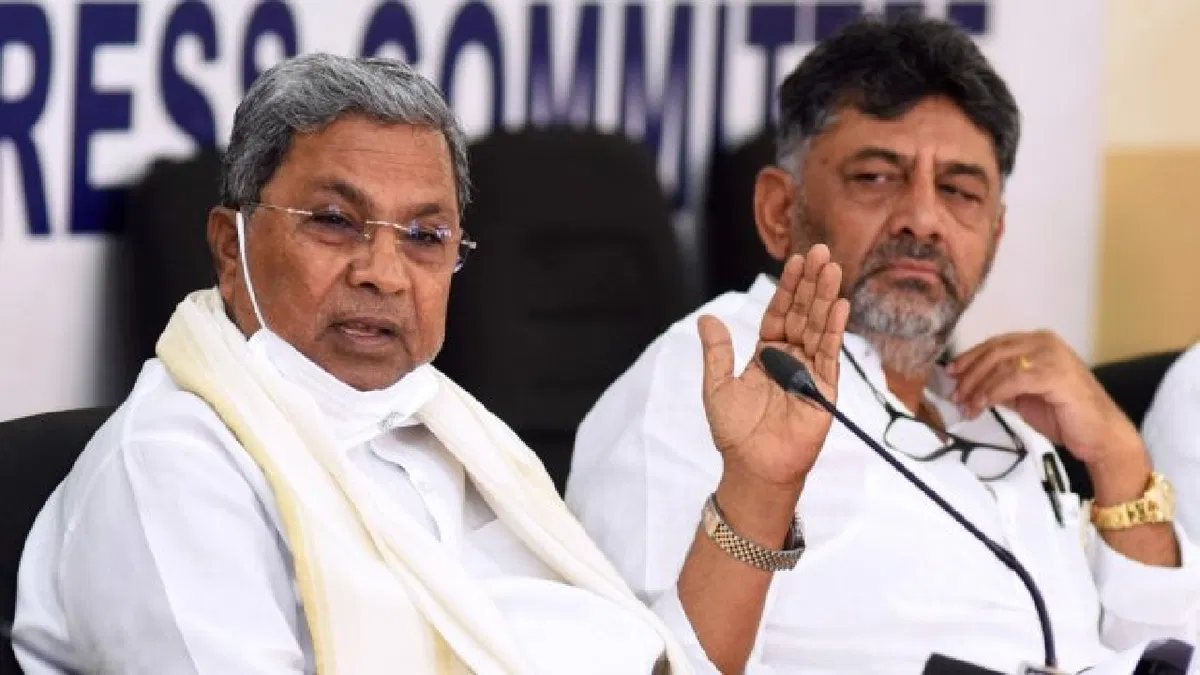
What was meant to be a celebration of the Karnataka government’s achievements last month in Mysuru turned into a revealing display of political powerplay within the Congress. As the Chief Minister Siddaramaiah delivered a fiery speech before a crowd of over a lakh, the Deputy Chief Minister DK Shivakumar quietly exited the venue — before the CM even took the mic. The gesture did not go unnoticed. In fact, it marked the clearest sign yet of a deepening rift within the Congress’s top leadership in the state.
The rally, dubbed “Sadhana Samavesha”, was officially organised to highlight the government’s welfare schemes and development record. But for political observers, it served as a stage for Siddaramaiah to assert his authority, and for Shivakumar’s growing frustration to spill into the open. The two leaders’ differences came to the fore just two days after the Karnataka in-charge and AICC General Secretary Randeep Singh Surjewala hosted a “white flag” meeting at a Bengaluru star hotel. The Mysuru incident made it clear that the patch-up bid had failed, forcing the AICC to take stock afresh.
Shivakumar, once seen as the natural successor under an informal power-sharing pact, now finds himself cornered, frustrated, and increasingly isolated. In 2023, when the Congress swept back to power in Karnataka, a delicate power-sharing deal was struck: Siddaramaiah would be the CM for 2.5 years, then Shivakumar would take over. That halfway mark, November 20 precisely, is now looming. But Siddaramaiah, buoyed by a large majority of the Congress MLAs — reportedly 119 of 136 — has repeatedly made it clear that he will complete the full five-year term. The Congress high command’s tacit support for the CM has only deepened Shivakumar’s predicament.
Despite holding two powerful posts — deputy CM and state Congress president — Shivakumar now faces a growing dilemma. Should he continue to wait and hope for the high command to honour the earlier arrangement? Should he mount pressure internally and risk being labelled a destabiliser? Or should he take the ultimate gamble: crossover to the BJP?
It is a delicate situation for a politician who has spent his entire career in Congress. Known for his organising skills, grassroots connections, and financial heft, Shivakumar has long been one of the party’s most influential leaders in Karnataka. But his ambition to lead the state now runs headlong into the party equations that appear to favour the status quo over transition.
Administrative clashes between his camp and Siddaramaiah’s have become increasingly frequent. Shivakumar’s portfolios — water resources and Bengaluru development — have reportedly faced scrutiny from the Chief Minister’s Office, souring relations further. One recent spat between the CM’s staff and Shivakumar’s officer escalated dramatically, with reports of a physical altercation at the Karnataka Bhavan in Delhi, making national headlines.
Even so, Shivakumar has remained largely restrained in public. The firebrand image that once defined him has given way to a more measured persona, even as his supporters grow louder in their calls for clarity. Some within his camp feel the delay in transition is a betrayal. Political observers warn that keeping Shivakumar out of the top post for much longer could fatally weaken his political standing.
Amid this backdrop, rumours of a possible shift to the BJP have gained traction. Shivakumar’s increased religious outreach over the past year — temple visits, public spiritual events, and even appearing on stage with the Union Home Minister Amit Shah — has antagonised the high command, especially Rahul Gandhi. Some party insiders see these moves as a signalling of readiness to jump ship if pushed too far.
The BJP, on its part, is grappling with internal leadership challenges of its own in Karnataka. With the Lingayat vote bank firmly in the hands of the father-son duo — Yediyurappa and Vijayendra — the party has struggled to make inroads among the influential Vokkaliga community. Shivakumar, a dominant Vokkaliga leader with a strong regional base, could offer the BJP a crucial breakthrough in South Karnataka. Currently, the Vokkaliga vote bank is split between three parties — the JD(S), the Congress and the BJP.
But the path ahead is not smooth. Central agency investigations — from the Enforcement Directorate to the Income Tax Department — still loom large over Shivakumar. A shift to the BJP could invite charges of rank opportunism, alienate his core voter base, and erode his credibility as a lifelong Congressman. There is also no assurance the BJP would hand him the chief minister’s chair — a central demand for any potential crossover.
Also, Shivakumar’s political identity and base are intrinsically linked to the Congress, and he may not be easily accepted in the BJP ranks. But, many political analysts believe the BJP leadership, especially Amit Shah, could still see value in bringing him on board to revive the party’s flagging fortunes in Karnataka. On the ground, the BJP has toned down its attacks on Shivakumar of late.
For now, Shivakumar continues to wait. Recent trips by both leaders to Delhi yielded no resolution. Rahul Gandhi, who many hoped would step in, met neither of them privately, leaving both camps in limbo. One option being floated is a national role for Siddaramaiah, potentially freeing up the CM seat. But the Congress high command has not signalled any movement in that direction. In fact, party sources suggest that Delhi sees Siddaramaiah as the more electorally valuable face, with no appetite for mid-term changes that could unsettle the government ahead of the 2026 Lok Sabha polls.
This leaves Shivakumar with dwindling options. Waiting risks political irrelevance. Rebelling could split the party. Switching sides may cost him his legacy. His loyalists are growing restless, and administrative friction within the government is becoming harder to ignore.
With the Congress facing critical bypolls and a possible reshuffle ahead of the 2026 general elections, the leadership question in Karnataka is no longer just about personalities — it is about the party’s ability to manage ambition, honour commitments, and retain unity.
For now, Shivakumar remains in place — caught in a political waiting game, balancing loyalty, ambition, and uncertainty. But if the deadlock continues, the waiting may not last much longer.