





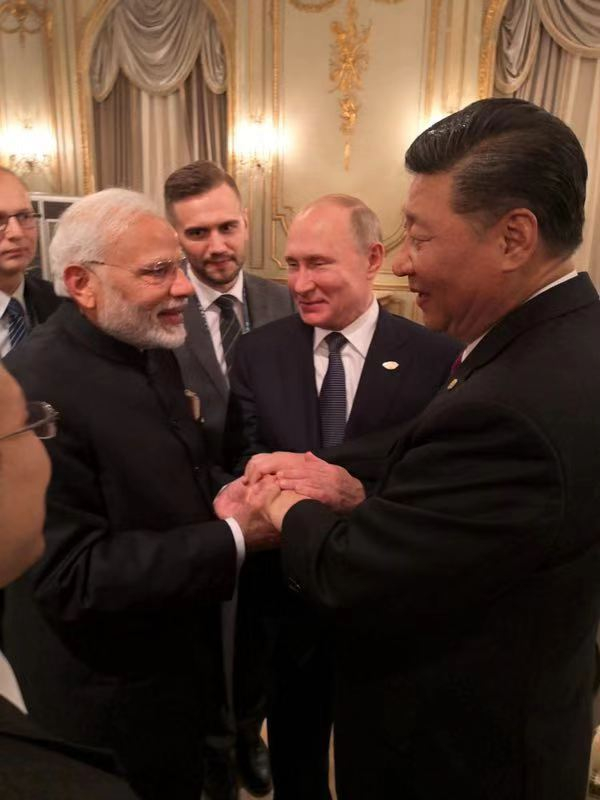
At the just-concluded Shanghai Cooperation Organisation (SCO) summit, India, Russia and China increasingly find themselves sharing the same table, signalling tactical convergence in a rapidly shifting geopolitical landscape. Their cooperation within this Eurasian forum has rekindled speculation: could these three giants, despite deep mistrust, form a genuine strategic alliance?
Russian President Vladimir Putin would love to see an India-Russia-China alliance. While he would like Russia to have a better relationship with the United States, he will not sacrifice his ambitions in Ukraine to achieve this. That ensures China will remain Russia’s most important bilateral partner for the foreseeable future.
In 2018, I was in Irkutsk, Siberia, at a meeting between Russian and Chinese officials discussing the Belt and Road Initiative. A senior Chinese official half-jokingly thanked Donald Trump for driving Moscow and Beijing closer together. Yet that same year, in Moscow, during talks on the troubled C929 aircraft project, the atmosphere was heavy with mistrust. This captured the paradox of the relationship: warm rhetoric at the top, but suspicion and hesitancy just beneath.
That phrase—“hot at the top, cold at the bottom”—long captured Russia-China ties in reference to the relationship between Vladimir Putin and Xi Jinping and the sparse engagement at lower levels, including business. However, Western sanctions and the exit of foreign firms have begun to change this dynamic. Chinese companies have flooded the Russian consumer market, but investors remain wary, deterred by sanctions, lingering suspicions, and Russia’s pursuit of technological sovereignty. Unlike in the United States or Australia, there is no community of Chinese immigrants in Russia to bridge the gap for business, further reinforcing this cautious approach.
Historical suspicions still linger. Some in Russia whisper about “Beijing’s designs” on territory once claimed by China. Yet since the 2004 border settlement, there is little basis for such fears. Harsh living conditions limit the land’s value, and resources are more easily purchased than seized. Both countries face more pressing security concerns elsewhere—Russia in Ukraine, and China in the South China Sea, under mounting US pressure.
The Ukraine war has added another layer of complexity. China does not want Russia to be defeated but has avoided overt military support. Its caution reflects concerns about US sanctions, its own balancing act in Central Asia, and the need to preserve ties across multiple fronts. Unsurprisingly, speculation has grown about a new “Great Game” in Central Asia, with Russia and China vying for influence. Russia’s war has weakened its standing there, while China’s economic clout has only deepened its footprint. Yet the Central Asian republics themselves are no longer passive—they are wealthier, more confident, and increasingly unwilling to be treated as pawns in anyone’s great power contest.
For over a decade, Moscow has tilted far more toward Beijing than New Delhi. By contrast, India continues to look back fondly on its special ties with the Soviet Union, even as it eyes China’s expanding partnership with Pakistan, including within the Belt and Road Initiative, with growing concern.
In response, New Delhi has edged closer to the Quad, the grouping of the US, Japan, Australia, and India. Yet its role there remains ambiguous. Analysts in Australia suggest that India “can expect to feel pressure to pull its weight militarily if there is some serious confrontation over Taiwan or in the South China Sea”.
But here, the economic logic complicates strategic rhetoric. It is often claimed that 55% of India’s foreign trade in goods flows through the South China Sea. In reality, the figure is closer to a third, and nearly half of that is with China and Hong Kong itself. The question, then, is stark: why would India risk military confrontation in waters vital mainly to its commerce with Beijing?
The unpredictability of US policy compounds the dilemma. Former US National Security Advisor John Bolton’s The Room Where It Happened shows how Russia, China, and India should be cautious in dealing with Trump, as his presidency lacks any coherent strategy and instead lurches from one impulsive decision to another. Trump, a successful showman in business and politics, is driven less by policy than by self-promotion, money, and vindictiveness, with only immigration and tariffs holding his sustained attention. His threat of heavy duties on Indian imports of Russian oil—framed around family interests, Pakistan, and even a bid for a Nobel Peace Prize—illustrates his erratic and self-serving approach. No leader can count on a consistent US policy under Trump. For India, Russia and China, the risk of Trump abruptly cutting a deal—perhaps with Xi Jinping at India’s expense—is ever-present.
Against this backdrop, the idea of an India-Russia-China alliance seems more rhetorical than real. Russia would welcome it, but China does not need it, and India does not trust it. Too much divides New Delhi and Beijing—from border disputes to Pakistan—while Moscow depends increasingly on Beijing in ways that limit its room for manoeuvre.
The SCO has become a convenient platform for Moscow, Beijing, and New Delhi to signal tactical convergence—yet mistrust lingers. Russia is too tied to China, New Delhi is too wary of Beijing, and both are too uncertain of US unpredictability. Their handshakes may appear warm in photo opportunities, but the underlying structural tensions are unmistakable, driven less by trust than by shared pressures from Western sanctions and US trade wars.
The bear, the dragon, and the elephant may occasionally align when interests overlap, but a true alliance remains improbable. What emerges instead is not a grand trilateral axis, but shifting partnerships of necessity—temporary dances rather than a lasting embrace.
(The author is a former chief economist of an Australian bank. He subsequently worked in business and academia in Russia and China)