


By Dr S. Krishnan, Happy Kumari & Pankhuri Sharma
It has been a few days since three women from Arunachal Pradesh were allegedly subjected to racial slurs, humiliation and intimidation by their neighbours following a dispute over repair work at their rented flat in south Delhi’s Malviya Nagar. The incident has once again raised concerns about racial discrimination faced by individuals from the Northeast in metropolitan cities.
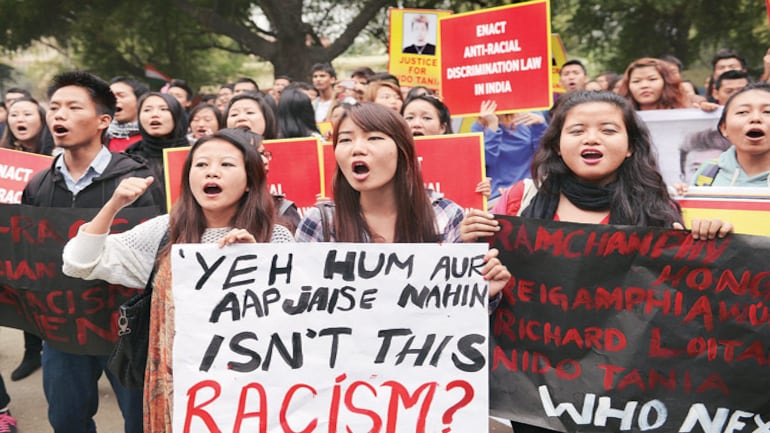
People of different races in India experience racism in various forms, but there has been a lack of academic discourse on this issue. In the past decades, many scholars have argued that the government or the academic fraternity did not recognise racism and racial ideology in India, although people from the North-East experience racism in their everyday lives in metropolitan cities. Last year, the death of Tripura student Anjel Chakma following an alleged racist attack in Uttarakhand brought back memories, for many in and from the North-East, of the killing of Arunachal student Nido Tania in Delhi in 2014. Then, as now, a young man from the North-East studying in a part of the “mainland” died following an assault by a group of men after a fight that erupted over comments about his appearance.
The M.P. Bezbaruah Committee had recommended the enactment of a law to address racial discrimination, but that has not happened so far, perhaps because of India’s unease with issues of race. The demand for such a law has resurfaced. A Public Interest Litigation has also been filed in the Supreme Court to press for court intervention in framing guidelines to prevent racial attacks.
Changing Demographics of the North-East
The demographics of the North-East are as varied as those of the rest of India. Contrary to popular belief, its people do not all look alike. Factors such as tribal migration, self-acculturation and assimilation from animism into religions such as Buddhism, Hinduism and Christianity have shaped the region’s population.
Whatever the details of the latest case the Uttarakhand police have claimed that it was not a racist attack, although the deceased’s family disputes this. The fact that discrimination based on physical appearance and skin colour exists in India, and in the world at large, is indisputable.
It existed in 2014, for centuries before that, and still exists today. It is less discussed nowadays than many other forms of discrimination, which is curious, because it remains arguably the principal dividing line in the world between the predominantly white “West” and the rest. This divide runs within countries and between them. White Americans continue to enjoy structural privilege over Black Americans, even now, 160 years after the end of slavery, just as the countries of colonisers retain advantages over the lands that were colonised.
Stereotypes and an Ongoing Identity Crisis
In India, racially defined stereotypes of appearance have long been a lived reality across regions. The admiration for fair skin, the slurs directed at Africans because of dark skin colour, and the taunts aimed at people of East Asian appearance, whether from the North-East, Nepal or elsewhere, are social realities widely acknowledged.
Many citizens from the North-Eastern states recount being asked, “Where are you really from”? or being mistaken for foreigners because of their physical features. Even when no harm is intended, such encounters can leave individuals feeling excluded, unrecognised or compelled to justify their belonging within their own country.
In recent years, young people from the North-East, about 15,000 a year, have been moving to the capital, fleeing insurgencies and seeking better educational and employment opportunities. Casual racism is commonplace. They are derided as “Chinkies” (a reference to single-fold eyelids) or “bahadur” (a term historically used for Nepali male domestic workers in India). The authorities have often been ineffective in integrating this ethnically and culturally distinct population. In 2007, the Delhi Police published a much-criticised booklet advising migrants from the North-East to avoid wearing revealing clothes and not to cook native foods such as bamboo shoots and fermented soybeans, for fear of upsetting Indian neighbours with unfamiliar smells.
The fault line between India’s North-East and its surroundings largely coincides with an imaginary line drawn by British colonial policymakers, separating hills inhabited by tribes of East Asian racial types from surrounding plains inhabited by people who appear South Asian.
A large part of those surrounding plains lies in Bangladesh. India’s longest land border is with Bangladesh, which shares boundaries with four North-Eastern states of Tripura, Meghalaya, Mizoram and Assam. The issue of “Bangladeshi” migration predates the formation of Bangladesh in 1971.
The fault line there, too, is arguably rooted in racial differences.
The Burmese term “kala” or “kalar”, used for Indians, carries derogatory racial connotations. Like the Khasi word “dkhar” or the Assamese word “bongal”, it could be used for outsiders or foreigners. In practice, however, it was more specific; a white man was not a “kala” any more than he was a “dkhar”. The word “Chinki”, used in mainland India for people from the North-East, is in some ways the inverse — implying Chinese, yet directed broadly at anyone of East Asian appearance. It is experienced as an abuse by those at the receiving end.
There is no solution in merely banning offensive words. Nor is policing intent a feasible answer, as that risks criminalising expression without addressing deeper prejudice.
Absence of a Comprehensive Anti-Racism Law
Although India is a signatory to the International Convention on the Elimination of All Forms of Racial Discrimination, adopted in 1965, the country still does not have a dedicated anti-racial discrimination law. Over the past two decades, civil society organisations have demanded such legislation. The Indian Penal Code contains provisions relating to hate crimes against Scheduled Caste and Scheduled Tribe individuals, but there is no comparable safeguard for people outside those categories. The diversity of the North-East remains legally under-recognised. Frequently, when crimes are reported, police authorities state that they lack specific statutory backing in the absence of an anti-racism law. As a result, racial crimes remain under-reported.
The Way Ahead
India is among the most diverse societies in the world, shaped by a wide range of cultures, languages and traditions. From the North-East to the South, from hill regions to the plains, each part of the country contributes to the national fabric. Yet diversity demands responsibility. It calls upon citizens to listen, learn and adapt. Differences must be approached with openness rather than suspicion, and with respect rather than judgement.
The loss of Anjel Chakma compels society to ask an uncomfortable question: Are we doing enough to ensure that every Indian feels equally accepted, regardless of appearance or origin? Preventing such tragedies does not depend solely on laws or institutions; it also requires sustained social awareness. Conversations about diversity, regional histories and cultural understanding must move beyond textbooks into everyday life.
Educational institutions can play a meaningful role by encouraging intercultural engagement, providing support systems for students from different regions, and fostering inclusive campuses. Host communities, too, benefit from greater exposure to India’s internal diversity.
(Dr S. Krishnan is an Associate Professor at the Seedling School of Law and Governance, Jaipur National University, Jaipur. Happy Kumari and Pankhuri Sharma are law students at the same university)